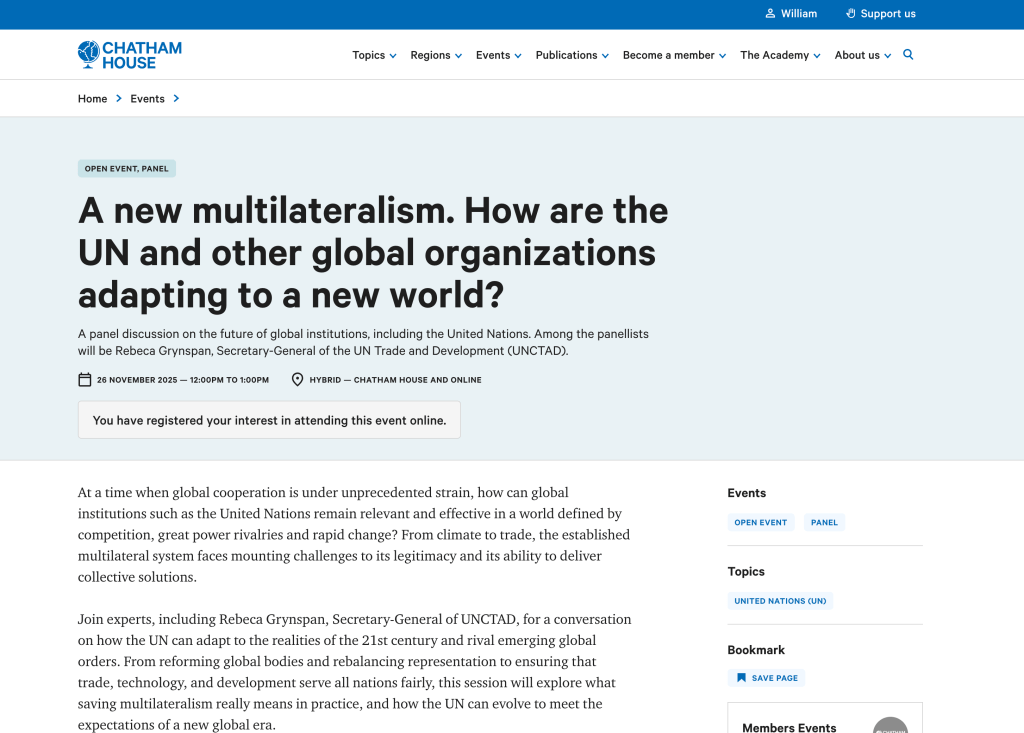
This Chatham House event is chaired by Samir Puri, Global Governance and Security Centre. On the panel are Rebeca Grynspan, Secretary-General UN Trade and Development (UNCTAD) and Sir Mark Lyall Grant.
With global cooperation is under unprecedented strain, how can global institutions such as the United Nations remain relevant and effective in a world defined by competition, great power rivalries and rapid change?
Rebeca was a former Vice President of Costa Rica. She is the first female Secretary-General of UNCTAD. Sir Mark Lyall is a former National Security Advisor (to both David Cameron and Teresa May).
There is always scrutiny on the UN. How has Rebeca felt under scrutiny at the two COP summits? She says that you get the feeling that the world wants to come together. There is a willingness to be at the United Nations. Many people go to COP to get a consensus on climate change. You hear that there is disillusionment.but there is still great international support for global institutions. There is the possibility of getting collective minimums at a multilateral level. The world today is very different to how it was in 1945. The United Nations has to be fit for purpose in a new century.
There is a great deal of anxieties throughout the world. How will the UNCTAD report reflect this? There is protectionism and nationalism occurring and this is affecting trade. The report tries to demonstrate how these forces are interacting. Not everything is going in the same direction in the world. Contradictory forces are in operation at the same time. We can shape what. is going to happen. It is necessary to try to understand the world.
There is a cascading second order impact from US tariffs. There is four percent global growth in trade. The ongoing trade war between the USA and China is under renegotiation. There are structural changes in the world. 70% of growth in the economy will be in the Global South in the near future. AI is growing too in services trade. Trade has become more resilient with structural changes. Post-colonial economies are now reaching maturation.
How is the art of diplomacy shifting in the world? The United Nations is in a bit of trouble. Donald Trump has accelerated a more nationalist and populist approach and he is dead against multilateralism which has caused a problem in the United Nations. The USA has a deficit with the UN and China has followed suit and is also in payment arrears. Small and medium size countries depend more on an international system than the global beasts. The UN needs the energy from member states. Three of the big five states are not presently interested in supporting the multilateralism system. The UN has been paralysed before in its history. There has to be a big effort to get back to a global order with rules and order. We are currently drifting away from that.
How is the UN dealing with conflict resolution? There is a Black Sea Grain Initiative. At the beginning of the war, the Black Sea is important for World Food Security. At the start fo the war Ukraine couldn’t export and it is a bread basket to the world. the UN approached Zelenskyy and Putin and managed to achieve a trade corridor to open for grain exports. Both signed independently a Memorandum of Understanding. Trade and food had to be restored so that a food crisis did not ensue. It is the only agreement signed between Russia and Ukraine. All the problems were not solved as in certain countries internal food prices went up but this was a huge contribution to the world. Mediation and Prevention has to be part of the UN multilateralism DNA. One of the vital levers is optimism.
Rebeca has been nominated to become the next UN Secretary-General. A formal nomination has been given. On the Security council there are fifteen countries. Five permanent member sand ten rotating members. The Security Council approved the nomination yesterday and the race is on. Nine votes are necessary from the Security Council for a nomination to be accepted. THe UN SG post has not yet been held by a woman. The P5 (Permanent Five) tend to decide on the Secretary-General. For France the French expect the candidate to speak French. The USA and Russia tend to want someone who won’t cause the problems. The UN SG is the servant of member states. The candidates have to make concessions is all the P5 capitals. This process can lead to a lowest common denominator consensus for the appointment of the post. There is a general view that it is about time for a female to hold the post. There is also a feeling that the rotation of the post should pass to Latin America. It is a P5 agreement, the final decision. The process now means that you have to present your case in each of the capitals whereas before this was not necessary. There is now an open process. The Secretary-General has to be proactive i international diplomacy and to take risks and the P5 are not always happy. Rebeca has been in politics for a long time and is not naive and can see the power game. The biggest problem for a SG is about re-election to the post after five years and not wanting to upset people. Mark believes that there should just be a single term for the Secretary-General in the future.
Over to Q&A…
The appointment of the position should be put out more to the public. How does Rebeca think the UN should change? The action internationally is not in the UN any more. It is with eg. Trump and the WTO is not effective any more. What will it take to bring the UN back to the centre? Will the United States and China be on board? The UN has to change as the capacities of countries are not the same as in 1945. Countries know much more today and capacities have been increased. This has to be reflected in the culture of the UN. The UN has to stick to its core and go back to basics. It should stick to its charter: The Core. The UN has to be more active and ore of a risk taker when it comes to security. Even if the UN fails it needs to show the action that may be possible. Failing is not the end of the world. It is part of the Peace and Security issue now. the UN needs to embrace the power of diplomacy. 20% of the budget cannot be cut without reform. In UNCTAD, Rebeca cut 20% of her labour force. They are doing better today than they were before. All organizations need reform after a certain amount of time. The UN needs to be effective in things that nobody else can do.
Should the veto of the P5 be abolished to give the 117 smaller countries a bigger voice? What is her advice for the Britihs system who plans to host the G20 meeting in two years time just after the Addis Adaba Ethiopian COP. How can the British system get organized as it is struggling. Should the UN be focused on Gaza or Sudan. Where is the risk? What would Rebeca prioritize? The UN should not withdraw from its wide activity. It is easy to set up a peacekeeping mission but not so easy to close it down. This needs to be sorted. the G20 is a potential rival to the UN and is seen as such by the G173 who are no tin the G20. The G20 is much more hated than the G7. The G20 has the champions of the Global South in it. The smaller countries do not have a seat or a say i decision-making like they do in the UN. The G20 is not universally welcomed around the world. For the G20 there needs to be reform in the global financial system. Lateral development needs to be reformed like in the IMF to make it conducive to development in the Global South. Some countries pay more in servicing debt than on health and education. the G20 can be used to change the IMF and international financial system. Rebeca sees the G20 as synergetic with the UN and not a rival. There needs to be liaison with other international bodies for successful resolutions to ensue.
In a more digitized world, how will the UN deal with the internet? Will it preserve human rights? For the digital revolution it has been agreed in the UN where there is a consensus in the Digital Compact. Nobody else can really have the legitimacy of the universal membership of the UN. The private sector is participating. There is a scientific panel for AI. The UN is very active in this area.
There are 5000 NGOs registered within the UN so it is open to the private sector. Should they be bound into the framework of the UN? The NGOs can do a lot of good and have an impact on the agenda.
This was an active and lively discussion whcih made some points about the international system that I was previously unaware of. Good luck to Rebeca in her quest to become the next Secretary-General of the United Nations!


Leave a comment