

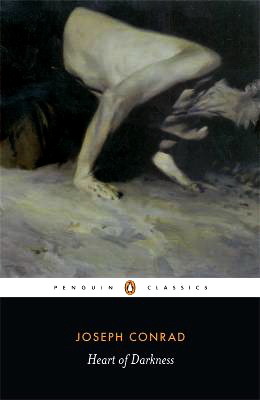
I love Apocalypse Now. It is one of my most favourite films. I learnt that apparently, Joseph Conrad’s ‘Heart of Darkness’ is the literary work that provides the basic narrative of the film. Apocalypse Now, however is set in war torn Vietnam, with the US Military hunting down an insane, erratic, murderous, rogue officer in the interior, deep in the Vietnamese jungle. Marlon Brando plays Kurtz and it is a totally gripping and disturbing performance. Conrad sets his work in nineteenth century Congo. The narrator, Marlow is sailing a British ship up the Congo river, into the interior, his mission to locate the important ivory trader, Kurtz, who none of the government officials have heard from for a while. This is the peak of Victorian British Imperialism, an Age of Empire, a time when the colonies offered all men a chance to enrich themselves and seek out adventures in wild, untamed, unknown lands. Marlow is on this quest himself. Kurtz has set out and established himself and apparently is making a good name for himself and delivering huge quantities of profitable ivory. The trade of ivory in itself is obviously ethically and environmentally questionable, but this is a different age. Also, when reading the book from a post-colonial politically correct, almost apologetic modern sense, the reader can discover often brutal and quite simply plainly racist terminology which recognises the African as quite a lesser human being than his Caucasian Western counterparts. Racist terminology is throughout the narrative and the value of the lives or the work of Africans, be they pilots of the ship or part of Kurtz’s native crew, is seen in very typical Victorian fashion. Civilisations were of course vastly different. Although the book may seem to contain a lot of prejudice, it does, however, offer an enlightened view of a different, exotic world and the way in which the Other is described in this novel may have had a transformative effect on the views of its contemporary readers. Although elements of an exotic, tropical, vast untouched African interior are well described in the story, on the whole it is the ‘darkness’ element of the ‘dark’ continent which forms the rather moody, melancholic, quite frankly intimidating atmosphere of the journey. We encounter a brutal world where traditional values have evaporated. It is a savage world. Kurtz has embraced the native and is wild and quite frankly, although recognised as very intelligent and does seem to make a lot of sense, he is also, prior to his tragic demise, clearly quite disturbed, even verging on insanity. His ivory jaunts with the natives into the deeper interior from his river Congo base have scarred him and de-Europeanised his ways. When Marlow’s steamer arrives natives greet the boat with a flurry of poisoned arrows, killing his undervalued African ship pilot. On the way, a starving African crew are seen by the Western travellers on board as totally alien and their open confessions to cannibalism is quite frightening. The whole novel is, very much like Apocalypse Now, memorably disturbing and although clues to divine salvation are mentioned the whole nature of the evil of mankind is central to the book’s winding theme. Conrad is originally Polish and although based in London and writing in the English language, he has quite a difficult style. His sentences are extensively long and sometimes a bit confusing and also he peppers the account with quite a wide range of difficult vocabulary not use in common vernacular. It is only a short work but is and, one can tell from its popularity and praise as a classic, a key piece of literature from the Imperial Age.
Discover more from Wez G Official Website
Subscribe to get the latest posts sent to your email.