

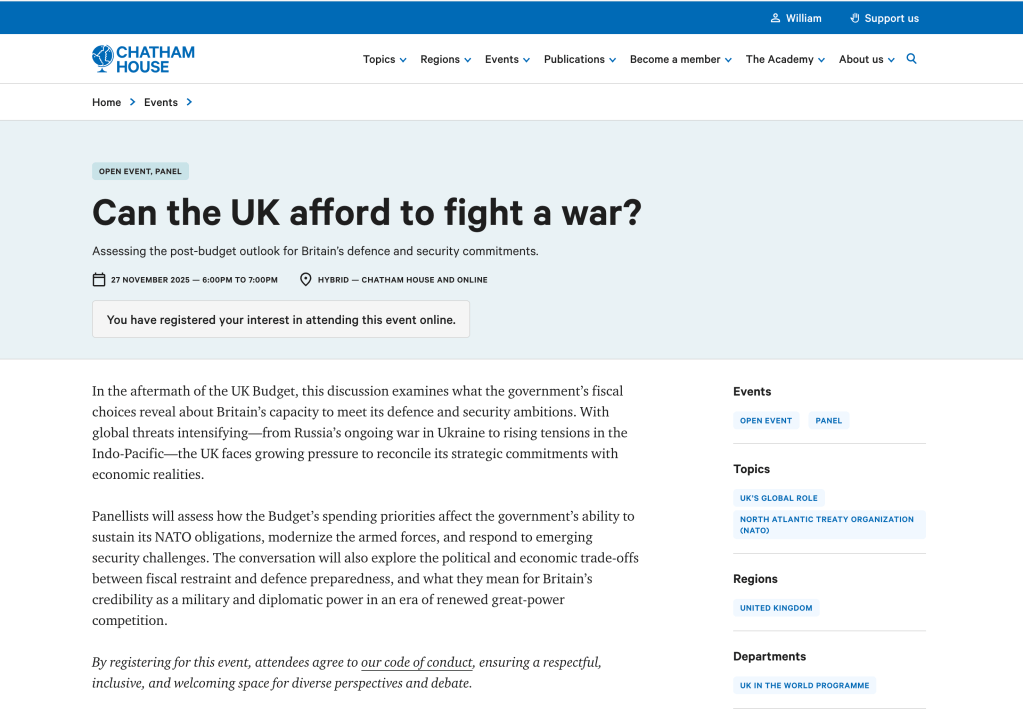
This Chatham House event is chaired by Olivia O’Sullivan, Director, UK in the World Programme. On the panel are: General Sir Richard Barrons KCB CBE, Professor Jamie Gaskarth, Deborah Haynes, Sky News and Max Warner.
Is the U.K. fully fulfilling its obligations to NATO? Are we on a realistic and honest trajectory with regard to defence spending and preparation for conflict? What kind of war could the U.K. expect to fight in?
The Strategic Defence Review presents that to fight Russia would be a very immersive experience. It poses potential existential levels of risk, unlike previous wars where we were fighting terrorism. A war with Russia would threaten the homeland. Cyber, social media misinformation and infrastructure would be threatened. There would be ballistic and cruise missiles and drones. War in the twenty-first century is in the digital age. According to the SDR, the U.K. has chosen to take ten years to get to the benchmark as indicated necessary by the SDR despite NATO allies saying we need to be prepared within 3-5 years. We have made the choice in the U.K. to take a lot longer. We need to move faster and the past six months clearly indicate the necessity of this. People are concerned about the NHS and potholes but not defence. In civil society in the U.K. today we are not making the choice that our own military suggests is necessary. Deterrence should be that escalation dominance should be achieved. Our habit for 30 odd years is to make a difficult conversation about public spending. Fighting a war would cost 50% of your GDP with a cost on the population enduring for 3-4 generations.
What are the fiscal challenges? We are approaching 3.5% of defence spending although we have spent a lot more in the past. We are increasing from 2.3% to 3.5% and it is a large increase. There are three options – we can borrow more to pay for it. It is undesirable to do this for the U.K. as we are in a worse fiscal position than say, Germany. The other two options are by tax or spending cuts. There would have to be 3-4 pence on income tax or VAT. It is like the entire budget for the Home Office. to get there we need to resize or reshape the State.
Germany and Poland are impressive international examples. Poland is spending way past 3.5%. Germany plans to go to 3.5% within a couple of years. The U.K. has traditionally always been the second largest defence spender in NATO but now Germany has overtaken us. If the money is spent does this improve our defence capability and make us secure? How does the defence spending translate into reality? The implementation phase of SDR reviews tends to fade away. We need to ruthlessly prioritize and this is a key aspect. It needs to be resourced properly and the treasury brain needs to be reversed. What will save money in the long run. Individuals need to be given responsibility and empowered to make decisions with benchmarking to monitor. There needs to be accountability. It must be unambiguous. There are many partners deflecting the burden of responsibility and this is a serious problem.
Is it a cultural problem in the U.K. in that we are not honest enough about what is needed. There is an endemic avoidance in the U.K. There needs to be a national conversation about these things and we should be more transparent. What do we want the armed forces to do? Where are the public on this?
The cost of war is deep. Societal awareness means that anyone under the age of 60 have lived in a post Cold War era and have lived in peacetime. Potholes, welfare, pensions. Since the 1990s politicians and the public have lost the language of defence. Counter-terrorism and counter-insurgency is tackled differently. War does not necessarily take place in a far off place. The ‘holiday of history’ has now ended and real danger has returned and the situation is grave as the public does not understand the risk as a country we are holding due to the lack of ability to defend ourselves against a similar attack to what happened in Ukraine. There is dishonesty in politicians and also among the defence sector. From 2015 the language was about growing defence but the messaging to the public was dishonest. We were coming from a deep trough of defence cuts. CLaims are being over-exaggerated about us being a strong military power which is not the case. Defence has done itself no favors by failing to spend its money well. AJAX is an example of a project which has overspent and is going wrong. Our industrial capacity and capabilities have been hollowed out. The national conversation allegedly launched has not happened and defence chiefs have been gagged.
How can we have greater scrutiny and transparency? The U.K. is not alone. People are hailing Germany but it is getting serious about defence from a very hollowed out base. It has a long way to go to build up its fighting capability. There has been wastage in U.K. defence spending. The Bernard Grey report laid out this in 2009. Does defence have the talents to procure with more risk, flexibility and speed?
Are our. presumptions on defence spending reliant on having the USA as a security partner? How reliant are the USA on this front as they appear to be pulling out of NATO and reducing its subsidy to European Security. This made sense in 1945 but not so much nowadays. IS this a cliff-edge or is it manageable. The US gets 31 allies out of NATO. The us does certain things for NATO like Space and AIr Power, that nobody else can do. Will this have to be managed differently? How do we deter Russia? We have deterrence by denial. Deterrence by punishment is easy to fall into shop window deterrence. 20% of our budget goes on our strategic deterrence. To improve our defence it requires leadership and more money.
Germany is bringing back conscription. France has announced it is doing tit today. The Conservatives mentioned this. Will we be seeing it here by 2030? How as a country can we protect our people from a potential war with Russia? Can the U.K. morally decide to go to war? We are not taking care of veterans properly. It will be young men and women expected to defend us.
France and Germany have come to the same decision. The need to be able to mobilize. In a long war there will be pressure on resources and also people. Reserves can be called back in the event of war. Can they be located? Reserves can be mobilized and volunteers can be called upon. It is still not enough. How can you conscript if you needed to? Germany and France are getting to know where people are. We need a conscription platform with education. In the context of Northern Ireland, the legacy is that our veterans have been held to account once and now new laws and processes are being found and 80 year olds sometimes for the eighth time are being asked to go through accountability for their actions again. Will this happen to our special forces? If they do what they needed to do in good faith, why are they being called to account. It will affect recruitment and is also affecting the retention of highly skilled people. You need to be able to know that you can act in an appropriate way.
Apparently the average age of a solider in Ukraine is 43. This is too old in our country to join the armed forces. Do we need to expand our capability. Do we need to be mounting campaigns of disinformation ourselves against Russia like we used to do against the Soviet Union during the Cold War? How do we counter Russian influence? Labour have and a problem with Chinese agents. BY 2035 there is likely to be a form of national service. Inside the defence sector we have looked closely at Norway were an elitist win-win situation is created through their conscription. Churchill said: “Conscription is a fundamental pillar of a democracy.” The National Cybersecurity centre is raising awareness of cybersecurity. However, tackling disinformation has not been structured in the U.K. We discourage our soldiers from publishing information online and this is a battle space when they might have critical information to share.
For credible deterrence you need 90 days of ammunition stocks. The armed forces need to move swiftly with innovation. When war starts GDP jumps. There is a real worry and politics comes into it Companies have a priority to their shareholders and not to their national interests. If we are to expand capacity at the speed of relevance we need to put pressure on the private sector. We re not working fast enough.
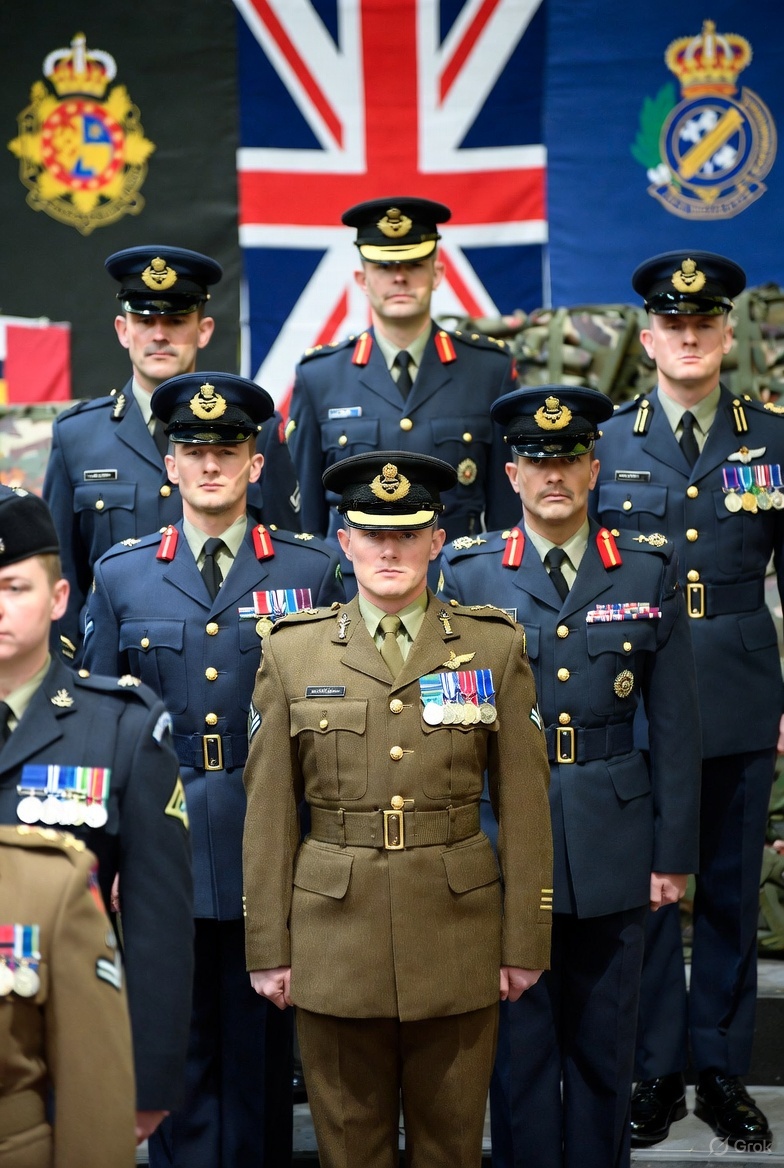
It has been an interesting discussion about what our preparedness for potential war and what is affecting our essential armed forces. We live in turbulent global times and need to be battle-ready.
Discover more from Wez G Official Website
Subscribe to get the latest posts sent to your email.