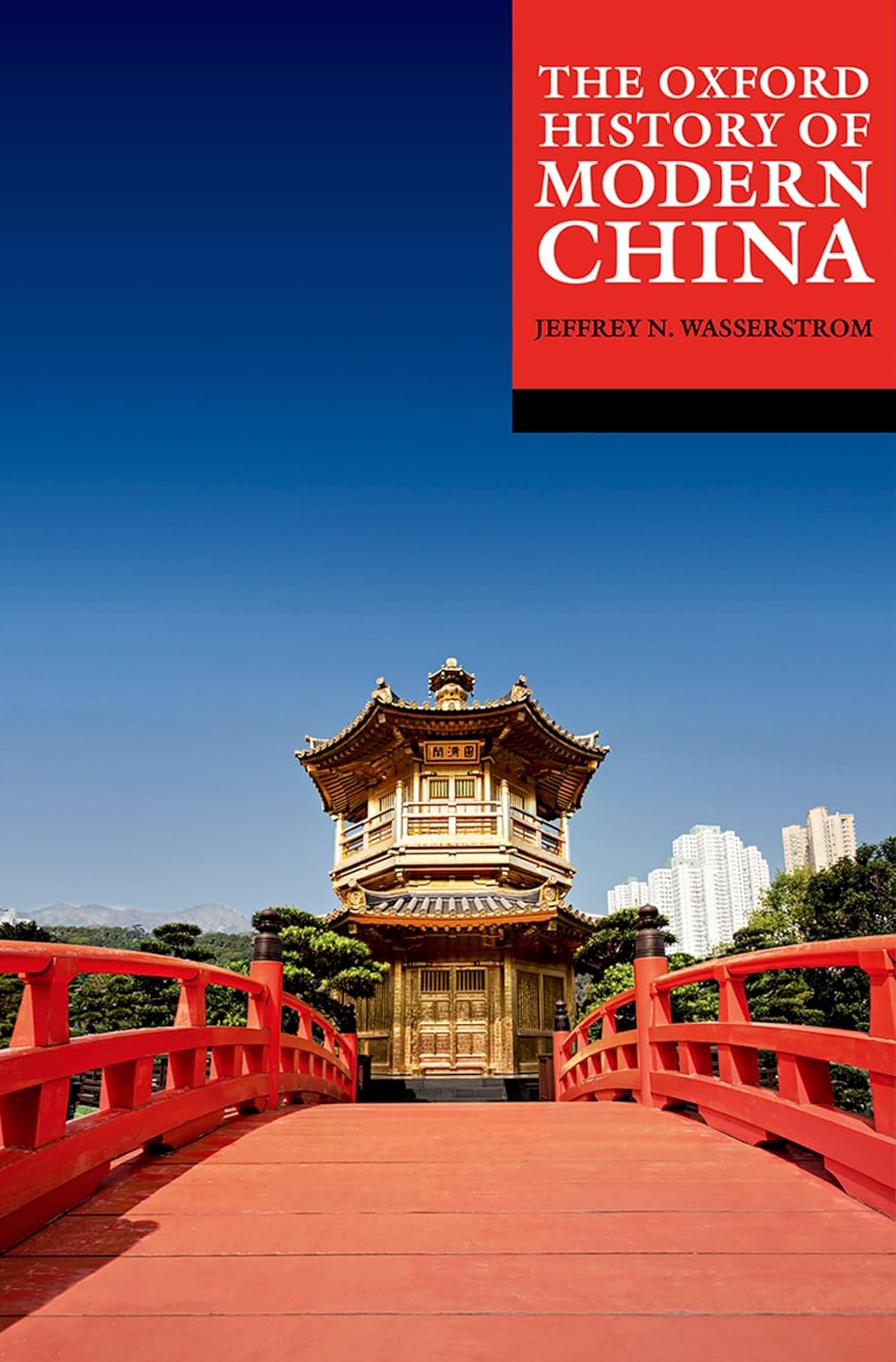
China is a massive superpower. To understand China and its role in the modern world, it is imperative to understand its history. This well written modern history details in brief the key points to note in the rise of China from the late Ming dynasty in 1550, through to the present day and the rule of President Xi Jinping. A team of separate specialist authors have penned each chapter. The book is quite simple to read, with large text and there is a coherent flow between the different themes. There is a focus on the more modern era during the twentieth and twenty-first century but. A basic understanding of what precedes this helps in forming an understanding of how and why China is as it is today.
The Ming Dynasty was a high point of Chinese culture. They believed that their empire had everything it needed and the Emperor closed off China to the rest of the world, scuttling its treasure ships and ending almost all contact with the outside world. It was a self-sufficient, a self-serving Empire.
The Qing dynasty followed on and the territory of China was doubled as to what it had been under the Ming. In 1796 the White Lotus uprisings sprung up, a radical strain of millenarian Buddhism that sought an end to Qing rule. In the 1800s the British East India Company started to shift massive amounts of opium from India into China, getting a vast amount of the population hooked on its smokable form. In 1840 the first Opium War was fought between Britain and China. The Treaty of Nanjing brought it to an end in 1842.This was what ceded Hong Kong to Britain in a 150 year lease. This was the start of the Chinese ‘Century of Humiliation’ which only came to an end with the successful communist revolution in 1949. A second Opium War broke out in 1856. After this and the Treaty of Tianjin, there continued to be a large foreign presence in China.
Around the turn of the century saw an uprising against the despised Manchu rulers, favouring the majority Han Chinese. The Boxer rebellion sprang up from the Christian community and garnered support in the Western world. This uprising was brutally suppressed. It led to greater Chinese nationalism at the start of the twentieth century. The Kuomintang was the Nationalist party and incorporated into it a newly formed Communist Party joined the ranks. A revolution in 1911 saw the Qing abdicate and the republic of China was born. Sun Yat-Sen was the key figure in the new unified Chinese State although this was a period with dominance by Warlords. After Sun’s death Chiang Kai-shek seized power and his anti-communist stance saw the start of civil war. Also a fierce war with the Japanese who had seized Manchuria (Manchukuo) occupied politics. Mao Tse-Tung or Mao Zedong, Chairman Mao led the communists against the Kuomintang government. There was brutal oppression in Shanghai and many communists were murdered. They eventually conducted a ‘Long March’ with the Red Army settling in a region in the North West of China where they founded Soviets and set about land reform for the peasants. Eventually the Nationalists and Communists ceased their internal strife and fought together against the Japanese invaders. World War 2 saw the Chinese unite with the Allies and ultimately defeat Japan. Civil War continued after 1945 until the eventual Communist Revolution that succeeded in 1949, catapulting Chairman Mao to power. Chiang Kai-shek fled to Taiwan where he sought refuge with his remaining forces and government.
The Century of Humiliation had ended and under the guidance of the CCP (Chinese Communist Party) a new China was formed and the CCP remain in power to this day. There was initial brotherhood with the Soviet Union and China was immediately thrown up against the Western democracies and international order by coming to the aid of the DPRK (North Korea) in the Korean War. International isolation was very much the theme for many years but China carved its own niche and developed foreign policies outside of existing models. The Sino – Soviet split saw a divide in the communist world. Maoism was a great export and Mao ‘s personality cult was imposed. The ‘Little Red Book’ was dispersed far and wide and The West were scared of the domino effect of communism spreading across Southeast Asia and the world. Mao continued with revolutionary ideas and was trying to bring China up to speed with the modern world. You could argue that his ’Great Leap Forward’ and ‘Cultural Revolution’ were great failures and his ruthless policies did indeed lead to the deaths of many of his own people, indeed he is believed to have killed more of his own people than any other dictator or leader in history, many through famines.
After the death of Mao in 1976, there was a struggle to replace him and we enter into the reform era of Deng Xiaoping. Distance was attempted to be put between the Party and Mao and a rapprochement was sought with the West. Through Henry Kissinger’s diplomacy, President Nixon made a famous visit to China and it was back again at the world table, entering the WTO and taking its seat at the United Nations. China started to rebuild and modernise its economy at great speed, paving the way for it to become the global superpower we see today. Some policies were seen as brutal, for example, the one child policy, that tried to tackle identified demographic issues with population growth. China continued to grow, becoming a manufacturing base for much tech.
Around the time of the fall of the Soviet Union, when the Iron Curtain fell, China had their own global crisis in 1989, when a student revolt was crushed with the Red Army’s tanks and many in Tianamen Square were massacred. There was public outcry but the CCP continued to survive and democratic reform was kept at bay.
Into the modern era, after years of opening up to the West, and allowing for capitalist enterprise to live side by side with the Communist one-Party State system, a populist leader in Xi Jinping has taken the helm. He is reverting to many Maoist tactics, has his one personality cult, for example, and is pursuing vast projects such as the One Belt, One Road Chinese foreign policy initiative that is broadening Chinese influence across the globe. A new Cold War is de facto between the USA and China as military tensions build as their economies fight each other for global dominance. China has mainly lifted its vast population out of poverty and although many of its policies such as human rights against minority populations, democratic freedoms and its vast surveillance networks are quite alien to us in the West, China does offer an alternative to the world than Western hegemony.
This book is neatly written and kept relatively simple in the way it introduces ideas, without going into too much depth, but whetting the reader’s appetite to indulge in further research on any given topic. It is an essential book to study in order to understand why modern China is the way it is in today’s world where China’s relevance is indeed very prominent and important to all on our planet.
Discover more from Wez G Official Website
Subscribe to get the latest posts sent to your email.