

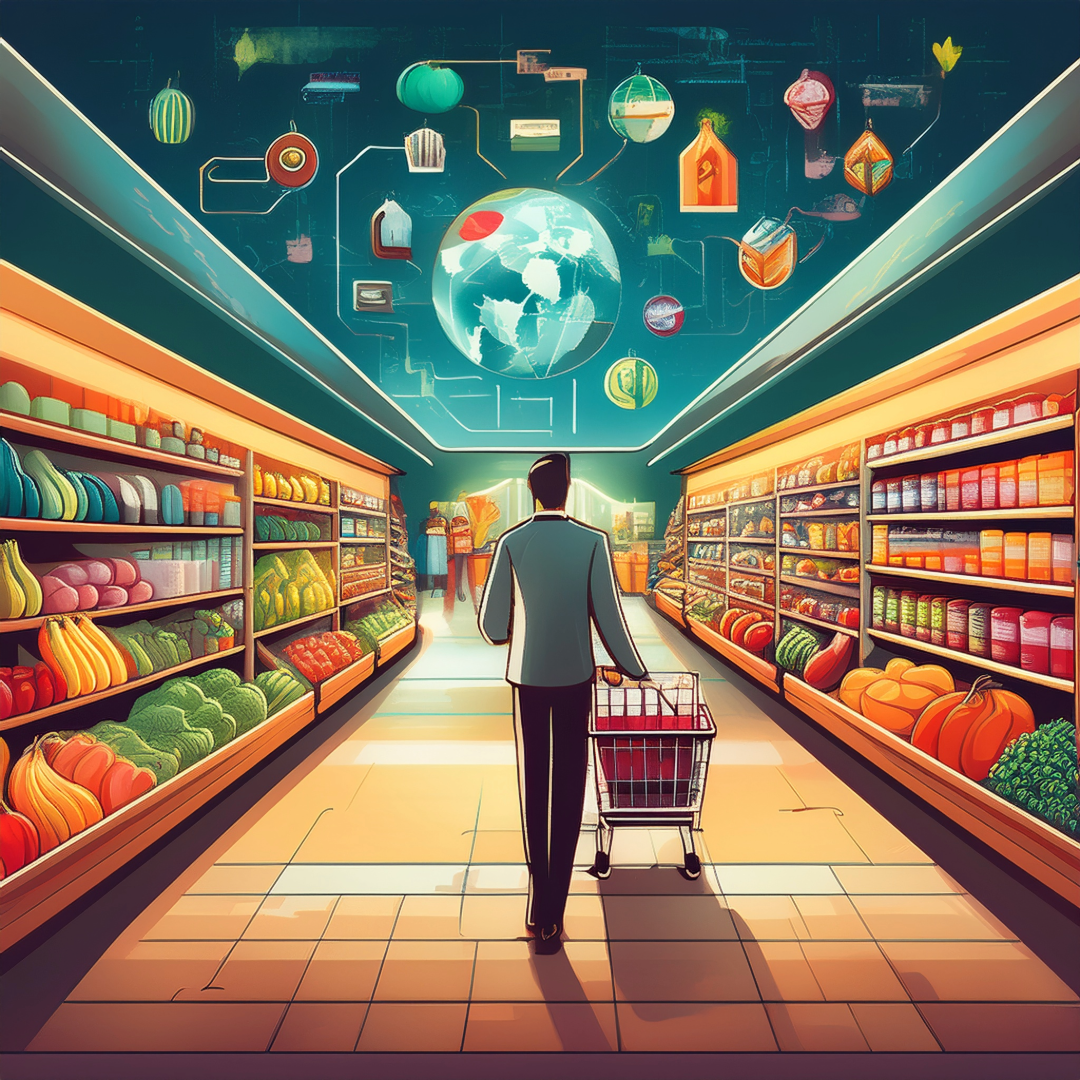
Describe the argument that consumer choice is shaped by the power of big retail.
We live in a post-industrial consumer society. Since its emergence in the 1960s, big retail has increasingly taken over our high streets and out of town shopping centres and increasingly too also the digital landscape of the internet. Big retail has a dominant position in the market and deeply affects consumer choice. How this can be expressed will be examined in this essay. The history of big retail shall be examined, how it operates and also advertising will be covered. Each section will be looked at with the underlying essay question in mind.
Big retail can offer plenty of choice but it can also be restricting. We touch upon Bauman’s ‘’the seduced and the repressed’. “Choice – is often highly valued, although perhaps more by those who believe they exercise choice, rather than by those who feel they have little in the way of choice.’(Hetherington, Harvard and Staples,2022:123) In a highly modern society, our choices are what define us and shopping or retail therapy is a key way of defining who we are as a people, as individuals within society. This consumer choice is shaped by decisions we make and with such a large share or market dominance, big retail governs who we are and what we buy and what defines us as consumers. Social cleavage, for Baumann, splits people into not class categories, but along lines of those who consume and use consumption to shape their identities. There is a fashion sense about where you do your food shopping. Marks and Spencers is seen as plusher than, for example, Aldi or Lidl.
Big retail is full of controversy: ‘Since their arrival in the UK in the 1960s, the growth and spread of big retailers, especially supermarket chains, has proven controversial, not least because of their size.’ (Allen, 2022:160) The power of big retail can be split into two parts: market power and buying power. Big retail can exert strangleholds on the market and dictate prices. The big chains can collude on things like the price of milk and butter. This, one would think benefits the consumer with low prices, yet it also restricts the buyers’ freedom. Would they not be better off shopping at independent retailers or farmers’ markets? It can be weighed up and those in favour of big retail may see it as a positive-sum game where everybody is a winner as opposed to a zero-sum game where the dominant position of supermarkets has a negative effect on shoppers.
In the Northern industrial towns, deeply affected by unemployment and poverty, the arrival of a new supermarket brings new hope. There is more employment through supermarkets and more consumer power through workers’ wages as the money made doesn’t all escape the till. ‘In run-down areas of the UK, the economic leverage of big retail can act as a force for social and economic regeneration.’(Allen 2022:164) However, the workers aren’t always 100% looked after. `Just take a look at the sweatshops of Bangladesh where Primark produces much of its garments. There is a scandal in workers’ conditions and as far remote as these places in south east Asia may seem from you shopping on the high street, the reality is that they are much closer.
The argument that consumer choice is shaped by the power of big retail suggests that large retail corporations have a disproportionate influence over what products are available to consumers, how those products are marketed, and at what prices they are sold. The availability of goods may be restricted. There could be limited options: Although it may appear that consumers have many choices, big retailers often narrow the selection by only stocking products from major brands or those with the highest profit margins. Big retail can also be affected by supplier dependence: Smaller producers may be excluded from shelves due to slotting fees, high volume requirements, or other barriers, meaning consumers only see what big retailers decide to carry. Market standardization and pricing power: The dominance of big retail can lead to homogenization of products and shopping experiences, reducing diversity and regional variety and by leveraging scale, big retailers can dictate pricing structures, both for consumers and for suppliers, which can shape purchasing behaviour. Through advertising and strategic placement, retailers can drive consumer demand toward certain products, creating the illusion of choice while guiding decisions. They create trends. Advertising can range from instore music to internet searches and is a broad subject.
Big retail can lead to the closure of smaller more independent shops. Although the loss of independents has slowed down of late, the trend remains upwards (Local Data Company, 2020 in Allen, 2022:158) We end up with homogeneity on the high street with small family run historic businesses disappearing and being replaced by 24 hour Tesco Expresses. Does the lack of a greengrocers reduce consumer choice? In effect it does. It pays to shop around and to bring diversity to one’s diet makes for healthy living. Too much power in the hands of too few can be a daunting prospect and in big retail taking maybe 3 in every 4 pounds spent out of shoppers’ pockets a monopoly is a very real situation.
Zukin claims that consumption is at the same time ‘our most creative and our most controlled behaviour’(Zukin 2004:7) Advertising is a form of seduction yet we are not automatons in receiving this advertising and acting upon it. A good example could be a Tesco club loyalty card which allows us to accumulate points while we shop which can then be traded in for cash or more products. This is branding and although a simple idea, loyalty cards are a feature used by many stores. There may be enough with a wallet containing a loyalty card to be just enough to ‘nudge’ a shopper through the doors of Tesco or wherever. Nudges may be more subliminal too, from celebrity endorsers to aisle mood music, advertising and marketing knows all the tricks by which to enhance big retail’s power and to seduce the consumer.
In concluding this essay, we have looked at many different ways by which big retail seduces its consumer base. It would be nice to live in a world where big retail didn’t have such a stranglehold on the market but unfortunately that is not true yet it can be hoped that it is learnt that big retail that it is OK for smaller people, the dispossessed, Bauman’s repressed to still benefit from big retail. I think that one of the more important elements of big retail’s power is in advertising. Without it the power of big retail is less noisy and more nuanced. In looking at the original question I think that I can affirm a positive response based on the evidence that has been explored in that ‘Consumer choice is affected by the power of big retail’
1139 words
References
Allen, J. (2022) ‘Big retail and the rest: winners and losers’, in Allen, J., Blakeley, G. and Staples, M. (eds) Understanding social lives, Part 1. Milton Keynes: The Open University, pp. 157–189.
Hetherington, K, Havard, C and Staples, M. (2022) ‘Consumer Society? Identity and lifestyle’, in Allen, J., Blakeley, G. and Staples, M. (eds) Understanding social lives, Part 1. Milton Keynes: The Open University, pp. 123–151.
Discover more from Wez G Official Website
Subscribe to get the latest posts sent to your email.