

Understanding the causes of the 2011 riots requires examining diverse factors. Compare and contrast two different perspectives on how inequalities contributed to the 2011 riots, as discussed in the module materials.
This essay will look specifically at the 2011 ‘Blackberry’ riots in England that caused havoc and spread around the country, requiring government intervention. Firstly, the whole concept of a riot needs to be defined. An examination of the history of riots here in the U.K. and abroad will assist in understanding what happened in 2011. The facts and history of the actual 2011 riots will give a background on which to work the analysis. Specifically, inequalities and their effect on the riots will require close examination. The riots shall be analysed in terms of two key political perspectives: that of conservatism and radicalism. A broad outline of these two political perspectives shall hopefully produce evidence of how these two differing political perspectives can explain the origins and causes and also solutions of the 2011 ‘Blackberry’ riots.
What is a riot? ‘Riot has become a widely used term encompassing a range of disorderly behaviour’ (Andrews 2022: 318) Riots are usually violent events and can occur at football matches, in prisons, on the street and also involve gang violence. They are often characterised by an anarchic state of disorder with looting, battles with law enforcement officers or the authorities and often they can spread become a general public nuisance. They may be seen to have political origins or can simply be used by opportunist criminals to take advantage of the chaotic situations which are produced by rioters. Often riots are difficult to define exactly and their origins involve multiple forms of analyses that may take historians years to correctly record. Riots often have negative connotations as opposed to simple political demonstrations. They are seen as regressive, against the ‘norm’ and to be destructive and irrational.
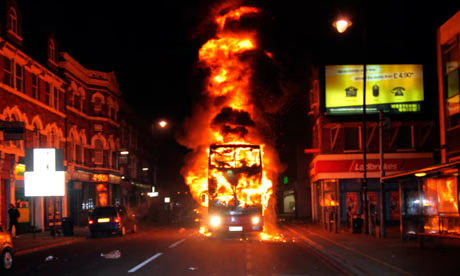
Over four days in England in August 2011 a series of riots took place with the catalyst for the unrest being the police shooting of Mark Duggan, a 29-year-old Black man from the Broadwater Farm Estate in Tottenham, north London. These riots initially began to spread across about 20 London suburbs before spreading out to major cities across the country, including, Bristol, Birmingham and Manchester. It was the worst civil unrest in Britain since the 1980s. The ‘Blackberry’ riots take their name from the prolific use of Blackberry Messenger phones that were used to co-ordinate protestors via the use of social media. The rioters were able to thwart police tactics and organise in a way that had never been envisaged before. The whole police presence was initially very insufficient to deal with the mass outbreak of rapid social disintegrated sporadic street unrest. The government had to recall from summer recess and deal with the whole situation and ended up employing significant increases in police reinforcement numbers from far and wide across the country in order to quell the disturbances. Whereas the riots seemingly had a legitimate initial reason for their gatherings with the heinous shooting of Mark Duggan, what eventually transpired during the mass civil unrest was severe cases of criminal activity and looting with freelance opportunists seizing advantage of the state of lawlessness and lack of control by the authorities to smash up suburban town centre shops and seize as many sorts of consumer goods as possible, thus lining their own pockets. There was a widening financial crisis occurring across the country at that time with many, especially poor people, experiencing the worst effects of a financial crisis. So, purse strings were tight and perfect conditions were present for a moods of unrest to seize upon the public masses. The riots were driven therefore by factors of inequality and it can be useful to begin to analyse two different alternative political perspectives in attempting to explain and analyse these ‘Blackberry’ Riots.
A Conservative government, led by David Cameron was in power in 2011. One of the main political approaches that will be analysed is that of Conservatism. The alternate political perspective shall be that of Radicalism. In examining both of these political ideologies it will be essential to focus on inequalities as being a significant contributing cause to the riots.
Conservatism with regards to riots was really pioneered by British author, Edmund Burke, back in the late eighteenth century. He was responding to the outrage he saw in the French Revolution of 1789 and his response to this was to attempt to defend the existing political institutions of the British State and to view the riots and indeed revolution that took place in France as nothing but a disorderly mob, out of control, driven by new political ideals that were dangerous such as the ‘Rights of Man’.
‘Burke maintained that social inequalities and hierarchies were indicative of an ‘imperfect’ system, which had evolved over time and could not be remedied by a constitution embodying universal rights.’ (Andrews 2022:334)
Conservatives have a pessimistic view of human nature and believe that power should always come from above and that governing institutions should be driven by wisom that is transferred slowly across the generations. The mob, he saw, was out of control and driven by greed and violence with no concrete political agenda.
After the 2011 ‘Blackberry’ riots in England, Conservative Prime Minister, David Cameron, was fast to speak out publicly, dominating the Press and setting out his own ideological political agenda to explain the disturbances. He defended private property and totally condemned the looting and criminal mentality of the rioters.
‘Those thugs we saw last week do not represent us, nor do they represent our young people – and they will not drag us down.’ (Cameron in Andrews 2022:338)
He exempted the ideas that poverty and a disillusionment with the government had in any way caused the riots. He saw in the rioters a ‘twisted moral code’. Moral collapse was to be remedied by better parenting and improved schoolteachers. A disdainful view of the unrest and its causes and failure to blame inequality in the Conservatist approach relies on a traditional moral code with government being right and correct and impoverished rebellions to be crushed from above by strong leadership and government.
Radicals had their agenda too in eighteenth century British and French riots which were the birth of modern mass political unrest in these demonstrations. Often political pamphleteers disseminated modern radical political ideas among the crowds, away from the censorship of authority. In this way, Rousseau and Thomas Paine guided the revolutionary zest in France and radicalists view riots as political expressions against the status quo. Similar to the pamphlets in terms of driving popular expression during unrest, in 2011 the riots in England had a strong presence of social media, co-ordinating actions and spreading the political actions of the mobs far and wide. It is no coincidence that they were called the ‘Blackberry’ riots and other social media such as Twitter also played an important role in disseminating the message.
Most of the mass media focussed on the view from politicians and expressed outrage consistent with a Conservative agenda. However, a study was completed by the Guardian newspaper and London School of Economics that sought the views of a selection of actual rioters who had taken part in the demonstrations. This study was revealing and showed the view from a radicalist perspective. Inequality was highlighted with poverty being viewed as the most significant cause of the riots. Also, policing and the original cause being the shooting of Mark Duggan was seen as significant. Few blamed poor parenting and gangs. During the French Revolution, Rudé analysed police reports and managed to produce an indication of the social composition of rioters. The ‘Blackberry’ riots were significantly contributed to by unacceptable government policy. There were… ‘structural socio-economic explanations that suggested that large numbers of young people had felt disenfranchised enough to take to the streets.’ (Andrews 2022: 347). Radicalists saw the rioters not as a ‘mob’ or ‘thugs’, but as an alienated youth, protesting against their lack of opportunities. Their foray into looting high street stores can be seen as an attack on consumerism and affluence.. Austerity had undermined a collective feeling of fairness and equality for young people.
Two opposing political explanations have been analysed in order to reflect upon the 2011 ‘Blackberry’ riots. The most appealing reason, for me, to explain the disturbances is that of radicalism. After the banking crisis and the political oppression of the poorest margins of society by an austere Conservative government, the people were on edge and the shooting of Mark Duggan was the catalyst necessary to provoke mass unrest with anger at inequalities rising to the surface and through savvy modern social media methods, a large section of national society rose up against the government in what definitely was a political expression, despite the government and media’s Conservatist attempts to brush it all off as criminal mobs causing chaos. It isn’t often that we get spontaneous widespread disturbances in our society and rather than the government seeking to blame the marginalised and fiercely punish rioters, they should instead seek to address the underlying issues at hand that explain the dissatisfaction of the people. Unless we learn political lessons from such incidences we will not be able to move on in society.
1519 words
BIBLIOGRAPHY
Andrews, G. (2022) ‘Riots and disorder on the street’, in Clarke, J., Doye, Z., Hassan, I. and Woodward, K. (eds) Understanding social lives, part 2. Milton Keynes: The Open University, pp. 313–354.
Thompson, E.P. (1991a) The making of the English working class. London: Penguin Books.
Discover more from Wez G Official Website
Subscribe to get the latest posts sent to your email.