
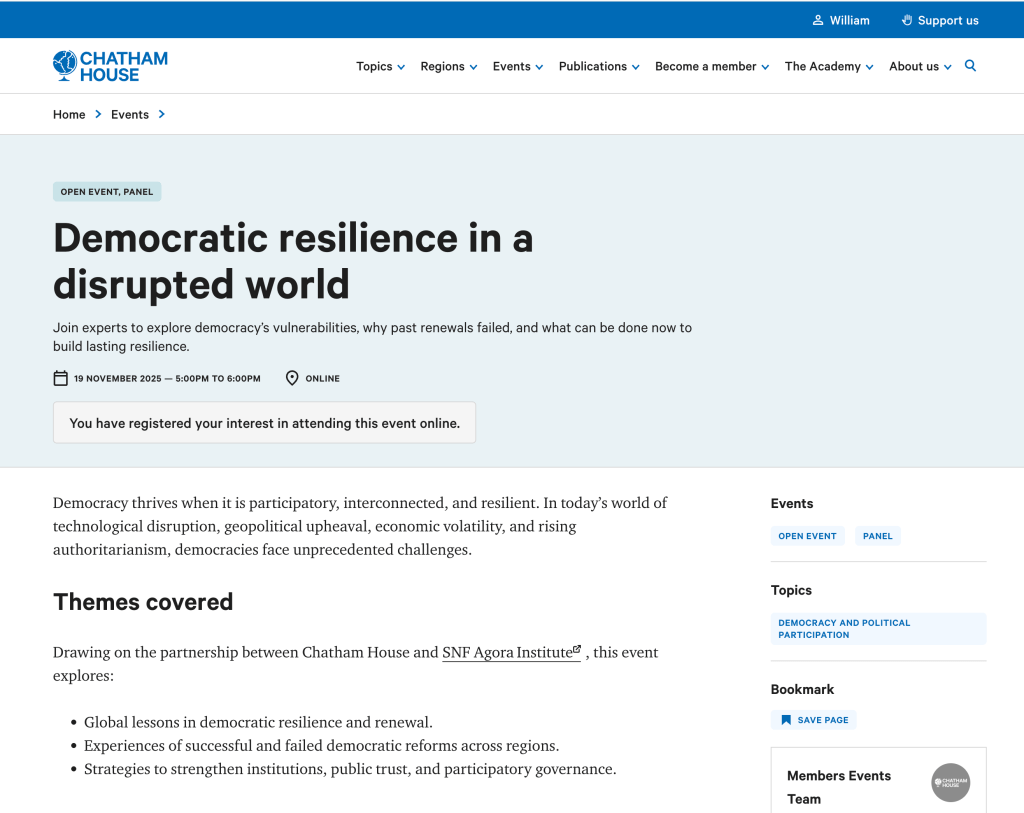
This Chatham House meeting is in partnership with SNF Agora Institute . The speakers are Mary Bruce, Sabina Ćudić, Alex Krasodomski, Anthony Smith, Scott Warren and Hayder Al-Shakeri.
Democracy is under pressure in a turbulent world with authoritarianism on the rise and technology being used to disrupt elections and confidence in the institutions of democracies running low. How can cross-border resilience be built in a changing global environment?
Democracy is at an inflection point. There is civic innovation, with youth-led movement for change, politics from the ground up. The SNF Agora Institute and Chatham House did a survey of young people about their experiences with democracy. The findings were brought to the Chatham House Annual conference earlier this year in London.
How will we respond to the challenges and make democracy more resilient? Young men in particular are not tending to engage with democratic action. With technology, young people are more connected than ever before. What separates democracies that demonstrate resilience and those that don’t?
Hayder discusses how there are messy democratic processes in the Middle East and North Africa region. Many citizens in the MENA region have lost confidence. There needs to be practical reform in the institutions. There are protests that are being co-ordinated by technology so that people can organize. They are rebuilding formal community structures. They are trying to make the governments hear them and to make the economies work for them. The governments realize that they cannot stop the processes. They are having to address the issue and make real changes. Tunisia saw change but has now back-slided towards authoritarianism. The Gulf States are trying to incorporate their people into decision making, even though they are not really democracies. The people want oversight over their decision makers.
Sabina talks of the protests in neighbouring Serbia but a complete absence of protests in Bosnia-Herzogovenia. There are 14 governments in a population of 4 million people. The experience is of democratic backsliding and there is a tendency to look inwards. After riding high after achieving democracy things have fallen flat. There is nostalgia for the communist regime and Tito’s government. Democracy brought freedom and freedom of speech and of the media. There is lacking the efficiency of a one party government system. The democratic transition did not provide the fruit that people generally thought would take place as democracy is associated with the European Union which hasn’t arrived. Paradigm shifts have led to paradigm breakdowns. Do freedoms matter more than economic progress? why is this a global trend?
Anthony Smith works at international level and national level within borders. Democratic resilience implies something that is true. Politics is a difficult field to work in. People are attacked and sometimes killed in politics. Resilience implies that the work is underpinned by values. What is the reason for this? Is it protecting freedoms? Resilience is more than just technical skills – it involves behaviours and culture. A few things can be misleading. Democratic resilience is a short phrase. We cannot recognize it as a shortcut – it is something that takes time. Democracy has to adapt and change with the times we are living in. He has been in the democratic support area for some time. The phrase has gathered traction in the sphere of security, for example being discussed at NATO. It is a universal issue. Without working together we will not reverse the backsliding of democracy that has taken place over the past 15 years.
Scott Warren is the only American on the panel. There is an opportunity for Americans to offer some humility. America has a role to play in the world. Young people play a specific and important role right now across the world and in the USA. They are frustrated with the democracies that they are seeing. Democracy as a principle is quite different from what they are seeing. There is skepticism and cynicism. The young expect change whereas older people are more satisfied with the institutions of democracy. A plurality of young people believe that their party is jot moving in the right direction. Older people feel that the opposing party is evil but young people are less fixed in their views on this. There is a tribal notion.
How are the young different in the democracies in which the panel work? Young people are globally facing issues with their economies and do not feel included. They are calling for reform and to end corruption. Hayder is from Iraq and the USA tried to enforce democracy upon it. Young people there do not feel included. Technology makes young people notice politics more.
Young people aged 18-25 are having difficulties identifying that political parties address the issues that are important to them. There is less discussion of policy process. Younger people have a more narrow way of digesting new information and don’t absorb more traditional channels like television and rely on social media. There are new ways of conducting campaigns. We are looking for quick fixes in campaigns and this is a mistake. Gimmicky solutions do not work.
The phrase ‘democracy isn’t delivering’ is misleading short-hand. The key element of democracy is to stop the abuse of power by elites. There is a situation where children believe they will not be better off or as wealthy as their parents. This is true in the United Kingdom. Young people are the majority in many countries and they do have a serious voice. Barriers to involvement in politics for young people are huge. Money really matters. Where there have been protests many young people believe that the political system is unfair. Apparently many young people in the U.K. believe that an autocracy or dictator would be better for them according to a survey conducted today.
There is a reality that young people don’t trust institutions that do not deliver for them. Older people vote more than young people with politicians therefore paying more attention to older people’s needs. There is a bifurcated information ecosystem. Bias on TikTok could mean that the young people do not believe anything. It is challenging to participate in the process. Democracy can’t just be about economic outcomes. Are we neglecting free speech? Just pushing on democracies delivering could get you into trouble.
Who inspire politically? Young people in Nepal and the Middle East are pushing on different systems right now. Who are the unlikely actors to show up for democratic resiliency – Conservatives in the USA? People in operation at a civil level are helping to direct political questions. How do we find a good solution for a problem, by working across lines. This is inspiring. The ideology does not necessarily matter. The solution for a long time has been assumed to come from a political laboratory. This is false. The solution is to lead with hope and authenticity and to avoid gimmicky solutions. It is not just about economic growth it is about evolution and human dignity.
It is how the grassroots mobilize around. certain position. They rally and lead on the issues that they are protesting on.
Over to Questions:
The Trump Administration would try to say that they are doing a lot to promote a stronger democracy. Some immigration policies have led to frustration with the judiciary. Un-elected judges are getting in the way of fulfilling the mandate. The weaponization of democracy is used in eg. USA and Hungary.
How is gender affected? There is unequal ability of women to participate in political systems across the world. This has to be remedied. They should.be able to participate fully so that they take part in all decisions. Where women are empowered policy-making is more effective. It improves the quality of the politics there.
Youth are fighting for gender rights and the environment. If people don’t have access to power the status quo is not working. There is a zoo of wonderful examples. Regarding international law – if people in power are not respecting international law then magic is not going to make it fall from the sky. People need to find ways in which they are not normally comfortable in expressing their views. Extraordinary measures are required.
Gaza and Ukraine are polarizing views.
The case has been made for democratic resilience and also for renewal. An informative panel with some useful facts, ideas and points about modern global democracies.
Discover more from Wez G Official Website
Subscribe to get the latest posts sent to your email.