This Chatham House event is chaired by Hayder Al-Shakeri, MENA Programme. On the panel are: Merissa Khurma, CEO AMENA Strategy, Mondher Tounsi, University of Oxford, Nissrine Ait Haji, Entrepreneur and Youth Activist.
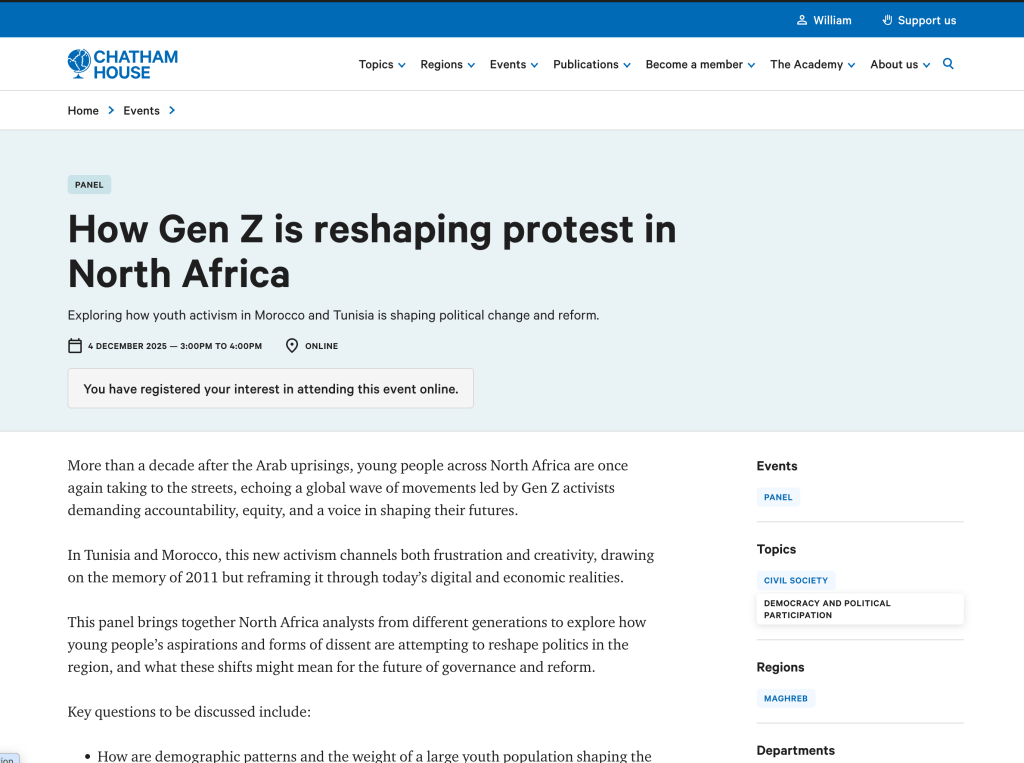
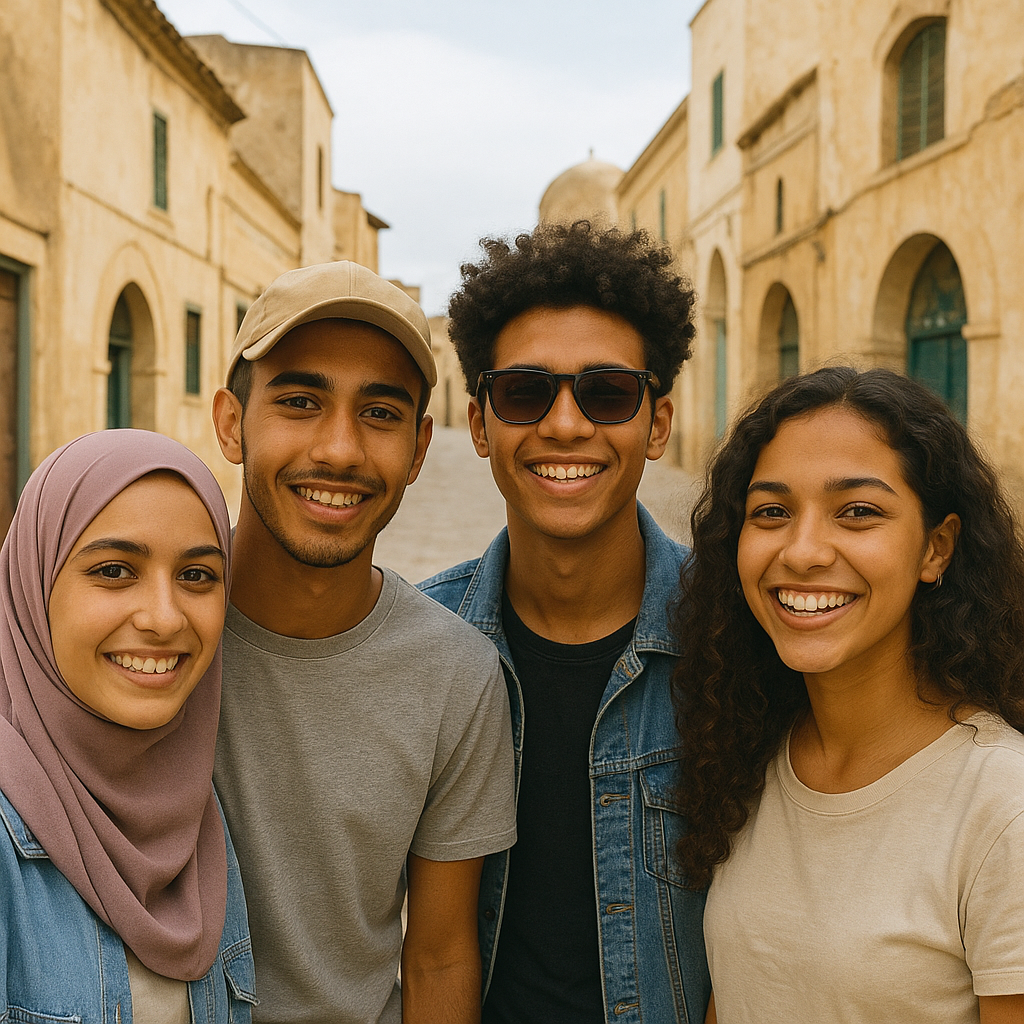
This is about how Gen Z are shaping protests in North Africa specifically in Morocco and Tunisia. How are these protests reshaping politics?
We have been seeing images from Rabat, Marrakesh, Tunis of protests. Why are these happening? In Morocco there is the 212 movement which is formed by Gen Z. In Tunis they have been protesting unemployment. We saw the Arab Spring protests in 2011. Digital tools, like then, are being used now. How are the demographic shifts expressing themselves in these protests. What are the governments’ reactions.
What is happening in Morocco? Moroccans are protesting for the love of their country. Morocco is not a country where people protest easily. When this is done on a mass scale it must be serious. The protests are fundamentally being done by Gen Z. TikTok and Instagram are the main channels of protest. The protests are not against the State or the monarchy. Moroccans are very proud of their country. Moroccans are very emotional and proud of their country. The protests were triggered over the deaths of some pregnant women in hospital. Young people were using digital tools to demand accountability. In the street and online people were arranging to march. There was a sense of urgency. They had to make people listen. The protests were due to happen as their causes have been underlying for years. Living standards have not been rising in pace with society. Young people are studying harder than ever but they are not getting the promised opportunities. The government can build stadiums but not hospitals. On the ground you can see how uneven everything is. The problems are not just institutional but also behavioral. They want jobs to be created and for institutions to deliver. They didn’t mobilize to destroy but to get change for the better. There has been an accumulation of pressure on the new generation.
In Tunisia the protests are focusing on environmental protection. The generation now are a different generation to those involved in the Arab Spring. It created an expectation and disillusionment. There is a narrative that social grievances are not being addressed. Conditions are getting worse, despite the ‘Spring of Hope’. There is a shift away from tourism. There has been police expansion and laws governing the digital landscape. For youth their isn’t a clear pathway to express dissent. Economic decline is the main driver for the protests. Dignity, transparency, employment. It is a digital-based mobilization. There are some decentralized protests. These protests are reactive, less revolutionary. They respond to events that are happening. There are graduates, disillusioned urban youth. There were protests in 2023 and 2024 about the costs of living and also against toxic polluting. Youngsters have joined in with the protests that go against the failure of the government. The government have seen these grievances as threats to public order and have responded with security measures.
Are their similarities between the two countries and in North Africa generally? There are trends that need to be observed closely and understood. This generation, Gen Z, is expressing their opinion online and eg. expressing their concerns on the War in Gaza. Their frustration comes to the fore. We do not understand this generation as we do not come from this generation ourselves. They have more comfort on social media. In this region and in the Levant go back to the underlying drivers that fueled 2011 Arab Spring. This generation are at the receiving end of lack of reform and failed policies. Youth unemployment rates in MENA area top 30%. We have to learn how can governments communicate with the youth? there are no channels of communication. There are asymmetries in the workforce developments. The higher education system does not link to the job marker. There is no communication between the private sector and education institutions. Education systems are not reforming fast enough and do not calibrate with market needs. With healthcare, a basic human service, that all in the world should have access to, a basic human right. In Morocco, the deficiencies in the public health system became most apparent during COVID-23. There is a contagion effect with a call for protests in Algeria too. In Jordan, Discord was disconnected after the protests in Tunisia took place. Unless grievances are addressed there will be more and more protests not just in North Africa but elsewhere.
What lessons were learned from the Arab Spring? Many governments came to power as a result of the Arab Spring. What we have seen evolve, in countries with peaceful, non-violent protests, that have been part of the calls from the start and are a key component. Libya and Syria are unsettled in a post-conflict situation. The other governments say that they need security in order to maintain peace. However, this does not wash with Gen Z. They care about justice, transparency and accountability and want to sit at the table and are seeking change. The governments have to recognize this. They talk about evolution and not revolution. The governments are acting slowly and piecemeal, in order to just maintain stability. Dissent is being crushed by governments by controlling online activity. Some governments are working towards job creation but this process is difficult. A lot of the governments have an archaic setup.
Changing the nature of the social contract between people and State. Gen Z want to feel that their voice matters. Violence doesn’t work but dialogue does. Ambition abroad must move at the same speed as dignity at home. Gen Z want real progress and it is not just about institutions but also about behaviour. There is inconsistency and lack of discipline. The government is supposed to build good institutions but also they must encourage cultural shift. Hospitals and schools should be a priority and not just part of a reactive sector in government policy. The governments are trying to show that they are listening and trying to change things. Gen Z want to be part of the process and part of the solution. A lot of Moroccans do not have the same levels of literacy and skill. The government must invest in people and not just infrastructure. Design p[policies with youth and not just for them. It is not about slowing down development. Morocco can move forward strongly if it gets the balance right. Gen Z want a place at the table. In Algeria there is a higher council of youth, but it is a checkbox and not formal or taken seriously.
In Tunisia the State is being reactive but in a counter-intuitive way. There needs to be a safe space in which to express dissent. A lot of short terms programs do not translate to structural reforms. Policies need to be targeted and have an impact on daily lives. Macro-political developments involve the inclusion of youth in decision-making processes. There is less policing. Longstanding institutional reforms and questions related to the composition of. the regime need to be addressed.
When youth graduate they need a job so that they can start a family. They are seeking economic justice. Income disparities are apparent. Graduates cannot find jobs. It is becoming more difficult across the MENA region. It is not fair. The way this generation has evolved is focused on justice, accountability, transparency, open communications and inclusion.
What is the role of gender in the protests. Are there rights-based demands or is it just economic grievances? Basic human rights and economic inclusion are linked together. People with masters degrees are getting just 100 Dirhams a day and it takes 4000 Dirhams a month to support a family. The protests are not about gender. Everyone shares the same struggles with health and education. Violence is endemic in hospitals. There is a demand for basic respect. Social issues are across the spectrum.
Do the restrictions on freedom of speech in Tunisia affect the protests? Many young people have been repressed. They are trying to qualify their rights to protest and how they can go into the streets. People are trying in the current landscape to find their fitting and to understand the regime. The restrictions on freedom of speech have created a hostile environment.
What is the State of the social contract in North Africa, fourteen years after the Arab Spring? There have been tweaks across the board to political policies. The social contract itself has jot really shifted. There are not too many openings for dialogue and communication. The war in Libya an Syria affected neighboring countries. There is a greater entrepreneurial spirit in the younger generation who are not so comfortable with stable public sector employment. A lesson from the Arab Spring is that political reform creates instability and creates an unpredictable future. The form of the social contract has not really changed. Young people are more defiant and unhappy with the status quo and have similar demands.
Gen Z are not afraid of anything. They have seen people achieve the unachievable on social media. Gen Z learn from other countries. Governments are being forced to negotiate. The protests oblige states to negotiate and revise the social contract. Governments should anticipate. Revolution is not predicted but governments should not ignore the protests.
Governments and society are changing as is the social contract and Gen Z cannot be ignored anywhere. Their democratic voice is breaking through and will be heard and affect change.
This was an interesting discussion and it still surprises me greatly just how effective an invention the internet and social media can be for enacting real transformative change for people and youth all across the world.
Discover more from Wez G Official Website
Subscribe to get the latest posts sent to your email.