

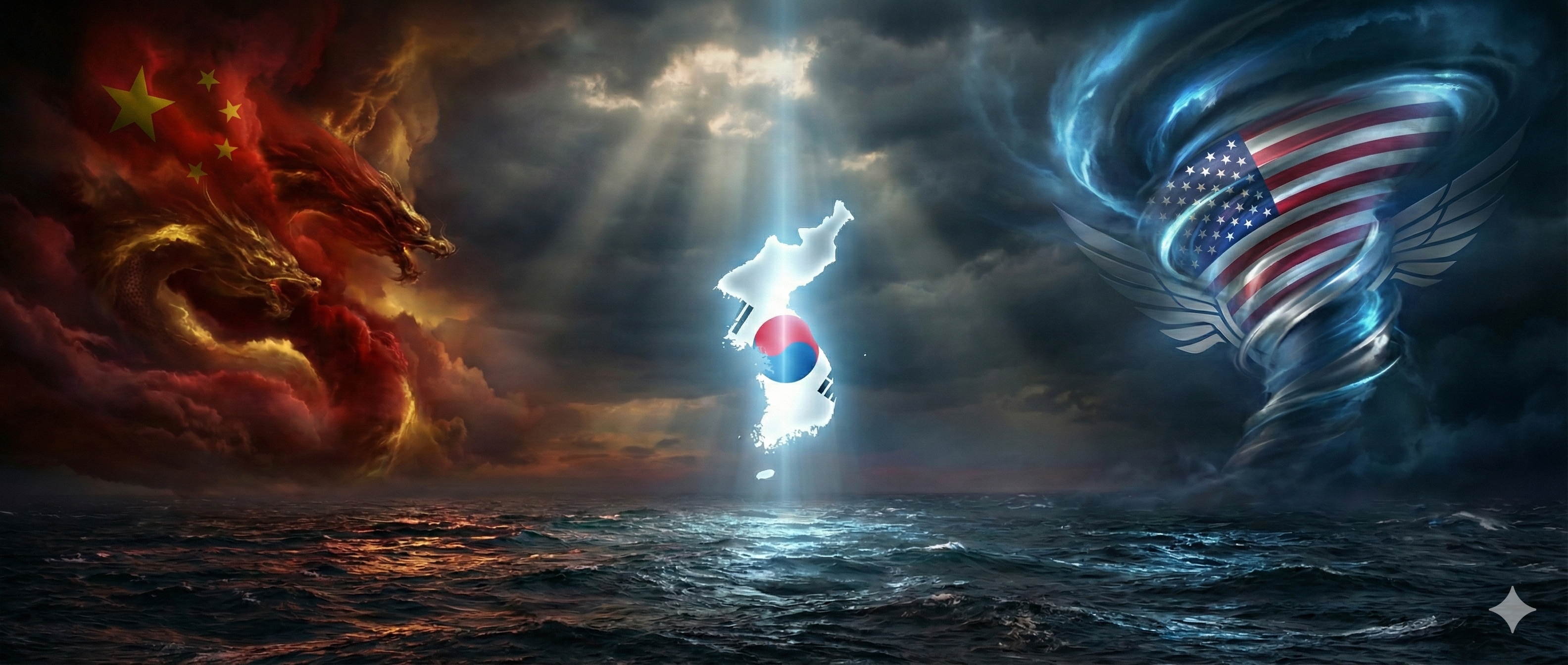
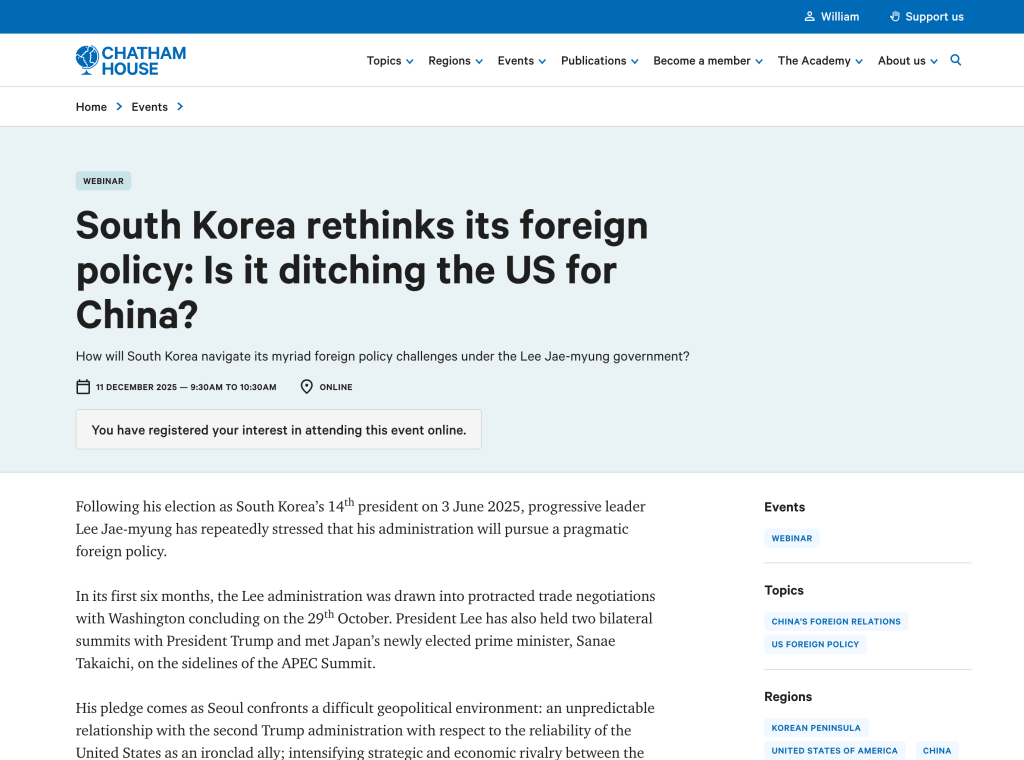
This Chatham House meeting is chaired by Dr Chietigj Bajpaee, South Asia, Asia-Pacific Programme. On the panel are: Kuyoun Chung, Associate Professor of Political Science, Kangyon National University, Dr. Edward Howell, Korea Foundation Fellow, Asia-Pacific Programme and Sang-Yoon Ma, Professor of International Relations, Catholic University of Korea.
How will South Korea navigate its myriad foreign policy challenges under the Lee Jae-myung government?
Following his election as South Korea’s 14th president on 3 June 2025, progressive leader Lee Jae-myung has repeatedly stressed that his administration will pursue a pragmatic foreign policy.
In its first six months, the Lee administration was drawn into protracted trade negotiations with Washington concluding on the 29 October. President Lee has also held two bilateral summits with President Trump and met Japan’s newly elected prime minister, Sanae Takaichi, on the sidelines of the APEC Summit.
His pledge comes as Seoul confronts a difficult geopolitical environment: an unpredictable relationship with the second Trump administration with respect to the reliability of the United States as an ironclad ally; intensifying strategic and economic rivalry between the United States and China; political and economic coercion from China, South Korea’s largest economic partner; and the mounting security threat from North Korea and Pyongyang’s expanding nuclear and missile development.
As the Lee Administration looks to re-calibrate South Korea’s foreign policy in an increasingly precarious regional and global security environment, our panel of experts will discuss:
- What are the principal drivers of South Korea’s foreign policy?
- What comprises a ‘pragmatic’ foreign policy and how will the Lee Jae-myung government pursue such an approach at a time when South Korea faces questions regarding US alliance commitments, intensified Sino-US rivalry and an emboldened nuclear North Korea?
- In light of these foreign policy challenges, will the Lee government’s foreign policy demonstrate greater continuity than change from that compared of its conservative predecessor?
This webinar launches the forthcoming Chatham House publication ‘How South Korea can balance its US commitments with global engagement: The key foreign policy challenges for the Lee government’.
Normally we are used to hearing of geopolitical tensions emanating from the DPRK on the Korean peninsula. However, more recently we have seen South Korea’s tender politics making headlines. Yet, South Korea has proved resilient. From the Yoon to the Lee presidency how has its foreign policy changed? Relations have remained stable with foreign countries. South Korea have maintained strong relations with the USA. North Korea have become more hostile. There have been structural changes and South Korea have to maintain their foreign policy relations. What is the new pragmatic foreign policy? The previous government had value-based diplomacy. The values of liberty and democracy and emphasizing the alliance. The new government doesn’t pursue purely ideological democracy. the world is changing quite rapidly. The old order is changing. The world order is quite unstable. Pursuing more interest-based diplomacy is more of a priority. Political alliance with the USA, Geo-economic links to China, security issues on Korean peninsula.
Is there more room for engagement with the USA over North Korea? At a recent meeting with Trump, much of the discussion was focused on North Korea. Lee was trying to capitalize on Trump’s penchant for resurrecting a relationship with Kim dynasty. USA can be a peacemaker with South Korea being a pacemaker. North Korea is no longer seeking peaceful reunification with South Korea. Tariffs and trade deals have also dominated the talks. There have been 15% tariffs from the USA.
There is a risk of entrapment. Taiwan is the number 1 priority for the United States. How can South Korea cope with the regional consequences? If Taiwan is invaded then there is likely also to be war in Korea so they have to prepare. South Korea is a middle power, seeking to avoid getting caught in the crossfire of the US-China rivalry.
South Korea cannot see their alliance with the USA to weaken as the alliance is the cornerstone of their foreign diplomacy. However, China is the number 1 trade partner and they have to maintain good relations there. Exports to China have been decreasing. The proportion of trade with China is decreasing too. There is no decoupling. Too much one-sided trade relations can be unhealthy. China can play a positive role in bringing North Korea to the negotiating table and ensuring a peaceful relationship. They are not prepared, however, to sacrifice their alliance relationship with the United States.
There has been rapprochement towards Japan. There are trilateral relationships with the USA. The right-wing Tokyo government and left-wing in Seoul could see a deterioration in relations? Lee had a previously negative relationship with Japan but it is now improved since he has become leader. The Japanese Prime Minister, Sanae Takaichi, when visiting APEC summit, took a rather conciliatory approach to South Korea. The Japan-Korea relationship can be improved. The Lee government is more security-focused. SOuth Korea needs to develop more military assets. It has to be more security-conscious. Japan is a good partner to maintain security in the region.
Can South Korea play a more active role in global flash-points? What is its global role?There is growing awareness of a dual contingency, with the Taiwan situation. North Korea could take advantage of an unsettling in the Taiwan situation. North Korea has sent troops to Russia. This makes South Korea face up to new North Korea problem. The Pyongyang-Moscow rapprochement signals potential danger. North Korea is engaging with broader and deeper security co-operation with Russia. This is a concern for Seoul.
What lessons can South Korea offer other countries? How can South Korea exert its soft power? There will be diplomacy with Ukraine. South Korea will seek to enhance its status in the global state. Koreans are fast in adapting to a new environment. The international world order is changing very fast. They are an exporter in the defense industry market. They have been developing their own weapon systems with the constant threat from North Korea. They have invested heavily, through necessity in hi-tech industries. Their product needs to reach the global market. After semi-conductors they are now focused on the AI revolution. During authoritarian regimes Koreans could not express their opinions. Korea has tool-kits that can help it change to a rapidly changing global environment. K-Pop and South Korean soap operas.
Will South Korea develop its own nuclear deterrent? They will remain nuclear-free. This is clear. Conventional deterrence is set against regional threats. The relationship with Washington has started on a positive note. North Korea is not interested in dialogue with either South Korea or the USA Trump administration. There could be a future Kim Jong-un – Trump summit. If the two countries talk of arms reduction, will this mean the US reduces its defense capabilities in the region? Kim Jong-un will only want to talk to the US if he gets something in return. After Hanoi summit, North Korean foreign minister made clear that his leader had lost his appetite for negotiations. North Korea is getting plenty on its table from Putin in Moscow. What impact is Russia having in the South Korea neighborhood? There have been good South Korea-Russia trading relations. With military incursions it has to be prepared. The US international order and US allies. South Korea has to take this into account when factoring Russia-China relations.
What role does the EU (and U.K.) play in South Korea’s strategy? We seek more like-minded countries. If we can share values and interests then this is positive. The relationship needs to be diversified. The EU and South Korea have more opportunities for future cooperation. South Korea needs to enhance its economic security. Small and medium companies in South Korea can be connected in many European countries. This will strengthen the economic relations in both areas. South Korea co-operates with the U.K in defense. There has been involvement with Royal Marines. South Korea is bolstering ties with NATO. there is talk of naval co-operation as South Korea values freedom of navigation in the Asia-Pacific region. The bedrock fo South Korea’s foreign policy with the USA will remain.
Can NATO IP4 co-operation continue? The Prime Minister of New Zealand was only IP4 leader to attend NATO summit. WIth regard to IP4 and its relationship with NATO, NATO has its own security focus area in Europe. IP4 are more interested in defending their own region. How much can European security capacity help Indo-Pacific players? They have to focus on their own security threats and risks. There are broader opportunities for economic co-operation. Russia-China-North Korea co-operation indicates that the relationship is growing stronger. There needs to be a dialogue about the geopolitical realities. A lot can be learned from each other.
It is exciting times for developments in the Asia-Pacific region and South Korea is at the heart. of it all.
Discover more from Wez G Official Website
Subscribe to get the latest posts sent to your email.