
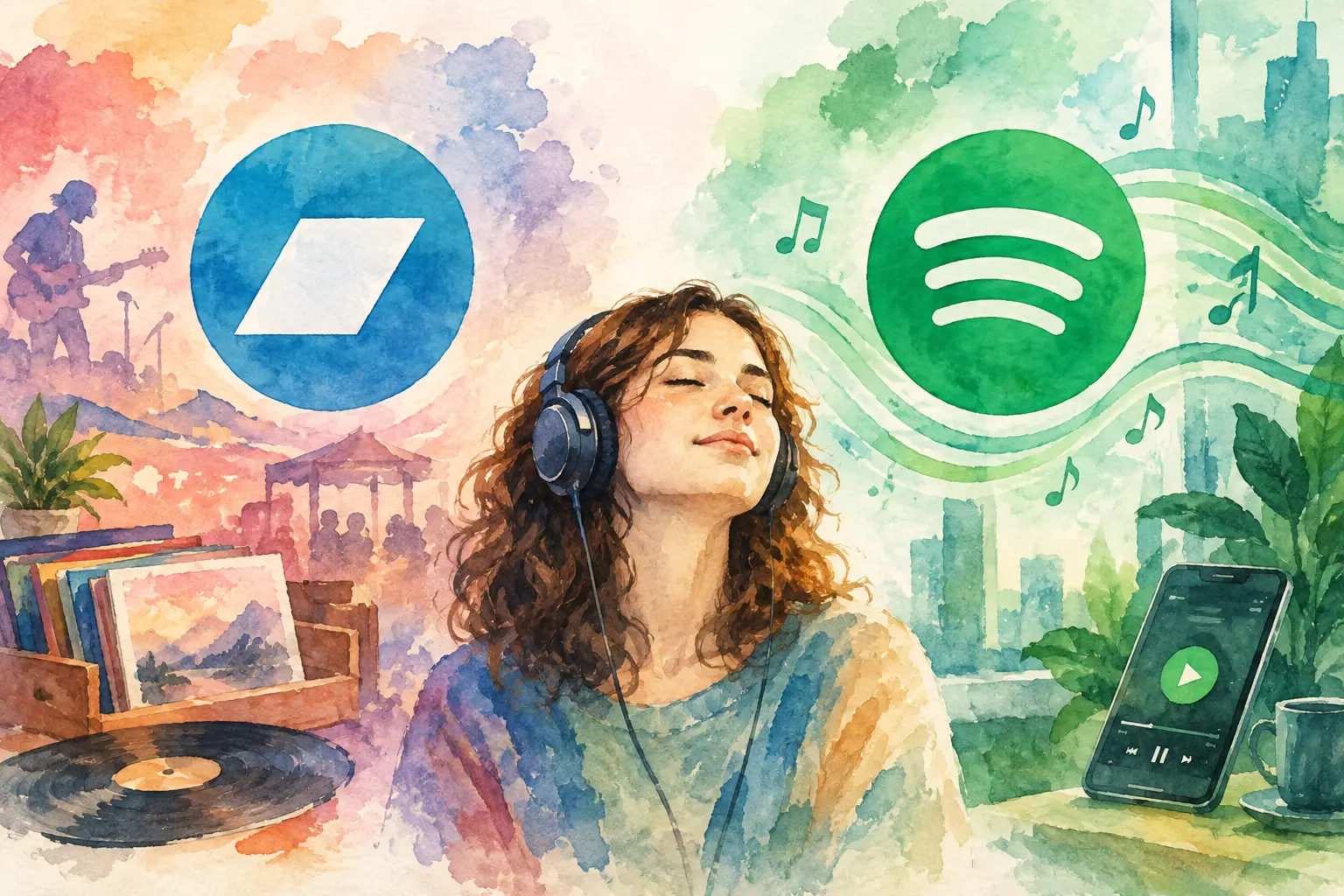
A new acid cut lands at 2am. One listener adds it to a late-night driving playlist, another buys the WAV file, and a DJ grabs it for a USB before Saturday’s set. That is the real Bandcamp versus Spotify question: not which platform is universally better, but what kind of relationship you want with the music.
For dance fans, selectors and independent artists, both platforms are useful. Spotify is the massive listening room, built for instant access, playlists and repeat discovery. Bandcamp is closer to the record table after the night ends – a place to buy music, follow labels and support the people actually making the noise. Treating them as rivals misses the point. They serve different moments in the same musical life.
Bandcamp versus Spotify: the core difference
Spotify sells access. A subscription opens a near-endless library of albums, singles, mixes and mood-based playlists. It is brilliant when you want to move from house to techno, drum and bass to chillout, without stopping to think about a purchase. Search a track, press play, save it, share it, and let the next recommendation take over.
Bandcamp sells connection and ownership. Fans can purchase a digital release in high-quality formats, order physical editions where available, pay more than the asking price, and receive updates directly from artists or labels they follow. The music becomes part of a collection rather than another item in a saved library controlled by a subscription.
Neither behaviour is more authentic. Someone who plays a track fifty times on Spotify may become a committed fan. Someone who buys one EP on Bandcamp may play it only occasionally. The difference lies in the route. Spotify reduces friction; Bandcamp makes support visible.
Spotify is built for discovery at scale
Spotify remains the practical first stop for listeners who want a constant flow of music. Its biggest strength is context. A listener can find a track through an editorial playlist, a friend’s share, an algorithmic recommendation, a DJ’s public playlist or a radio-style autoplay session. That matters enormously for emerging electronic music, where a great record often needs to meet people in the middle of their existing listening habits.
For an artist, a placement on a relevant playlist can introduce a release to listeners who would never have searched for it by name. A house track can land beside established favourites; a beachy downtempo tune can reach people planning a summer set; a punchy hip-hop release can appear in a gym rotation. The listener does not need prior knowledge of the artist. They only need to like the track within that moment.
Spotify also wins for convenience in daily life. It works for commutes, parties, background listening, workouts and the random ten-minute gap before heading out. The app remembers what you play, makes playlists portable and encourages low-commitment exploration. For fans who want new music without managing files or paying release by release, that is a powerful offer.
There is a trade-off. Discovery on Spotify is crowded and partially opaque. A release can be excellent, professionally mastered and perfect for the dancefloor, yet struggle to travel if it does not reach the right listeners, playlists or recommendation signals. Artists are competing with a vast catalogue, not just this week’s new releases.
Playlists are a gateway, not the whole plan
Playlists can create momentum, but they should not be mistaken for a fanbase. A listener may save one track without ever learning who produced it. That is still valuable – every play can lead somewhere – but the strongest result is when playlist discovery turns into profile follows, repeat listening, social interaction and interest in the wider catalogue.
For a multi-genre artist, Spotify makes that catalogue easy to browse. Fans can jump from a club-focused single to a relaxed mix, then back to an older remix. Wez G Music works naturally in this environment because the catalogue has room for different moods, from acid pressure to open-air chillout. The challenge is giving each release a clear job rather than expecting one track to represent every corner of the project.
Bandcamp makes the fan relationship more direct
Bandcamp feels different because the purchase means something. When a listener pays for a release, they are not merely signalling approval with a save. They are making a direct financial choice to keep that music close. For independent artists, labels and producers, that can be far more meaningful than a large number of passive plays.
The platform is especially strong for listeners who care about credits, artwork, liner notes, labels, limited editions and high-quality downloads. It suits the collector instinct that still runs through electronic music. Even if a DJ plays from digital files rather than vinyl, there is satisfaction in owning the release, storing it properly and knowing exactly where it came from.
Bandcamp also supports a healthier sense of scene. Fans often browse by label, genre tags or the people who bought a release. They can find a small techno imprint, follow its next compilation and become part of a community that is more focused than an algorithmic feed. It is not as frictionless as Spotify, but that friction can be useful. It asks the listener to choose.
For artists, direct sales offer more control over presentation and often a clearer route between fan support and the release itself. A well-organised page with strong artwork, accurate tags, credits and a sensible price can turn a casual listener into a buyer. Special editions, bundles and pay-what-you-want options can add another reason to act now rather than save a track for later.
Ownership matters most to DJs and collectors
If you DJ regularly, Bandcamp has a practical advantage: buying a download gives you a file you can prepare, tag, back up and play in your own workflow. Streaming services may help with set research and music discovery, but access can change when subscriptions, licensing or catalogues change. A purchased file is yours to manage.
That does not mean every DJ must buy every tune. Budget matters, and Spotify is excellent for digging through unfamiliar artists before committing. A sensible pattern is to discover broadly on streaming, then buy the records that earn a place in your sets. The same applies to fans who want to own only their personal classics rather than build an enormous digital library.
Money, value and the awkward streaming question
It is tempting to reduce this comparison to one line: Bandcamp pays better, Spotify pays less. The broad direction is understandable, but the reality is more complicated. Streaming income depends on territory, subscription type, distributor arrangements, rights splits and the overall way a platform allocates revenue. It is not a fixed price tag per play.
What is clearer is the difference in transaction size. A Bandcamp purchase can generate a meaningful amount from one committed fan, while streaming usually works through volume over time. That makes Bandcamp particularly useful for niche releases with dedicated audiences, and Spotify useful for building reach across a much larger pool of casual listeners.
Artists need both awareness and support. Reach without any deeper relationship can be fragile. Direct sales without fresh discovery can plateau. The strongest independent approach is often to let Spotify handle broad listening and let Bandcamp give the most engaged supporters somewhere tangible to go.
Which platform should listeners choose?
Choose Spotify when you want breadth, convenience and constant discovery. It is the better companion for a long journey, a party queue, a gym session or a week spent chasing fresh playlist additions. Follow artists you genuinely rate, save the tracks you return to, and share the music with friends. Those small actions help more than people think.
Choose Bandcamp when a release has become part of your world. Buy the EP you keep replaying. Pick up the DJ tool that will work in your next set. Support the label putting out left-field records that would never thrive in a mainstream recommendation lane. If the option is there, paying a little above the price is a direct vote for more music.
You do not have to choose a side and stay there. Stream the new release on Monday, add it to a playlist on Wednesday, then buy it on Bandcamp once it has proven itself at home, in the car or on the dancefloor. That is not divided loyalty. It is using each platform for what it does best.
The next time a track catches you properly, do more than let it disappear into the feed. Follow the artist, tell a mate, play it loud, and if it becomes one of your records, own it. CHEERS!

Leave a Reply