
By Wez G | wezg.co.uk
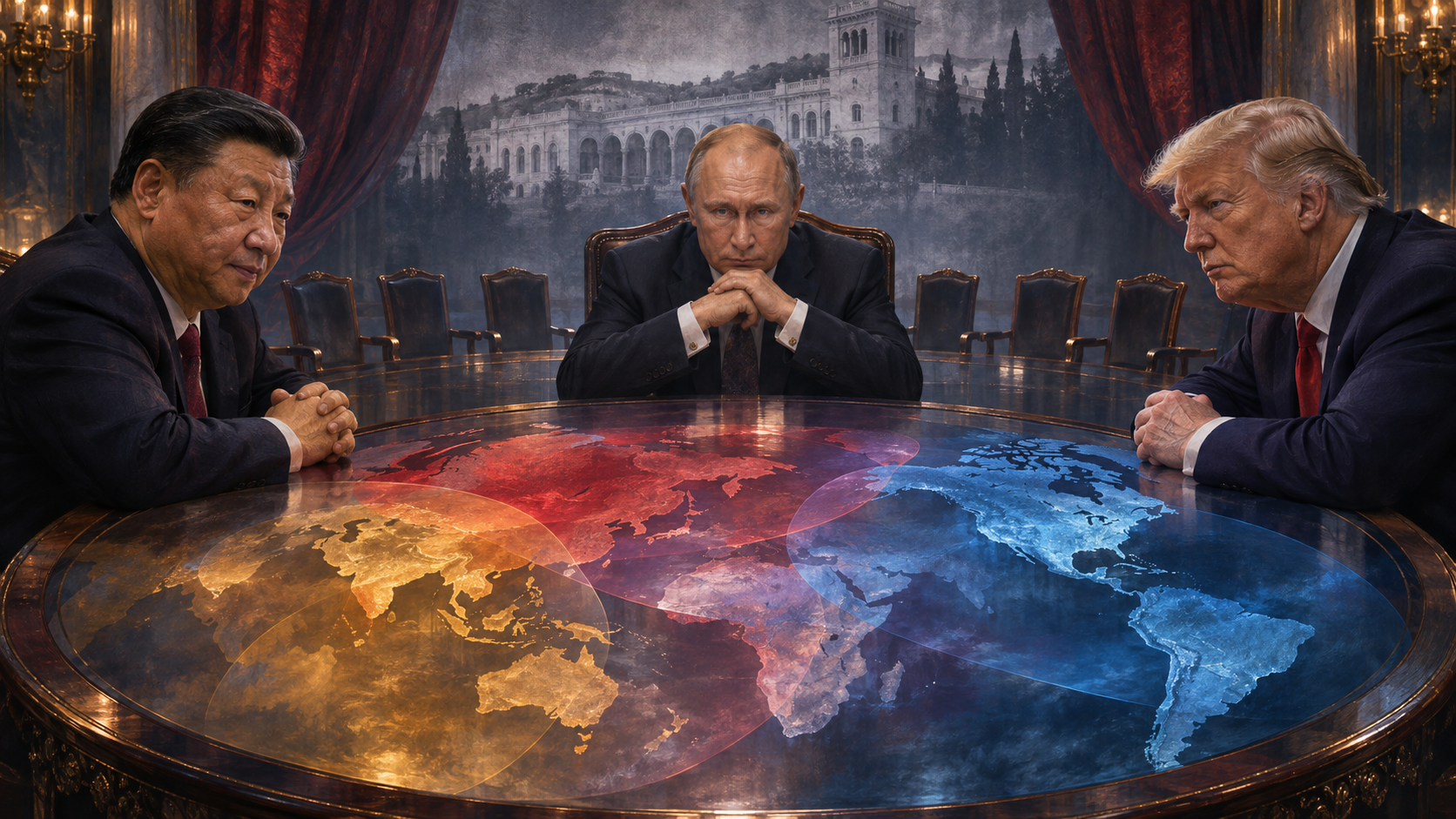
Three leaders around a table. Nuclear arsenals behind them. Countries outside the room wondering whether their futures are being discussed.
The planned meeting between Xi Jinping, Vladimir Putin and Donald Trump in Shenzhen on 19 November 2026 invites an unsettling comparison with Yalta: the wartime conference that became synonymous with great powers deciding the fate of smaller nations. The Kremlin has announced the date, while Washington has confirmed plans for trilateral talks alongside the APEC summit.
Could this become a defining moment when the world is divided into American, Chinese and Russian spheres of influence?
My view is that a comprehensive carve-up is unlikely at this meeting. But the danger deserves attention. A world organised around great-power privileges could emerge through a succession of bargains, concessions and calculated silences, without anyone ever signing a document called “the new Yalta”.
What Yalta actually means
In February 1945, Franklin D. Roosevelt, Winston Churchill and Joseph Stalin met in Crimea as the Second World War approached its conclusion in Europe. They negotiated arrangements concerning defeated Germany, Poland and the foundations of the United Nations. The conference combined practical cooperation with profound disagreements about Europe’s future.
It is too simplistic to say that three men drew a line across a map and created the entire Cold War. Military occupation, subsequent decisions and the breakdown of Allied cooperation shaped what followed.
Nevertheless, “Yalta” carries a powerful political meaning: people discovering that their national freedom depends on arrangements negotiated elsewhere.
That is why the comparison matters today. Who gets a seat at the table, and who becomes an item on the agenda?
What is actually on the table in Shenzhen?
We should distinguish the symbolism from the reported plans.
US officials have identified nuclear arms control and Iran as subjects for discussion. They have said Ukraine is being handled through a separate channel and that Washington does not expect this meeting to produce an agreement.
Reuters also reported continuing negotiations over the agenda and format, alongside significant differences between the leaders’ objectives. That is a fragile starting point for a comprehensive settlement of world affairs.
There is no established basis for claiming that a secret agreement to divide the planet already exists.
The following is therefore a scenario: what a spheres-of-influence order could look like if these governments increasingly accepted each other’s claims to regional dominance.
Russia: a veto over its neighbours’ choices
For Moscow, the most valuable sphere would extend beyond territory into political control.
In such a scenario, Ukraine might retain formal independence while facing restrictions on its alliances, armed forces or foreign military partnerships. Pressure could extend to other neighbouring countries whenever their governments sought closer Western relationships.
The crucial distinction is between a negotiated security arrangement accepted freely by those affected and an imposed settlement that gives Russia a permanent veto over another country’s future.
A ceasefire could save lives and create space for reconstruction. But if its terms established that invasion earns lasting political privileges, the consequences would reach far beyond Ukraine.
The test would be whether Ukrainians meaningfully consent to the settlement and have credible protection against another attack.
China: regional primacy and economic influence
A Chinese sphere would centre on East Asia and the western Pacific. Taiwan would be its most dangerous potential flashpoint.
One hypothetical bargain would involve Washington reducing support for Taiwan in exchange for Chinese cooperation elsewhere. Another could involve a gradual weakening of American commitments, leaving governments across the region less confident that Washington would support them during a crisis.
Neither outcome should be presented as an announced summit agreement.
Nor would Chinese influence necessarily require territorial expansion. Dependence on markets, manufacturing, infrastructure, technology and critical materials can narrow a government’s practical freedom to act.
In this scenario, countries could remain sovereign on paper while finding that challenging Beijing carried costs they could scarcely afford.
But Japan, South Korea, the Philippines, Vietnam and others would make their own choices. They would have strong reasons to resist any arrangement made over their heads.
America: a dominant hemisphere, with interests everywhere
An American sphere might emphasise predominance in the Western Hemisphere, alongside continued influence through finance, technology, trade and military partnerships.
The imagined bargain would be reciprocal restraint: Washington tolerates greater Russian and Chinese dominance near their borders, while Moscow and Beijing accept stronger American demands closer to the United States.
Yet this picture quickly becomes untidy.
American interests extend across Europe, Asia and the Middle East. Chinese commercial interests stretch across the Americas. Russia seeks influence beyond its immediate neighbourhood.
None of the three could retreat neatly into its allotted section of the map. Their interests would continue to collide.
Europe would face a difficult choice
For Britain and the rest of Europe, the disturbing image would be a discussion of European security conducted without meaningful European participation.
A bargain between Washington and Moscow could force European governments to confront how much security they could provide for themselves if American priorities changed.
My expectation is that an overt attempt to impose such a bargain would encourage greater European cooperation on defence, infrastructure and support for vulnerable neighbours.
Whether governments could sustain that cooperation would depend on political will, resources and public support.
From here in Wales, these discussions can sound remote. Their effects would be familiar enough: pressure on household bills, public spending, employment and the choices facing future generations.
The rest of the world would resist being allocated
The greatest weakness in the “three leaders divide the world” theory is that it underestimates everyone else.
India would have little reason to accept a subordinate place in a Chinese-led Asia. Brazil, Indonesia, Türkiye, South Africa and Gulf governments would have incentives to preserve room for manoeuvre.
African countries would pursue their own interests rather than simply become territory in someone else’s strategic contest.
Some governments might seek investment from China, security cooperation with the United States and commercial relationships with Russia simultaneously. Others could organise regional partnerships to increase their bargaining power.
A multipolar world contains many centres of decision-making. Reducing it to three personalities mistakes diplomatic theatre for the full distribution of power.
The borders could run through our phones
A modern division of the world might be most visible in technology and commerce.
Countries could face increasing pressure to choose between competing payment systems, communications networks, cloud services, AI platforms and supply chains.
For musicians, artists and other creators, that raises practical questions. Can we reach audiences across political boundaries? Can we receive payments? Which platforms carry our work, and whose restrictions govern them?
A fragmented world could make international cultural exchange harder, even where physical borders remain unchanged.
The map of influence would include cables, servers, currencies and algorithms.
What would make this a defining moment?
The photograph alone will tell us very little.
More revealing would be subsequent decisions: changes to military support, sanctions, alliance commitments, trade restrictions and the language used about smaller countries’ sovereignty.
We should also distinguish cooperation from domination. Serious nuclear risk reduction would be welcome. Direct communication between rivals can prevent miscalculation. Diplomacy becomes dangerous when cooperation depends on treating other populations’ rights as expendable.
The question is whether the leaders establish habits of consultation that reduce conflict, or habits of bargaining that exclude those most affected.
A warning, rather than a prediction
I do not expect Shenzhen to produce a tidy three-way division of the planet. The interests involved are too tangled, the disagreements too substantial and the other countries too capable of resistance.
The more plausible danger is gradual acceptance of a principle: that powerful states deserve special authority over their neighbours.
Once that principle takes hold, each concession can become the justification for the next.
The lesson I take from Yalta is to watch who has power to shape the settlement—and who must live with it.
If this summit becomes a defining moment, we should judge it by whether it strengthens a peace that countries can freely accept. A stable world needs more than an understanding between three powerful men.
It needs the consent of the people whose futures they are discussing.


Leave a Reply