
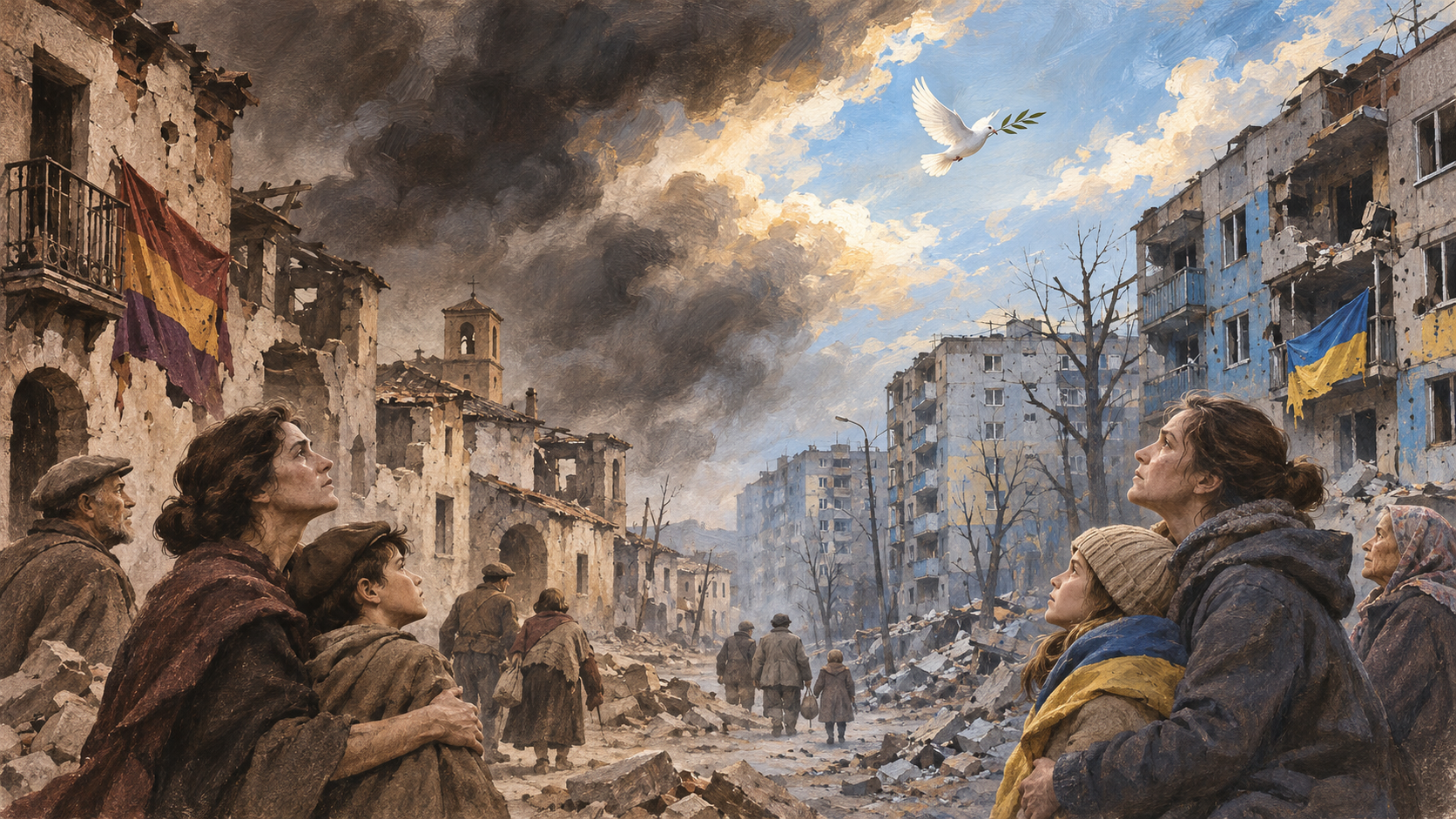
There is something deeply unsettling about watching a war unfold while wondering whether future generations will describe it as the beginning of something much larger.
The Spanish Civil War, fought between 1936 and 1939, carries that shadow. It became a meeting point for international rivalries, ideological struggles and military experimentation shortly before Europe descended into the Second World War.
Looking at Ukraine, the parallels are disturbing. Yet history offers warnings, not a timetable. A wider war is a danger we must work to prevent, rather than an outcome we should accept as inevitable.
The challenge is to defend Ukraine’s right to exist and determine its own future while creating a credible route away from escalation.
When the world enters one country’s war
Spain’s civil war began with a military uprising against the elected Republic in July 1936. Nazi Germany and Fascist Italy backed Franco’s Nationalists, while the Soviet Union supported the Republic. Foreign volunteers joined the Republican cause through the International Brigades. A struggle rooted in Spanish society acquired an international dimension. United States Holocaust Memorial Museum
Ukraine’s circumstances are fundamentally different. Russia’s full-scale invasion in February 2022 was an attack by one sovereign state on another, following the conflict that began in 2014. Describing it simply as a “proxy war” obscures Russia’s responsibility and Ukrainians’ own reasons for resisting. The UN has repeatedly affirmed Ukraine’s sovereignty and territorial integrity. UN Secretary-General
The useful parallel concerns what happens when outside powers invest their own security, prestige and political ambitions in a conflict. Their involvement can help a country survive. It can also make compromise harder if every setback becomes a test of international credibility.
We should therefore resist language that turns Ukraine into a chessboard. The people living through the war must have a decisive voice in its resolution.
The danger of neutrality without enforcement
Britain and France pursued non-intervention in Spain partly to prevent a wider European conflict. But Germany and Italy continued supporting Franco, while the Soviet Union supplied the Republic. The agreement constrained states unevenly and failed to keep foreign powers out. United States Holocaust Memorial Museum
That experience raises a difficult question for today: what happens when restraint is observed by some governments and exploited by others?
Withholding assistance does not automatically produce peace. If it makes conquest easier, it may encourage future aggression. Equally, every proposal for greater military involvement needs scrutiny: what is its purpose, what risks does it create, and how does it help bring the war to an end?
There is no historical shortcut through those decisions. Support for Ukraine and efforts to prevent escalation must be judged together.
A battlefield becomes a laboratory
Spain offered foreign forces opportunities to test weapons and tactics. The bombing of Guernica by German and Italian aircraft became an enduring symbol of civilians’ vulnerability to modern warfare. United States Holocaust Memorial Museum
Ukraine prompts a related concern: governments and military industries can study a war as a source of lessons while the people beneath the weapons experience bereavement, injury and displacement.
We should be wary whenever technical fascination crowds out human consequences. A successful interception still takes place above somebody’s home. An attack on infrastructure can mean a hospital without reliable electricity or a family facing winter without heat.
The measure of policy must include how many people it protects and what prospects it creates for lasting peace.
Where the comparison breaks down
Calling Spain a “dress rehearsal” for the Second World War can make events seem more inevitable than they were. Spain’s war did not mechanically cause the global conflict that followed.
The Spanish Republic also contained deep political divisions. Historian Paul Preston’s work describes both the complexity of the Republican coalition and the violence of the conflict, challenging a comforting picture of two perfectly unified camps. London School of Economics
Today’s world has different institutions, alliances and economic relationships. Above all, it has nuclear weapons. That changes the consequences of miscalculation profoundly.
Historical comparisons are most useful when they sharpen our questions. They become dangerous when they supply ready-made identities and persuade us that we already know the ending.
How do we prevent a wider conflagration?
Keep diplomacy working throughout the fighting
Diplomacy needs sustained staffing, political backing and clear objectives. Governments should maintain reliable military and diplomatic communication channels, including procedures for investigating incidents before retaliation follows.
An aircraft encounter, a missile crossing a border or a misunderstood military exercise must not become the first step in an uncontrolled chain of escalation.
Talking to an adversary is a practical responsibility. It allows governments to communicate limits, test proposals and reduce uncertainty, even when trust is absent.
Combine Ukrainian security with a credible peace process
A settlement imposed on Ukraine by larger powers would carry a serious legitimacy problem. Negotiations must include Ukraine meaningfully and address how its population will be protected after an agreement.
A ceasefire could save lives, but its durability would depend on practical details: who monitors it, how violations are investigated, what happens after a breach, and what security commitments are actually enforceable.
The UN Secretary-General has called for an immediate ceasefire as a step towards a just and lasting peace consistent with Ukraine’s sovereignty and international law. Turning that principle into workable arrangements requires persistent negotiation. UN Secretary-General
Treat nuclear risk as an urgent shared responsibility
Governments should reject nuclear threats, maintain crisis communication and pursue verifiable measures that reduce the chance of nuclear use.
Civilian nuclear safety also needs protection. The IAEA’s safety principles include secure external electricity supplies, functioning cooling systems, reliable communications and staff able to work safely. Those requirements should command international support regardless of wider political disagreements. OECD Nuclear Energy Agency
Access for inspectors and protection for essential infrastructure should be practical priorities in negotiations.
Build agreements that protect people now
Comprehensive peace may be difficult to achieve. Governments should still pursue prisoner exchanges, humanitarian access, family reunification, the release of unlawfully detained civilians and the return of children unlawfully transferred or deported.
These measures have immediate value. They can also establish working relationships and procedures that support further negotiations. The ICRC’s work demonstrates why humanitarian organisations need communication with both sides and access to those affected. International Committee of the Red Cross
Make peace a global undertaking
Diplomatic efforts should involve countries beyond the Western alliance system, including states able to communicate with Moscow and Kyiv.
Their participation must be substantive. A durable settlement needs broad support for its implementation, reconstruction and underlying principle: powerful countries cannot acquire a general licence to seize their neighbours’ territory.
Governments should also address the war’s effects on food security, energy costs and poorer countries. International solidarity becomes more credible when it takes those concerns seriously.
What can the rest of us do?
Most of us cannot negotiate a ceasefire. We can influence the political environment in which decisions are made.
We can ask elected representatives for a clear strategy connecting assistance to Ukraine, civilian protection, diplomacy and the prevention of wider war. We can support reputable humanitarian organisations and refugees in our communities. We can check claims before sharing them, especially dramatic footage or allegations designed to provoke immediate anger.
We can refuse the dehumanisation of entire populations. Responsibility for decisions and crimes should be investigated and attributed to those responsible. Collective hatred makes future coexistence harder.
Artists, musicians and writers have a role here too. Culture can keep people visible when public debate reduces them to flags, casualty figures and military objectives. It can sustain attention after the headlines move elsewhere.
The ending remains ours to influence
The Spanish Civil War shows how one country’s suffering can become entangled with the ambitions and fears of a wider world. It also exposes the weakness of international agreements that lack credible enforcement.
Ukraine deserves security, sovereignty and a future its people can shape. Achieving that while preventing a wider war demands resolve, restraint and patient diplomacy.
We should be deeply concerned by the echoes of the 1930s. We should also remember that every effort to protect civilians, prevent miscalculation and negotiate an enforceable peace helps determine whether those echoes grow louder—or finally begin to fade.


Leave a Reply