
By Wez G
The Crimean War is probably best remembered in Britain for a cavalry charge that went disastrously wrong and a nurse who carried a lamp. The Charge of the Light Brigade and Florence Nightingale deserve their place in the story. But they can distract from a bigger question. How did a dispute over Christian holy sites in Jerusalem end with British, French and Ottoman soldiers besieging a Russian naval base on the Black Sea? National Army Museum
From Jerusalem to the Black Sea
In the early 1850s, France backed Catholic claims to privileges at holy sites in Ottoman-controlled Palestine, while Russia supported Orthodox claims. Tsar Nicholas I went further, pressing for a wider role as protector of the Ottoman Empire’s Orthodox Christians. Such a claim would have given Russia leverage over a large part of the Sultan’s population. When Russian troops occupied Moldavia and Wallachia, two principalities under Ottoman suzerainty, the Ottoman Empire went to war in 1853. The Gazette
Britain and France entered the war in 1854. Both had reason to resist an expansion of Russian influence over the Ottoman Empire and the waters connecting the Black Sea to the Mediterranean. The Bosporus and the Dardanelles mattered because whoever could control passage through them held considerable power over trade and naval movement. The Kingdom of Sardinia joined the alliance in 1855. academic.oup.com
The Welsh connection at the Alma
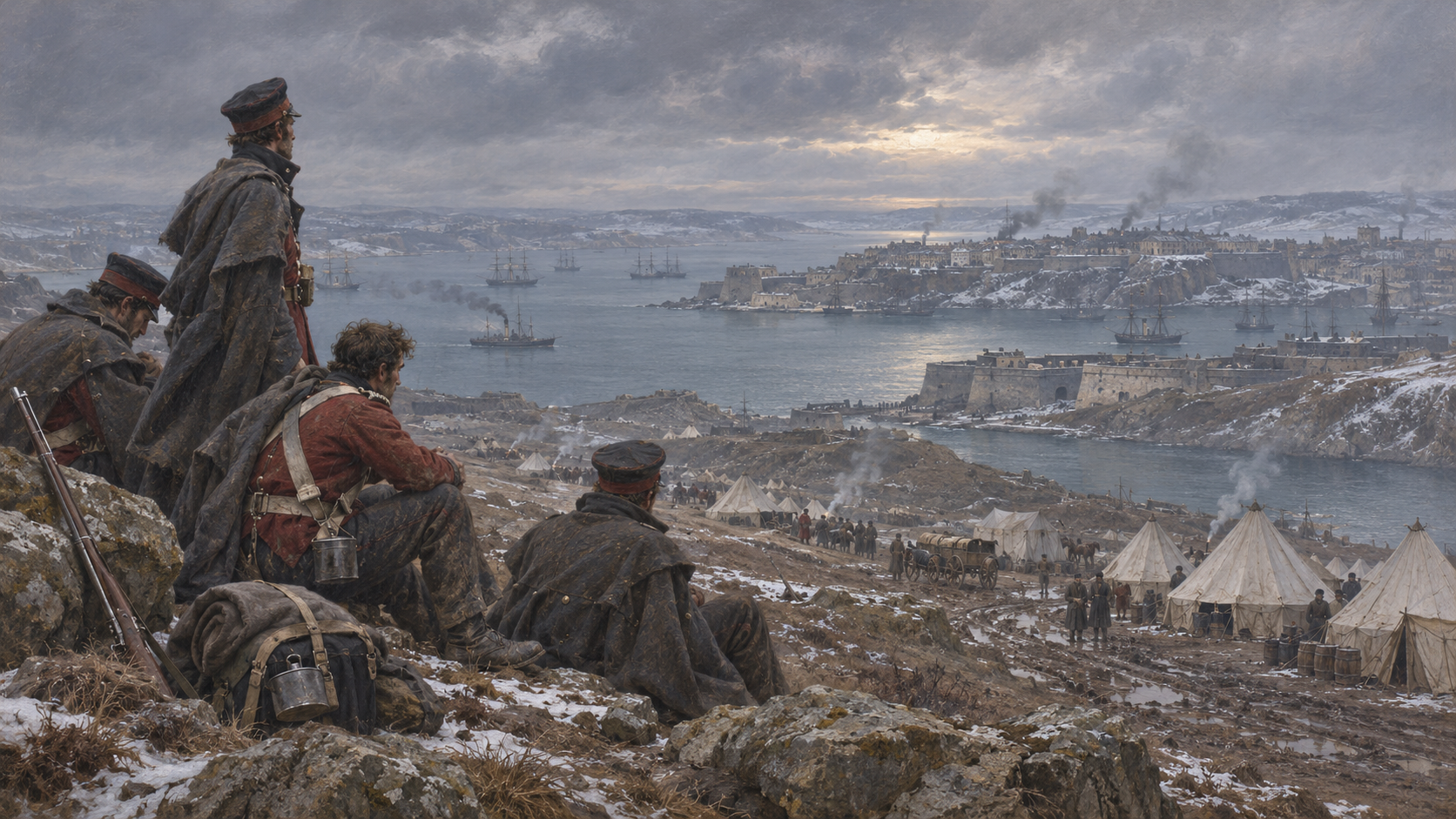
In September 1854, allied troops landed in Crimea and advanced towards Sevastopol, the base of Russia’s Black Sea Fleet. Their first major battle came at the River Alma, where Russian forces held the high ground. Among the troops sent up the slope were the 23rd Regiment of Foot, the Royal Welch Fusiliers. National Army Museum
The regiment’s museum at Caernarfon Castle records how Sergeant Luke O’Connor, already wounded, picked up the Queen’s Colour after the officers carrying the regiment’s colours were killed. He carried it up to the Russian earthwork and planted it there. The allies won the battle, but Sevastopol held out for nearly another year. For readers in Wales, the story at Caernarfon gives a distant campaign a local point of entry. National Army Museum
The war the public could read about
At Balaclava in October 1854, a confused order sent the Light Brigade down a valley towards Russian guns. Tennyson’s poem made the charge a story of courage under fire. The circumstances also raised a question about command that the poem’s fame can obscure. Who was accountable for sending those men down the valley? National Army Museum
William Howard Russell’s reporting for The Times brought other failures to public attention. Men were falling ill in appalling conditions, and the army struggled to keep them supplied through the winter. Florence Nightingale and her nurses cared for patients at Scutari, across the Bosporus from Constantinople. A government sanitary commission helped bring down the death rate by improving conditions there. Mary Seacole, a Jamaican-born healer and businesswoman, travelled independently to Crimea and ran the British Hotel near Balaclava. She supplied soldiers and tended to the sick and wounded. The two women worked in different places, and their stories show how much of the war was spent trying to keep men alive away from the battlefield. National Army Museum
What did the peace settle?
Russian forces abandoned the southern side of Sevastopol in September 1855. The Treaty of Paris, signed on 30 March 1856, ended the war and neutralised the Black Sea, barring Russia and the Ottoman Empire from maintaining war fleets there, apart from limited exceptions. The settlement curbed Russian naval power for a time. Geography remained the same. Sevastopol was still a valuable harbour, and the straits were still the Black Sea’s route to the Mediterranean. National Army Museum
Crimea returned to the centre of European politics in 2014, when Russia occupied and claimed to annex the peninsula. The UN General Assembly reaffirmed Ukraine’s territorial integrity and called on states to recognise no change in Crimea’s status based on the referendum held that March. The geography helps explain why the peninsula matters across both periods. The question of sovereignty today belongs to Ukraine’s internationally recognised borders. mandates.un.org
What stays with me about the Crimean War is the distance between the decisions taken in imperial capitals and the realities reported from the front. Governments talked about protecting Christians, keeping rivals in check and securing access to the sea. Soldiers discovered what those promises meant when winter arrived and their camps and hospitals could barely cope. The war is worth remembering for what happened in those wards as much as for what happened in the valley at Balaclava.


Leave a Reply