
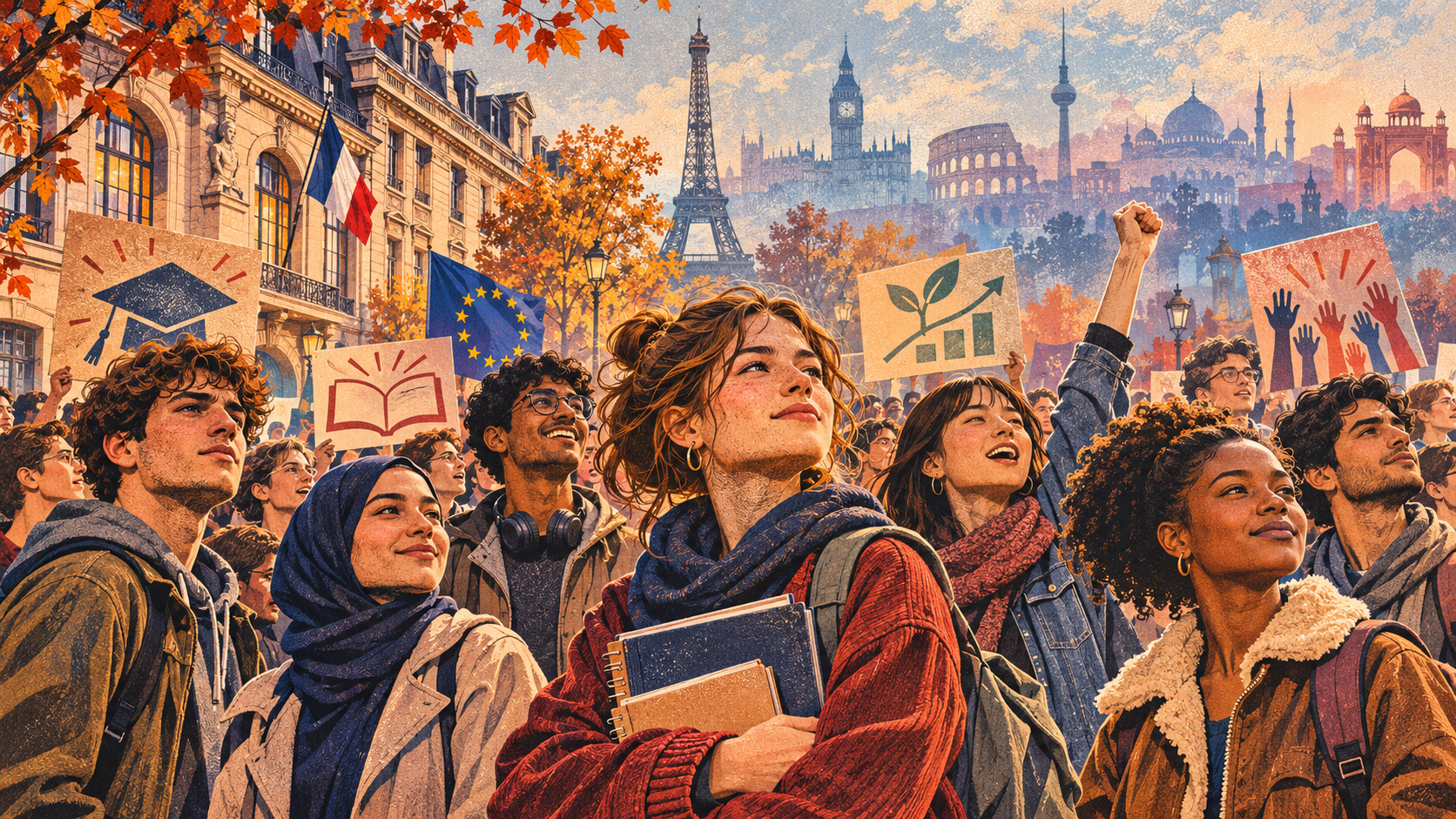
From French school blockades to South Asia’s political upheavals, young people are demanding a future they can believe in. Their success will depend on what follows the demonstrations.
A school ceiling falling apart might seem an unlikely starting point for an international political awakening. Yet when young people see neglected classrooms alongside rising living costs and politicians who appear unable to improve either, the connection becomes obvious. The condition of their school becomes a judgement on the condition of their country.
France’s student protests began in September over deteriorating school conditions, teacher shortages and dissatisfaction with university admissions. By late October, Germany’s “Gen Z regelt” demonstrations were demanding investment in education, healthcare and climate protection, affordable living and opposition to renewed military conscription. These are concrete arguments about the future governments are offering the young. Associated Press
For those of us watching from Britain, the questions are immediate. Could this energy produce meaningful change here? Are we witnessing a global youth movement? And should democracy welcome a generation becoming more confrontational?
My answer to that last question is yes—with the same democratic expectations we should apply to every generation.
Political participation is healthy. Its value depends on the methods people use, the rights they respect and the institutions they build.
Calling this an “awakening” requires some care. Young Europeans were political before these protests, and students on the streets cannot speak for everyone their age. What feels significant is the visibility of their anger, and the growing recognition that frustrations experienced individually might have collective political solutions.
The grievances also extend beyond education. The European Parliament’s youth survey, published in February 2025, identified living costs as the leading priority among respondents aged 16–30, followed by climate and environmental concerns, then the economy and jobs. That age range is broader than Gen Z alone, but it helps explain why a dispute beginning at the school gates can resonate much further. European Parliament
The underlying political question is powerful: what does society owe those who will inherit it?
If education offers diminishing security, independent housing feels unreachable and public services struggle, telling young people to be patient becomes an increasingly weak response. Governments have to offer a credible route to improvement.
South Asia shows how quickly accumulated frustration can transform politics. Sri Lanka’s uprising in 2022 helped force President Gotabaya Rajapaksa from office. Bangladesh’s student-led mobilisation in 2024 brought down Sheikh Hasina. In Nepal, protests against corruption and a social-media ban forced Prime Minister K. P. Sharma Oli to resign in September 2025. These were different national crises, and Sri Lanka’s movement in particular involved a broad coalition across generations. Describing them all simply as “Gen Z revolutions” obscures part of their strength. Associated Press
They nevertheless demonstrated something young Europeans can recognise: established leaders can become vulnerable when enough people stop accepting that political failure is inevitable.
But “successful revolution” needs a definition.
Removing a leader is an immediate, visible achievement. Establishing accountable government, protecting minorities, creating jobs and ending corruption require years of political work.
The electoral aftermath already reveals different outcomes. Nepal’s Rastriya Swatantra Party won 182 of 275 parliamentary seats in March 2026, delivering a major breakthrough against established parties. In Bangladesh, February’s election instead brought a landslide for the long-established Bangladesh Nationalist Party; the youth-led National Citizen Party won only five of the 30 seats it contested. Protest leadership did not automatically translate into electoral dominance. Associated Press, Reuters
As Chatham House’s assessment of the region argues, new mandates now confront difficult governing realities. Political renewal must survive economic constraints and the practical demands of delivering change. Chatham House
That is the lesson Europe should take seriously.
European protesters could prove highly effective without reproducing South Asia’s upheavals. In a functioning democracy, securing enforceable reforms through public pressure and elections is a substantial achievement. A government’s collapse is a poor universal measure of progress.
For Britain, useful tests would include whether youth mobilisation changes housing policy, improves education and training, strengthens employment prospects or produces better representation. Those are proposed measures of success, rather than a claim that British young people share one agreed manifesto.
The strongest movements would connect students with apprentices, young workers, tenants and older people who share their concerns. A campaign becomes harder to dismiss when its demands make sense beyond the campus.
It also needs enough organisation to negotiate, scrutinise promises and keep going when attention moves elsewhere. Demonstrations can force an issue onto the agenda. Budgets, legislation and implementation determine whether anything changes.
There is evidence of an international wave. Reporting from Europe describes activists drawing inspiration from neighbouring countries and using social media to circulate protest tactics and messages. Yet the movements retain their own organisations and national demands. Inspiration travels more easily than a common political programme. CNA
My reading is that the shared ambition is a demand for a fairer relationship between effort, opportunity and political power. Young people want public institutions that work, a reasonable chance of economic independence and leaders who answer for failure.
That leaves enormous room for disagreement. Climate policy, taxation, migration, defence and public spending involve choices that a generational label cannot resolve. Gen Z contains competing political traditions, personal interests and ideas about society. No protest organiser has a mandate to erase that diversity.
Democracy should welcome their involvement precisely because those disagreements need public expression.
Peaceful demonstrations, campaigning, union activity, community organising and standing for election all give people ways to influence decisions between ballots. They can expose problems that established parties overlook and bring new participants into public life.
The democratic obligations run both ways. Protesters must respect other people’s safety and political rights. Governments must protect peaceful assembly, respond proportionately and investigate misconduct by the authorities. Violence and intimidation undermine democratic participation whoever commits them.
Nor does being young make someone automatically democratic. A movement strengthens democracy when it accepts pluralism, protects minorities, permits criticism and recognises that opponents also have a legitimate voice. The same standards apply to its leaders once they gain power.
Europe’s young protesters may be opening a valuable political moment. Whether they sustain it remains uncertain. Their greatest opportunity is to turn public frustration into specific demands, broad alliances and institutions capable of delivering them.
For Britain, that should be an invitation to listen and engage. A generation asking for a meaningful stake in its country’s future deserves a serious political response.
The students at the school gates have made themselves visible. Lasting success will mean being able to point, years later, to what their participation helped improve.


Leave a Reply