
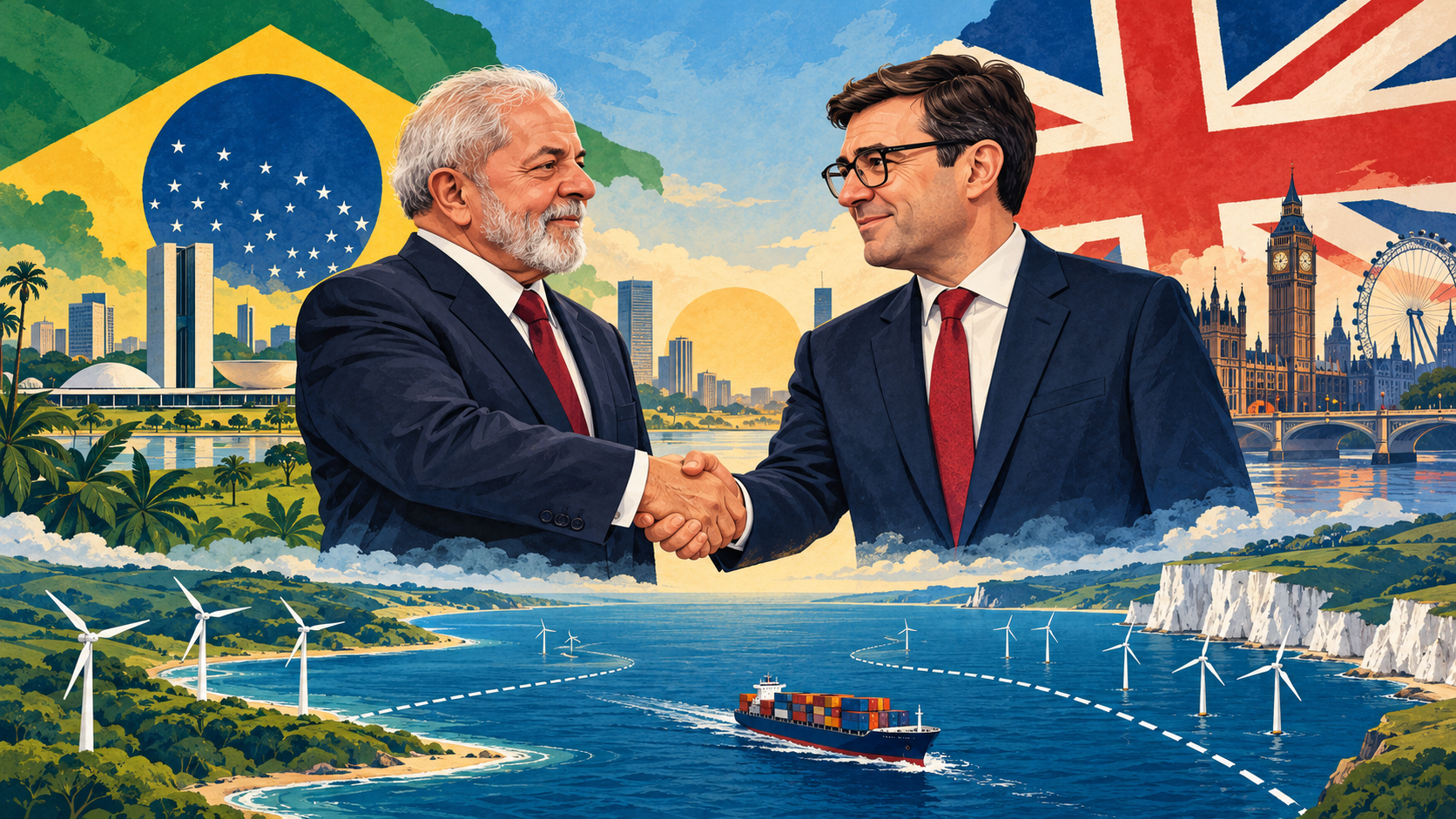
Lula’s re-election in Brazil is good news for the international left. For Andy Burnham’s Labour government, it also creates an opportunity to build a stronger political partnership with a major economy whose leadership shares a commitment to tackling poverty, strengthening public provision and making economic growth work for ordinary people.
Brazil’s electoral authorities confirmed that Luiz Inácio Lula da Silva won the presidential run-off on 25 October with 51.79% of valid votes. His victory gives Britain an opening to deepen a relationship that could deliver practical benefits on both sides of the Atlantic. Brazil’s election result
Burnham should seize it. A Labour government seeking to rebuild public services and spread prosperity across the United Kingdom needs international partners willing to discuss what governments can achieve through investment, cooperation and democratic control.
Lula offers the prospect of a powerful ally in that argument.
A shared political language
There is a natural basis for cooperation between the British labour movement and Lula’s Workers’ Party: the conviction that working people deserve a greater share of the wealth they create, and that public policy should actively reduce inequality.
Their countries face different circumstances, and neither government can simply transplant the other’s policies. But they can learn from each other.
Burnham’s experience of bringing Greater Manchester’s buses under public control gives him a concrete example of public intervention to bring to those discussions. His government could use a closer relationship with Brazil to exchange ideas about transport, healthcare, regional development and the delivery of essential services. Burnham’s record in government
For the left, this matters politically as well as administratively. International cooperation can help demonstrate that ambitious social policy belongs at the centre of economic government.
An economic relationship with room to grow
The commercial foundations already exist. The UK government’s Brazil market guide records approximately £13 billion in bilateral trade during 2025. It identifies opportunities in clean energy, life sciences, financial services, and food and drink. Brazil is South America’s largest economy: a substantial partner with which Britain should build a lasting relationship. UK–Brazil trade and market guide
The question for Labour is what kind of trade it wants to encourage.
A progressive approach should judge success through better wages, productive investment, stronger skills and reliable employment. More trade is valuable when its benefits reach the people doing the work.
Burnham should therefore champion partnerships that connect businesses, universities, trade unions and public institutions. Joint research, apprenticeships and industrial projects could give the relationship substance beyond ministerial visits and commercial announcements.
There should also be a clear place for Wales, Scotland, Northern Ireland and England’s regions. A partnership with Brazil ought to create opportunities for manufacturers, researchers and smaller businesses across the UK.
Make clean industry the centrepiece
Clean energy and industrial renewal offer particularly promising ground.
The UK and Brazil have already established an Industrial Decarbonisation Hub to coordinate support for Brazil’s transition towards cleaner industry. That gives both governments something practical to develop. The joint industrial initiative
Burnham and Lula should push for projects that combine lower emissions with secure employment: cleaner manufacturing, improved energy infrastructure and training that helps workers move into growing industries.
Any public support should carry clear expectations about labour standards, local benefits and environmental protection. Communities need a stake in the transition and evidence that it will improve their lives.
Build on the agreement already signed
There is no need to begin with a blank sheet of paper. In March, the two countries signed a Strategic Partnership covering 2026–2030, including trade, sustainable development and political cooperation. Lula’s renewed mandate offers a chance to turn those commitments into sustained action. UK–Brazil Strategic Partnership
Burnham should propose an early meeting with Lula, followed by a public programme of joint priorities with deadlines and measurable results. Trade unions, regional leaders and civil society should help shape that programme.
An ally with an independent voice
Political friendship will still involve disagreement. Brazil has its own interests, domestic pressures and international relationships. A mature partnership must allow both governments to speak honestly and challenge each other.
Britain should approach Brazil as an equal, with something to learn as well as something to offer. Cooperation will be stronger when it respects Brazilian sovereignty and takes environmental protection, Indigenous rights and workers’ rights seriously.
Lula’s victory creates an opening for a confident Labour internationalism: outward-looking, economically practical and rooted in solidarity.
Burnham now has the opportunity to turn shared political instincts into jobs, investment and a stronger international voice for the left. He should make that partnership a priority.


Leave a Reply