
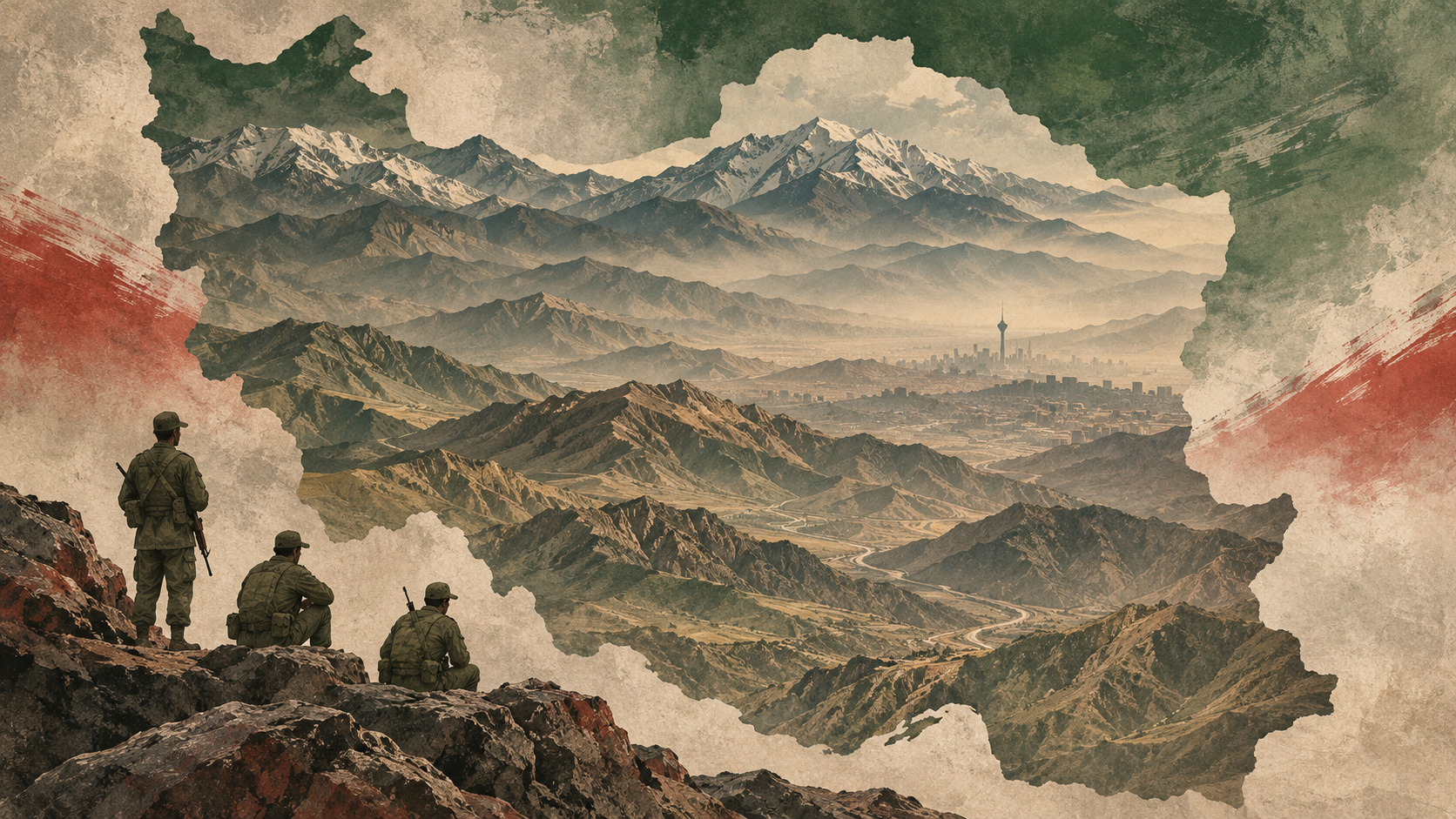
An invading army could inflict devastating losses on Iran’s Revolutionary Guards. Turning those losses into lasting political control would be a much harder task.
The Islamic Revolutionary Guard Corps could lose battles and remain a formidable obstacle to anyone attempting to control Iran. That is the central distinction in assessing its ability to withstand a foreign invasion.
Against a sustained American-led campaign, the IRGC would face a serious disadvantage in conventional warfare. Its prospects would become more complicated—and potentially stronger—if the conflict developed into a prolonged struggle over territory, government and occupation.
This is an assessment of a possible ground invasion, rather than a prediction that one will happen. The experience of the 2026 conflict already offers an important warning: destroying military assets and forcing a government to surrender are different achievements.
What would “withstanding” an invasion mean?
A limited operation to seize a particular site would present a different challenge from an invasion intended to overthrow Iran’s government. Occupying the country would demand more again.
The Congressional Research Service’s September 2026 assessment described an Iranian government that remained in power despite unprecedented leadership and material losses. It also treated the introduction of foreign ground forces as a possible escalation, with outcomes extending well beyond straightforward military victory. Congressional Research Service
The IRGC’s chances therefore depend heavily on the attacker’s objective. Preventing every foreign advance would be a demanding standard. Preserving an organisation capable of continued resistance would be a lower threshold.
The Guards would not fight alone
The IRGC is only part of Iran’s military establishment. Iran also has its regular armed forces, the Artesh. The Guards combine military responsibilities with a commitment to preserving the Islamic Republic, while the Basij provides an associated mobilisation and internal security network.
This matters because the survival of individual IRGC formations would not tell us everything about Iran’s defence. Cooperation between institutions, the continuity of government and the willingness of personnel to keep fighting would all shape the outcome.
Iran’s longstanding approach reflects its awareness of stronger opponents. Research published by the International Institute for Strategic Studies describes “Mosaic Defence”: a doctrine developed after the invasion of Iraq that envisages dispersed resistance, including guerrilla warfare if territory is lost. This is evidence of preparation and intent, rather than proof that the system would work under invasion. IISS
Its conventional weaknesses are substantial
The 2026 fighting has demonstrated the vulnerability of Iranian military infrastructure to sustained air attack. ACLED’s early assessment documented extensive strikes against air defences, missile facilities, naval infrastructure and leadership targets. It also described significant degradation of Iran’s military capabilities. ACLED
My assessment is that an American-led invasion supported by sustained air superiority would place severe pressure on organised Iranian ground forces. Moving reinforcements, maintaining supplies and coordinating large formations would become increasingly difficult.
The Guards’ reputation for determination cannot remove those material problems. Political commitment does not replace functioning communications, equipment or logistics.
However, air superiority would not establish control over every town, road and community. An attacker could achieve considerable freedom to strike while still facing persistent resistance on the ground.
Survival is the IRGC’s stronger proposition
The strongest case for IRGC resilience rests on its ability to continue functioning after heavy losses.
A September 2026 Hudson Institute assessment argued that the Guards’ missile and drone forces had suffered substantial attrition without organisational disintegration. It also assessed that Iran’s dispersed drone industry could recover faster than its missile production capacity. These are analytical judgments, and should not be read as independently verified inventories of surviving weapons. Hudson Institute
Continued resistance would not require the Guards to match an invader’s firepower. It would require enough surviving personnel, supplies and organisation to keep imposing costs.
Iran’s extensive territory and mountainous terrain would add to the demands of occupation. Yet geography offers opportunities rather than guarantees. Dispersed units can survive more easily while becoming less capable of coordinated action.
Public support is the greatest uncertainty
It would be a mistake to assume that opposition to the Islamic Republic translates into support for a foreign invasion.
Equally, resisting an invasion would not necessarily mean accepting IRGC leadership. Iranians could oppose foreign forces while also rejecting the political system the Guards protect.
The relationship between those positions would be decisive. A prolonged resistance needs cooperation, recruitment and access to resources. Coercion may secure temporary compliance while undermining the support required to sustain it.
Early in the 2026 war, ACLED found little evidence of the rapid internal fracture or mass defections on which some expectations of regime collapse appeared to depend. That observation challenges assumptions of immediate collapse; it does not establish how Iranian society would respond to occupation. ACLED
A difficult force to defeat politically
My judgment is that the IRGC would struggle to stop a major American-led invasion through conventional military resistance alone. Its ability to survive, disperse and contribute to prolonged resistance would be considerably more credible.
Neither outcome is certain. Institutional cohesion could weaken, supplies could run short and public cooperation could disappear. Conversely, an invasion could generate resistance extending far beyond existing supporters of the government.
The essential question is what an invader would need to achieve after the initial battles. Capturing territory, dismantling the Guards and establishing a government accepted by Iranians are separate challenges.
The IRGC could suffer a devastating military defeat while leaving an occupying power with a costly, unresolved political struggle. Any serious discussion of invading Iran has to account for that possibility.
Assessment dated 3 November 2026. Battlefield claims and estimates of surviving capabilities remain uncertain.


Leave a Reply