
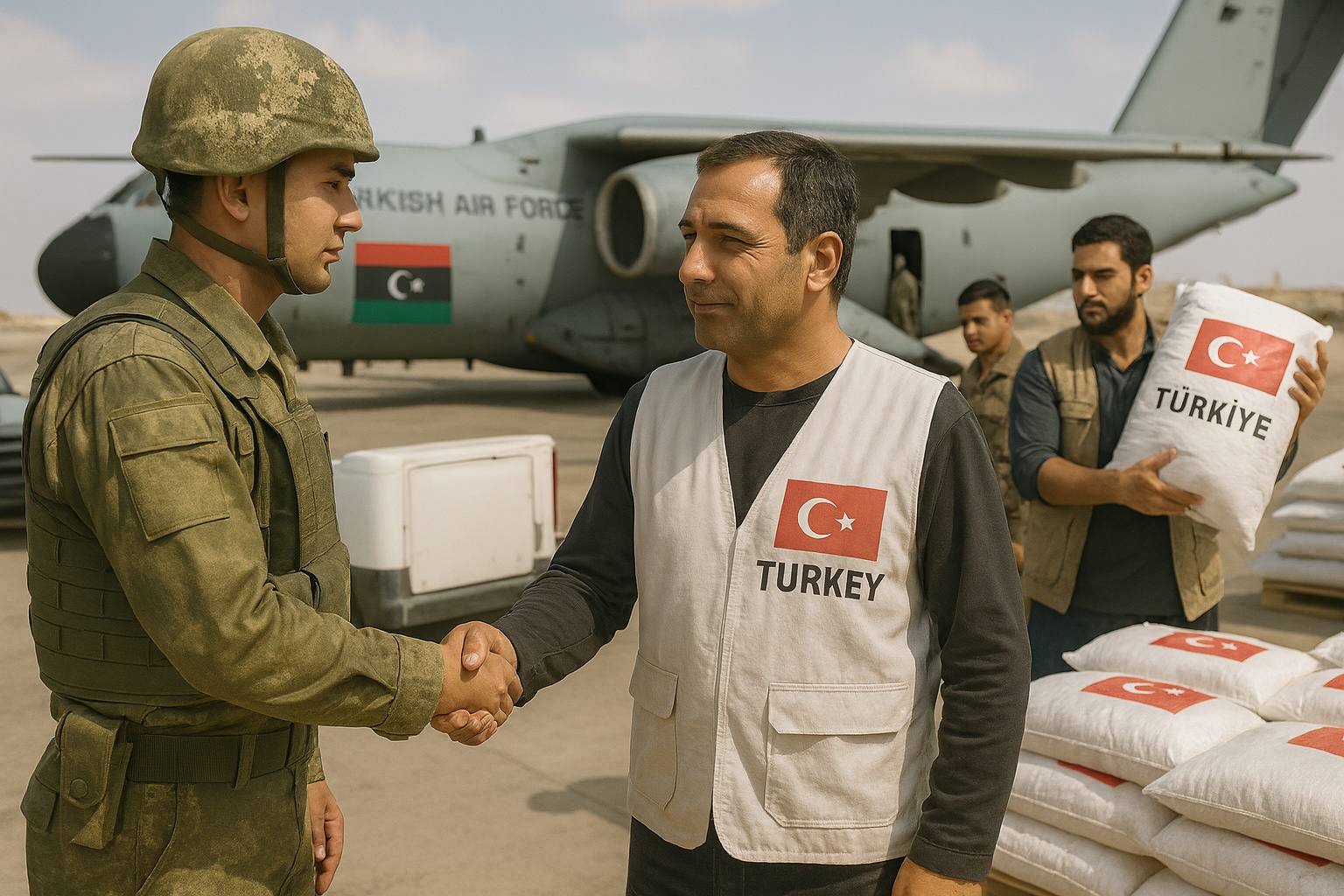
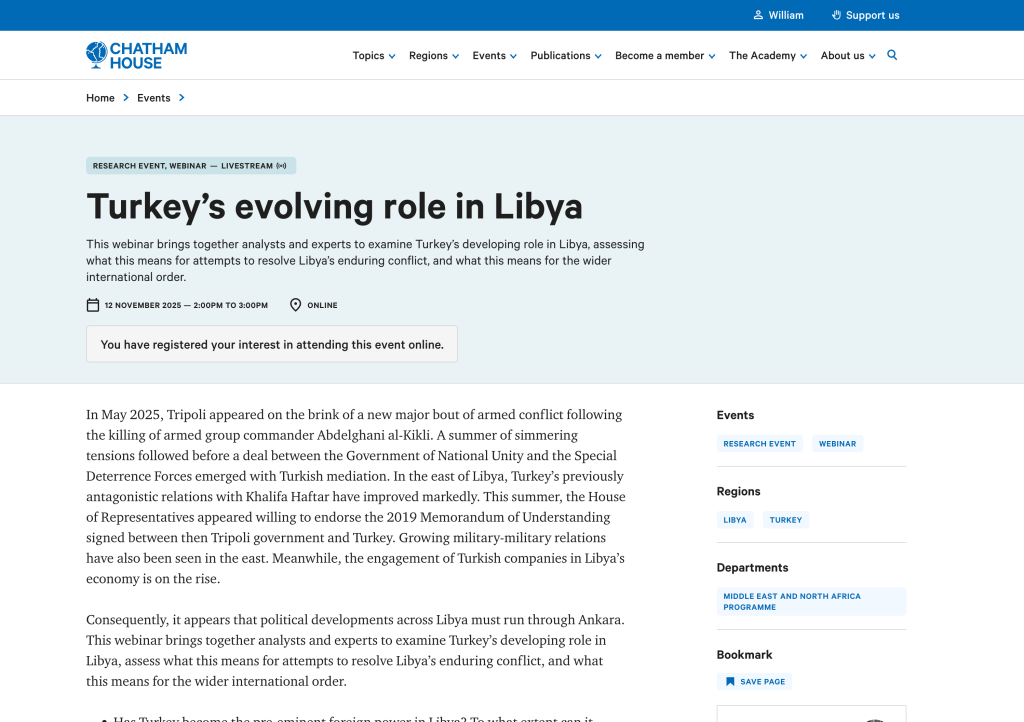
New violence had broken out in Libya and increasingly the Turkish government in Ankara are wielding influence, both politically and militarily in Libya.
The speakers for this seminar are: Emaddedin Badi, Senior Fellow, Global Initiative against Transnational Crime; Tim Eaton, Senior Research Fellow, Middle East and North Africa Programme; Nebahat Tanriverdi Yaşar, Visiting Fellow, Centre for Applied Turkey studies (CATS), German Institute for International and Security Affairs.
Why is the discussion focused on Turkey’s role in Libya? Turkey have become every more apparent in the involvement of Libyan affairs. In the East of Libya, Turkey’s previous antagonistic relationship has become closer to the military there, supplying training and also a memorandum on drilling rights in the Eastern Med.
Turkey seeks to be an influential regional power. Libya identifies with Turkey’s increasing defence posture. It has started to act independently from Western allies. This can be seen in the way it has acted in Syria and Iraq more recently. Libya has become a testing ground for Turkey’s stabilization model. It has used drones and local partnerships to achieve objectives with limited costs. The focus has transferred toward security assistance. There has been a wide redirection of foreign policy, away from idealistic to pragmatic. Turkey wants its economy at the heart of regional infrastructure and Libya is a central pivot in this MENA geographical area. Turkey aims to overcome its existing limitations. There is a fragile security situation in Libya, putting Turkish personnel at risk. It aims to move beyond towards a more balanced and sustainable power structure. It is reaching out to the East of Libya and also focusing on consolidating power and influence in Tripoli. It is aiming to be non-factional and universal in its balance of support. Turkey wants Turkish companies to benefit from Libyan reconstruction. Libya is an intersection for the interests and priorities of the Turkish State. This is at a strategic and tactical level.
In 2025 there was a clear potential for conflict in the capital between opposing political faction. Did Turkish influence prevent a conflict? There are political tensions as security arrangements that currently exist are nit set in stone. The summer close conflict and its causes have still not been resolved and tensions remain. WIth GNU leadership ie. Prime Minister and stakeholders surrounding him, the relationship with Turkey is at an all-time low – The deterioration of relationship with Prime Minister is not reflected throughout as other members of the GNU like defence minister have good relations. Turkey’s role in diffusing the summer tensions was by: Coercive intervention. Hard attempt at deescalation, also direct mediation. Turkish intelligence chiefs visited Tripoli. Turkey, however, was not able to diffuse the tensions. They just put a lid on the situation. In Libya they are gearing up for conflict. Turkey prevented an escalation to war and it did this decisively. But this is temporary. A prolonged war down the line, however, looks likely and a threat in the East of Libya looms large. An idea that stabilization is possible through this rubric is a fantasy and not reality.
WHat is Turkey’s relationship with other states and how does this affect its Libya policy? is the UN roadmap a threat to Turkish security right now? In addition to Qatar there is a growing co-ordination with Egypt, Italy and the USA. They seek pragmatic co-ordination with Egypt in Libyan intervention. Countries share a mutual interest in preventing hostilities in Libya. There was unity between Egyptian and Turkish firms who completed the reconstruction of Tripoli airport. In Italy, Turkey seeks a European partner to assist in interventions in Libya. There is a consensus between Turkish and Italian energy firms. They seek to counter-balance Russia. Ankara’s border interventions in the Eastern Mediterranean continue to cause concern. Turkey is more open to co-ordinate with the US in Libya. Turkey and Russia have maintained a ceasefire in Libya, like in Syria. Turkey’s perspective towards Russia, they see that Russia limits Turkey’s operational freedom. They believe there is an opportunity due to Russian retreat from Syria and Armenia. Turkey has a rapprochment with East Libya. There will seemingly be a situation there like the Sahel.
Turkey aims to legitimise its presence in Libya through the UN. Main concern is if elections produce a bad outcome for Turkey, the whole strategic situation for Turkey could radically alter.
What has Turkish engagement in Eastern Libya achieved? Turkey has turned a corner with the East. Eastern-based power-brokers are Haftar and the EHR. The Afro-Asia policy towards Eastern Med is better served to Turkey by dealing with political actors in the East. There is a clear interest there too for the Turkish defence industry. Egyptian policy differs with the Turkish in this area. There are differences in Turkish ambitions and the Haftar’s decisions to centralize command. Turkey is likely to face a dilemma with Khalifa Haftar. WHat are the contours of a political deal in Libya? Russia and Turkey are important players and can often see eye to eye in policy in Libya but agreements are less likely with the Egyptian stakeholders. The Turkey-US relationship has agreement on some issues, however, the Turks do not fully co-ordinate with the Americans.
There have been issues with trying to get Haftar’s sons to create a political coalition in Parliament. The effort to mobilise a wider set of stakeholders has been full of cracks. It is difficult predicting votes. The Haftars have down a lot of effort in dividing and ruling in Eastern Libya. Foreign visitors tend to visit the Haftar sons.
What attitude has Donald Trump had towards the Turkish role in Libya? There are opportunities here for oil companies etc. What are Turkish perspectives of the US? The two parties can talk and agree on an agenda. The military and political basis has to be expanded.Both sides agree on this. They both want to sever the Russian influence in East Libya. Co-ordination will remain limited, however, despite some mutual business interests eg. with energy firms. Overcoming existing fragmentation sees certain disagreements. the coastline with Eastern Med sees the USA and Turkey having different regional policies and interests. Turkey does not follow a strict political formula. Turkey’s intent is less about control or to produce outcomes but seeks more sustainability. In the long run there is likely to be better co=ordination between Turkey and the USA.
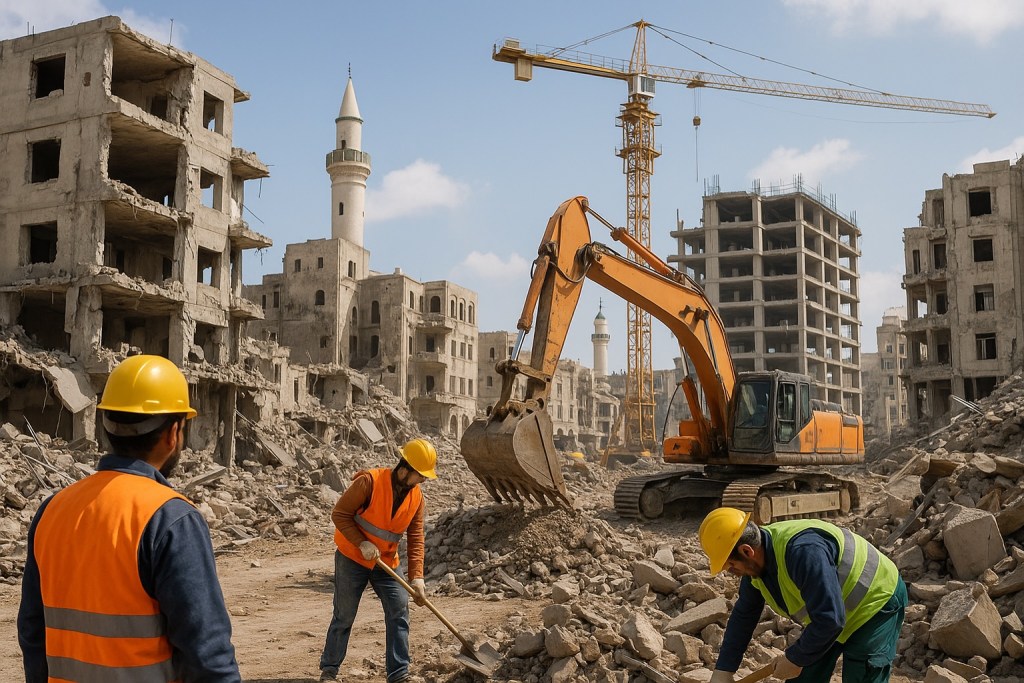
What is the wider engagement of the Turkish commercial sector, other than oil and gas companies? A lot of delegations are going to Libya, to get payments as debts are high. They are also seeking lots of new reconstruction contracts. Deals are being made in infrastructure projects. Major construction in Libya is very lucrative. In Syria comparatively the financial burden is a lot less. The Turkish are targeting the Libya market a lot and expand the export trade and Libya is seen as a gateway to the North African and African markets.
How can corruption be mitigated in Libya with foreign investments? The Haftar family has set up their own reconstruction company and this does not report back. There is opportunity for rife corruption. Many elites see consolidation of their authority through privatizing State assets and developing commercial interests. A Major US Oil firm needs to be there long terms and investments are complex and long term. With th corruption it can be a risky bet. Libya’s institutions need to work for this but are often closed in their set up.
Turkey is not the sole stakeholder. It is building commercial ties despite the sclerotic politics. Putting it bluntly there are three pools of money – The National Development Agency , the National Reconstruction budget and the National budget in Tripoli. The first two are likely to be combined into one central authority that will be divided between the two governments but this is likely to enhance corruption. There are political repercussions as military issues are involved. Political and security repercussions result from any commercial investments and Turkey is concerned that it will upset the balance.
Turkey is spinning many plates and there are nuances. Turkey’s dilemma is that despite economic investments, Turkey is also exporting certain issues, including its own problems – such as corruption and potential political unrest.
It will be interesting to see how Turkey’s involvement in Libya continues to develop.It is a key part of their foreign policy and Turkey perhaps holds the keys to maintaining stability and peace in Libya.
Discover more from Wez G Official Website
Subscribe to get the latest posts sent to your email.