

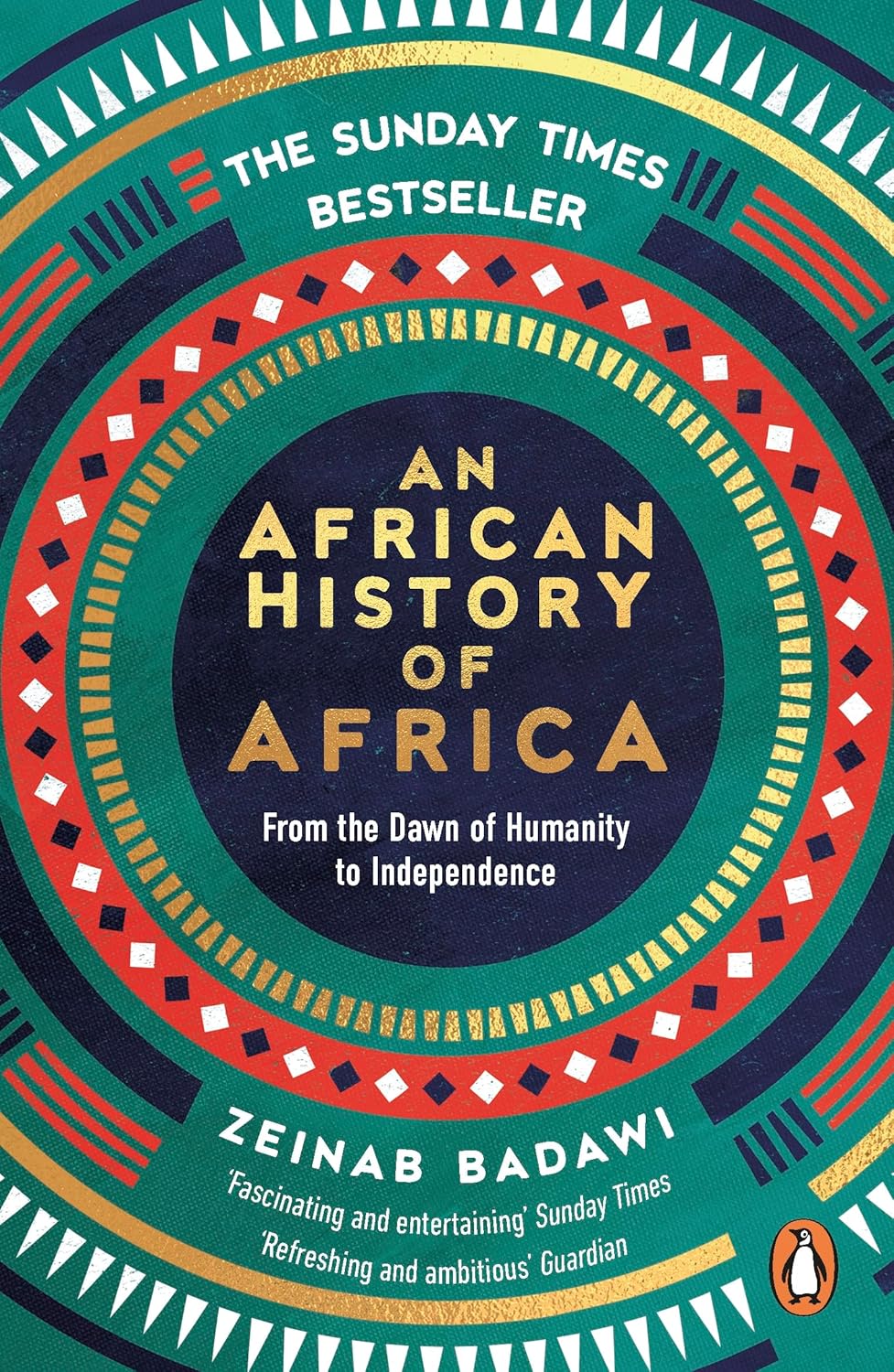
I’ve always been a fan of BBC Presenter Zeinab Badawi and I was encouraged to buy the book by this fact when I saw that she was the author. Zeinab was born in Sudan so hails from the Dark Continent, ie. Africa. She is currently President of SOAS, an excellent education institution, part of the University of London, and, indeed, I used SOAS library books for my own African studies for my UCL Geography degree on the Tropical Africa module. Having said that, my knowledge on Africa is scarce and limited. I have never set foot on this continent and my knowledge of history there is, as Badawi criticises, written by the White Man, the coloniser and it tends to be a history of the conqueror – the vanquished find little voice in the Imperial texts, who record their own bias about contact with African natives. I suppose one of the most enlightening aspects of this book is that Badawi always approaches material wearing Afrocentric goggles. She seeks out experts and researchers who have direct experience or are renowned in the shift in education since decolonization and independence for the vast majority of African States. We explore the roles of various different parts of this rather large and populous land mass. I expected slavery to feature as a topic as I am aware of the transatlantic slave trade perpetuated by Great Britain among other European nations. There is a lot of current talk about reparations for the damages done by slavery to native populations but to be frank I am in two minds about this and do not see why current British people should have to pay huge sums for the sins of their ancestors, during a time when values were rather different. I wonder what these vast sums of money might be put towards and I could readily envisage much corruption causing a lot of the funds to disappear in the hands of tyrannical African dictators and privileged elites. I think there are better ways of addressing the post-colonial legacy and slavery that would have a more profound and lasting effect than simply cash. Racial tensions would probably rise in the event of populations in Western nations being taxed heavily and this would be counter-productive. Regarding slavery I was surprised to learn that the Arabs on the East of Africa were also slave-trading and indeed probably more so than their Atlantic counterparts. Arab traders in the Indian Ocean tended to favour women slaves rather than the men required for Cotton Plantations in the Caribbean, The Indian Ocean slave trade continued long after it has been abolished by Western European nations.
The conquest of North Africa by Islam is interesting and a history I had scant knowledge on. For me, the real treasures of the book, however, were the stories of great African Kings and Kingdoms and tribes. Often colonial histories have portrayed these native African heroes in a negative light and have undermined their contribution to civilization and global society. Africa is typically characterized as being backward and undeveloped and uncivilised and its only progress allegedly brought to it by European colonisers.
Mansa Musa is a historical African King with Empire. He ruled in West Africa in the fourteenth century, governing the Mali Empire. He has a credible claim to being the richest individual who ever lived. A lot of his wealth came from Gold and he successively set up and traded in international markets. He made an infamous ‘hajj’ to Mecca, carrying his retinue in a huge caravan, journeying across Africa and lavishing a great quantity of uber-wealthy treasures as gifts upon all who he encountered, indeed people took advantage to such an extent that his economy and prestige were severely damaged due to his over-generosity. It is a great tale of adventure from the Middle Ages. Timbuktu was turned into a legendary city and although it is now a more or less abandoned desert outpost, at the time of Mansa Musa it was a great global city and represented a high point of African civilization and culture.
I found the story of the Zulus and Shaka Zulu fascinating and is something that I was, perhaps, a little more familiar with. He was a great foe to the European colonisers and a hero to many Southern Africans. He paved the way for Nelson Mandela to emerge to end Apartheid and to bring South Africa back under Black African rule. There is often a conflict between Europeans and Africans across the continent. Trade, slavery, exploitation, divergence of cultures. It is a constant theme on the African continent. The telling of histories varies and although most knowledge we have on our Western universities may slate the development of Africa and there is a tendency to regard it as.a backward place, there were most certainly advanced cultures and civilizations in Africa. All of humanity sprang from Africa at some point so to denigrate its history is to deny our own ancient ancestors and forebearers. I found great hope in the reworking of African history in post-colonial African education centres by African professors to be a very positive aspect of this book, something that Badawi focusses on clearly.
The book is an essential text to anyone with interest in the Global South, international politics or indeed Africa. I would recommend reading it to learn something new that is not necessarily mainstream knowledge.
Discover more from Wez G Official Website
Subscribe to get the latest posts sent to your email.