


PHOTO: The new Syrian Government
Today’s Chatham House meeting is chaired by Raya Jalabi, Middle East Correspondent, Financial Times. On the panel are: Dr Haid Haid, MENA Programme, Rime Allaf, Syrian writer, formerly Chatham House and Dr Ibrahim Al-Assil, Belfer Center, Harvard University.
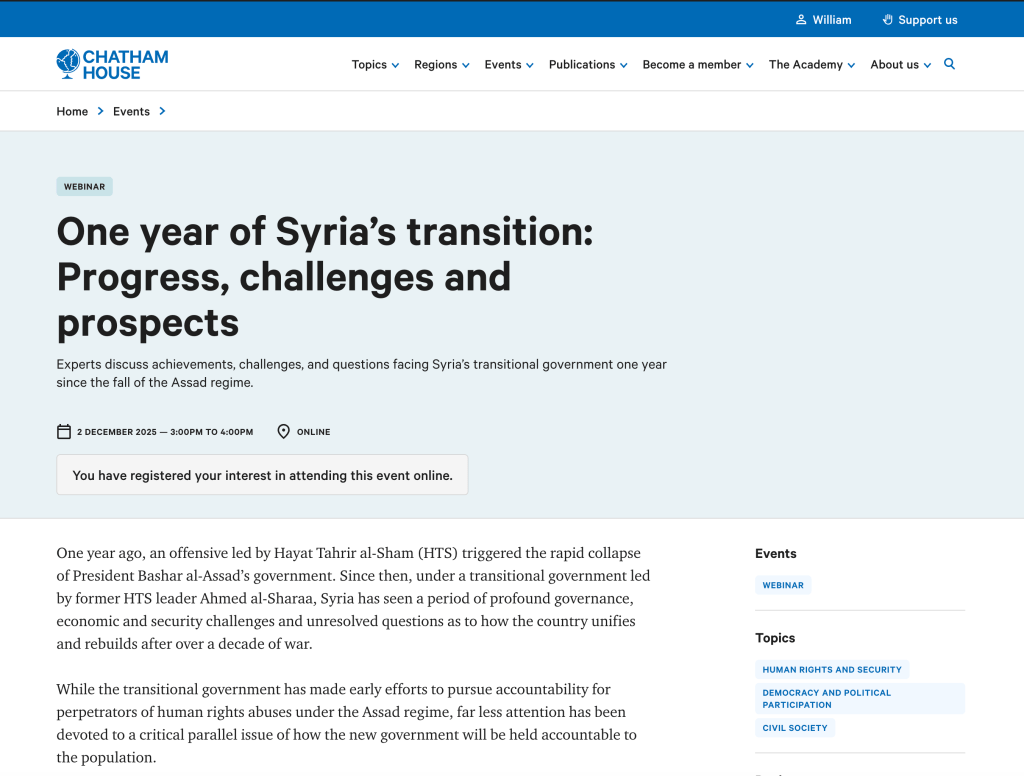
It is a year since the rapid disintegration of President Assad’s government and the fall of the regime. After years of devastation and conflict the new transitional government have had to tackle the crisis. What has this transitional government achieved and what challenges does it face?
The roadmap has almost been completed. Ahmed al-Sharaa who leads the government has tried to be inclusive and to achieve everything. A national dialogue is supposed to have brought all actors together to discuss the new State. This did not play out well. The constitutional declaration was not seen positive by many as it concentrated powers with al-Sharaa. The selection of people in the government do not reflect upon Syrian society. Has the political economy emerged in a certain direction? They have tried to root out corruption among former government officials. There is a lack of transparency. Business owners in Damascus are reporting that government officials are trying to muscle in on business. There is a tightly-controlled centralized style of government. Despite the appointment of technical ministries, everything is tightly controlled in the hands of a few, costing the country many opportunities. Will this change after the first year of the transition? There has been space in civil society for people to speak freely and demonstrate. This is not universal, however, and is better in Damascus than in other areas where the older legal frameworks are still being used. Political parties will be allowed and this is the main challenge to allow this. A clear answer is not being given with regard to this by the transitional government.
There is a general malaise after initial euphoria after the Fall of Assad. There is a huge dichotomy between what is being promised and what is being seen long term and in daily life. The lowest common denominator is how to survive from day to day. Damascus is bursting at the seams with people from all over the provinces. Electricity, power cuts and water supply are critical and drastic issues affecting daily lives. People are living with these basics at the forefront and are negative and need the government to sort it out. Life is expensive as the currency has collapsed. These factors draw the attention of most people. There is a chasm between the haves and have nots, especially seen in Damascus. There are the wealthy traditional elites and mass begging with vast numbers on the streets, desperate.
Do many Syrians want to come back who have left during the civil war? Some have failed to make it abroad and want to return and others want to return to invest but the opportunities are lacking and these people are disappointed when they return. There has been a huge increase in electricity prices – up suddenly by 500-600% This affected everyone. The government seem to be governing by trial and error. The government do listen and make decisions when things are deeply unpopular.
What about transitional justice? How are crimes of the former regime being tackled? There is no clear vision and process. It is being handled ad-hoc by the authorities. Certain high-ranking figures are walking around, having made deals with the new government. This angers many people. The government say it is realpolitik and that too many people would have to be prosecuted and. it is unrealistic. Some crimes are being addressed but it isn’t being done on a wide scale.
There is fragmentation, eg. with the Kurds in the north-east. Could we see. more fragmented country into the future? Fragmentation is reality in Syria but there is space for negotiations. Syria is not united and it will be difficult to make it united. In different regions people lived the war differently. Regime-controlled areas, rural areas. Each area built its own political networks. Each area: The Druze, The Kurds – they expected negotiations and settlement, not centralized control. The geopolitical considerations involve Turkey and Israel who have influence. These countries seek buffer zones. There are divergent security realities and the external actors maintain the fragmentation inside Syria. The Druze and Kurds didn’t want to be integrated. The Kurds want constitutional guarantees, cultural rights and decentralization. The Druze want to be at the table for negotiations. Damascus have been trying to avoid violence but in other ways it has tried to enforce a centralized system. The leader, Ahmed al-Sharaa, has either been pragmatic or has tried to impose force.
Will the SDF be integrated into the government with its control of the revenue-generating oil-fields? The army needs to be Syrianized. Assurances need to be there for unity to be developed. The shadow of the Syrian National Army has influence from Turkey and the Kurds have ideas on the integration. What is the State of the Syrian Armed Forces? All of the major groups have agreed to join. The unification is not as real as the defense minister might indicate. Will full integration be allowed with the Kurdish and SDF issues still outstanding. There is a lack of trust between minority-aligned forces and Damascus and also Sunni factions. The lack of trust will not disappear overnight. The integration is being talked about as a technical exercise. The reality of a unified army is more complex. Most of the integration issues are political issues that still need to be addressed.
Foreign fighters were integral to HTS success. Will these forces be integrated into the army? Factions are being formed around these fighters that are being integrated. Some, however, remain outside of the framework. There has been direct confrontation between government forces and a small French armed group where the government had to back down. The leader here is a criminal and has resisted arrest. WHen the government has better control issues such as these can be dealt with. This needs to be sorted quickly though.
How are Syria’s international relations? Turkey, Israel, Russia? Turkey have a veto power. Do they influence the government? al-Sharaa is his own guy and has his own agenda. The foreign powers have influence as Syria is fragmented. Turkey is interested in the Kurdish issue plus has economic interests. such as linking Syria to the Arab pipeline. Israel, Syria and the Arab States do not want to see Turkey in Central Syria. The Gulf and Israel could get closer. Israel, however, is seen as the main danger to Syria. Israel want a buffer zone in Southern Syria and do no trust the government. They believe that the new government are anti-Israel in its DNA. There could be Druze-Druze conflict. This is likely to persist. The Druze are asking for more than the Kurds. What is Israel’s support for the Druze and Alawite minorities? There are calls fro protection from Israel from the Druze. the Alawites never had autonomy. In the coastal area, they are more likely to press for integration within the system. Will Syria kick out the Russians? There are two big camps. One pro-Russian camp and one against them. There is a gradual acceptance that the Russians are a different category to the Iranian regime. Most Syrians are enjoying the new balance of power. They are not in the axis of resistance. There are a lot more countries now involved in Syria. There is an active role from the Saudis. This hasn’t been so for decades. Also there are new dynamics with the relationship with Europe, the U.K. and USA. Only with the presence of superpowers can Israel be contained. Russia is likely to be a presence that will stay. The USA are supposed to have a military stronghold in SOuthern Syria that the people would welcome in order to counter Israel.
Is there a comparison with Iraq? Are scores being settled in the post-Assad dictatorship regime? Transitional justice is important. There is sectarian incitement. the government is seen as representative of one faction. this inflames sectarian tensions. It would be an intelligent move for the President to broaden his circles. There has been a decrease in the level of captagon drug production and trafficking. This has been previously endorsed during the Assad leadership. The new government has had a relatively successful crackdown on this as it is seen as undesirable. Not total success as smugglers have adapted their tactics. It is an easy way to make money. Medium to small level actors are still engaged in this trade.
Is ISIS still a risk? Like in Iraq this could be a problem. They could be lying low, waiting for the right time to strike. If issues are not dealt with eg. transitional justice – this can trigger backlash. Many hardliners and foreigners are not happy with the leadership. The root causes that allow the group to operate need to be tackled by the government.
Western countries want Syria to be stable. Donald Trump was saying yesterday on Truth that he wants Israel to work with Syria. The Western countries should help and not interfere too much. They do need help and support though. They should strike. balance of how to help and to be too hands-on.
The meeting concluded and it offered a vital insight into the challenges facing Syria in its future as a fledgling new State, free from its previous tyrannical rule. Not everything is completely rosy and it faces a rocky road of challenges ahead but there are opportunities in abundance and with the right form of sensible government and balance, it can be hoped that Syria can re-find its feet and establish itself as a stable country in the Middle East and within the international global order.
Discover more from Wez G Official Website
Subscribe to get the latest posts sent to your email.