
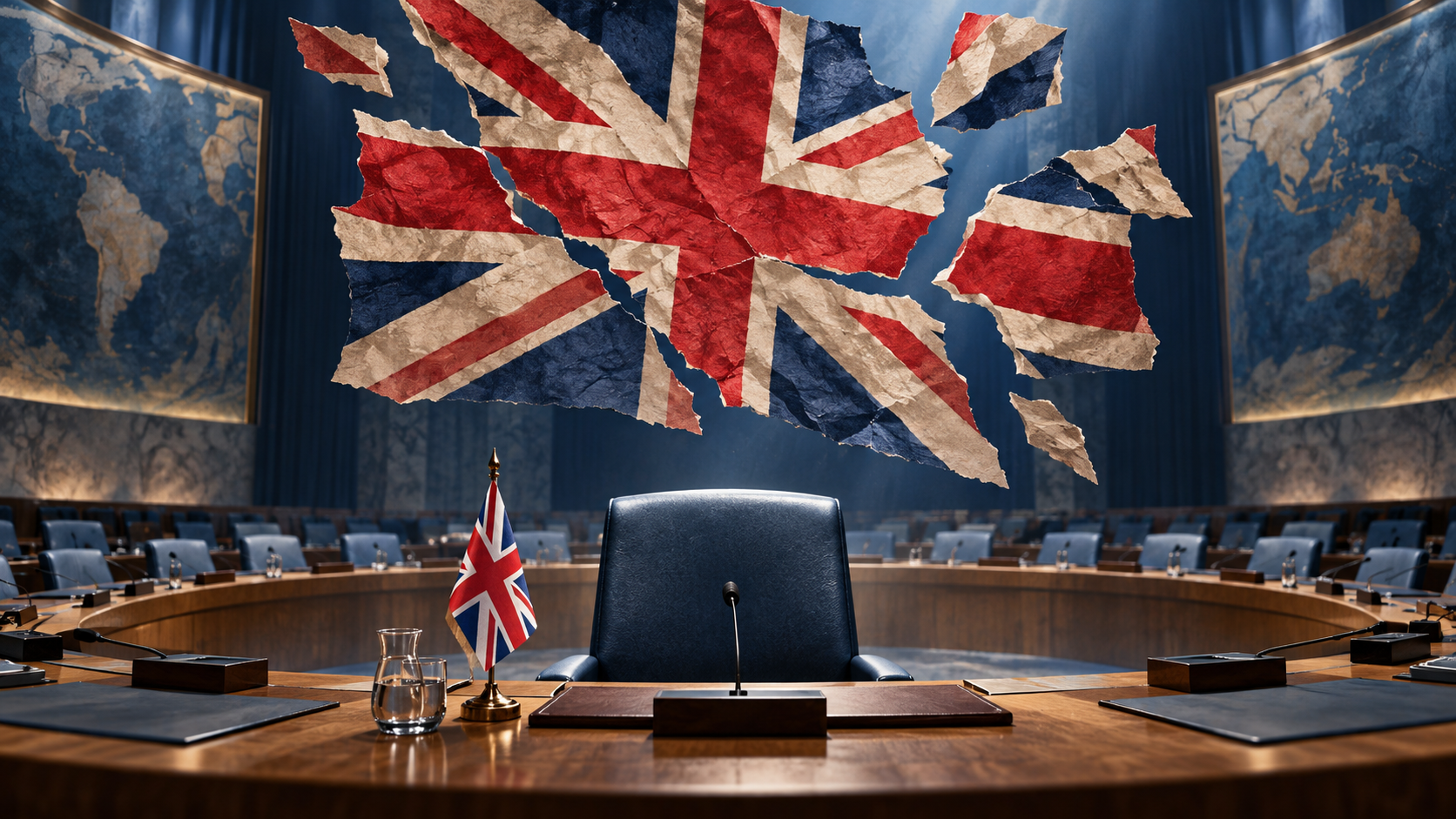
Debates about devolution usually centre on decisions made closer to home: who controls taxes, who runs public services, and how much authority Westminster should retain. But there is an international question lurking behind the domestic argument. If constitutional change eventually leads to the United Kingdom breaking apart, what happens to its permanent seat on the United Nations Security Council?
The answer matters. That seat gives Britain a privileged role in decisions about international peace and security, including the power to veto substantive resolutions. Losing it would represent a profound change in Britain’s international standing.
However, there is an essential distinction: further devolution would not automatically threaten the seat. Even Scottish independence would probably leave the remaining UK holding it. The danger would arise from a much more disruptive outcome — a break-up in which Britain’s status as a continuing state became contested.
From devolution to dissolution
Devolution transfers powers within a state. Independence creates a separate state. Those are different constitutional events, and any argument linking devolution to the loss of Britain’s UN seat must explain how one might lead to the other.
The concern is that successive transfers of authority could strengthen separate national political identities while weakening the institutions that hold the UK together. If Westminster increasingly becomes associated with England, and devolved governments become the principal focus of political loyalty elsewhere, independence could become easier to imagine and organise.
That is a possible political trajectory, not an inevitable one. Effective devolution could also preserve the Union by giving its constituent nations greater control over their affairs. The risk depends on whether constitutional reform builds a durable partnership or leaves each nation preparing for departure.
It is therefore misleading to suggest that handing another power to Edinburgh or Cardiff would itself endanger Britain’s place at the UN. The relevant question is whether the eventual settlement preserves a recognisable United Kingdom.
What Putin actually said
Vladimir Putin addressed Scottish independence in an interview broadcast in January 2014, before that year’s referendum. He described it as a domestic matter for the UK, while observing that being part of a “single strong state has some advantages”. His remarks were reproduced in the BBC’s Sunday Politics Scotland broadcast. Broadcast transcript.
Those comments should be treated precisely. They were an observation about independence and the advantages of unity, not a documented threat to strip Britain of its Security Council seat.
Nevertheless, they touch on the central issue: constitutional choices can change a country’s ability to exercise power abroad. A fragmented Britain could face difficult negotiations over defence, finances and international obligations, with consequences extending well beyond its borders.
My concern is that an adversarial government could exploit that uncertainty. Moscow would not need to succeed in removing Britain from the Security Council to benefit politically from an argument over whether Britain still deserved, or legally retained, its place.
The legal protection is substantial
Britain’s seat is not awarded according to an annual ranking of population, economic output or military strength. Article 23 of the UN Charter expressly names the United Kingdom of Great Britain and Northern Ireland as a permanent member. Article 108 requires Charter amendments to be ratified by two-thirds of UN members, including every permanent member. Britain therefore has powerful protection against an ordinary amendment removing its seat. UN Charter.
The more complicated question concerns state continuity. If Scotland became independent, would the remaining UK continue as the same international legal entity, with reduced territory? Or would the United Kingdom have ceased to exist, leaving newly created states behind?
The prevailing expectation favours continuity. In evidence to Parliament in 2013, the UK government said it did not foresee difficulty retaining the seat, citing international law and the precedent of Russia continuing the Soviet Union’s membership. Foreign Affairs Committee evidence.
That position also had support from the other side of the independence debate. The Scottish Government’s 2013 independence prospectus said an independent Scotland would support the rest of the UK remaining a permanent Security Council member. Scotland’s Future.
An agreed separation, with both governments supporting continuity, would therefore offer a strong basis for retaining the seat.
Where the danger could emerge
A more serious risk would arise from a contested dissolution involving several parts of the UK, especially if the resulting governments disagreed over whether any one of them continued the original state.
UNA-UK’s assessment is that Scottish independence would almost certainly leave Britain’s seat intact. It nevertheless identifies a theoretical exception: if the UK were considered to have ceased to exist, with no recognised continuing state, none of the new states would automatically inherit its permanent place. UNA-UK analysis.
This is an exceptional scenario. A change in the country’s name or borders would not, by itself, establish that the state had disappeared. But a badly negotiated break-up could create an opening for legal objections and diplomatic pressure.
There is an obvious irony here. Russia retained the Soviet Union’s permanent seat after the USSR’s collapse. Any Russian challenge to British continuity would have to confront the precedent on which Russia’s own position rests.
That would strengthen Britain’s defence. It would not necessarily prevent Moscow from making the argument.
Keeping the seat, losing influence
The more plausible immediate danger is diminished influence while the seat remains secure.
Constitutional fragmentation could consume years of political attention. Disputes over military assets, public debt and treaty obligations could weaken Britain’s ability to act internationally. Scottish independence would also require negotiations over the future of the UK’s nuclear submarine facilities in Scotland.
Nuclear weapons are not a legal condition of permanent membership. Nevertheless, disruption to defence arrangements could contribute to a wider perception that Britain’s capabilities were shrinking.
That perception would matter in debates about Security Council reform. A government might successfully defend its legal entitlement while finding it harder to persuade others that its exceptional privileges remained justified.
A constitutional debate with international consequences
There is a credible argument that further devolution could contribute to a chain of events ending in a challenge to Britain’s Security Council seat. But every link in that chain matters: devolution would have to contribute to separation, separation would have to raise a serious dispute over continuity, and that dispute would have to overcome substantial legal and diplomatic protections.
Presenting the loss of the seat as an automatic consequence would exaggerate the danger. Ignoring the international consequences of a disorderly break-up would be equally careless.
Putin’s comments about the advantages of a strong, united state offer a useful starting point for this debate. They do not settle it. Britain’s constitutional future should be decided democratically by its people, with a clear understanding of what different choices could mean.
The task is to build a settlement that people want to sustain — and that allows the United Kingdom to remain a coherent, effective voice abroad. A permanent seat provides considerable protection. It cannot, on its own, preserve the country that occupies it.


Leave a Reply