
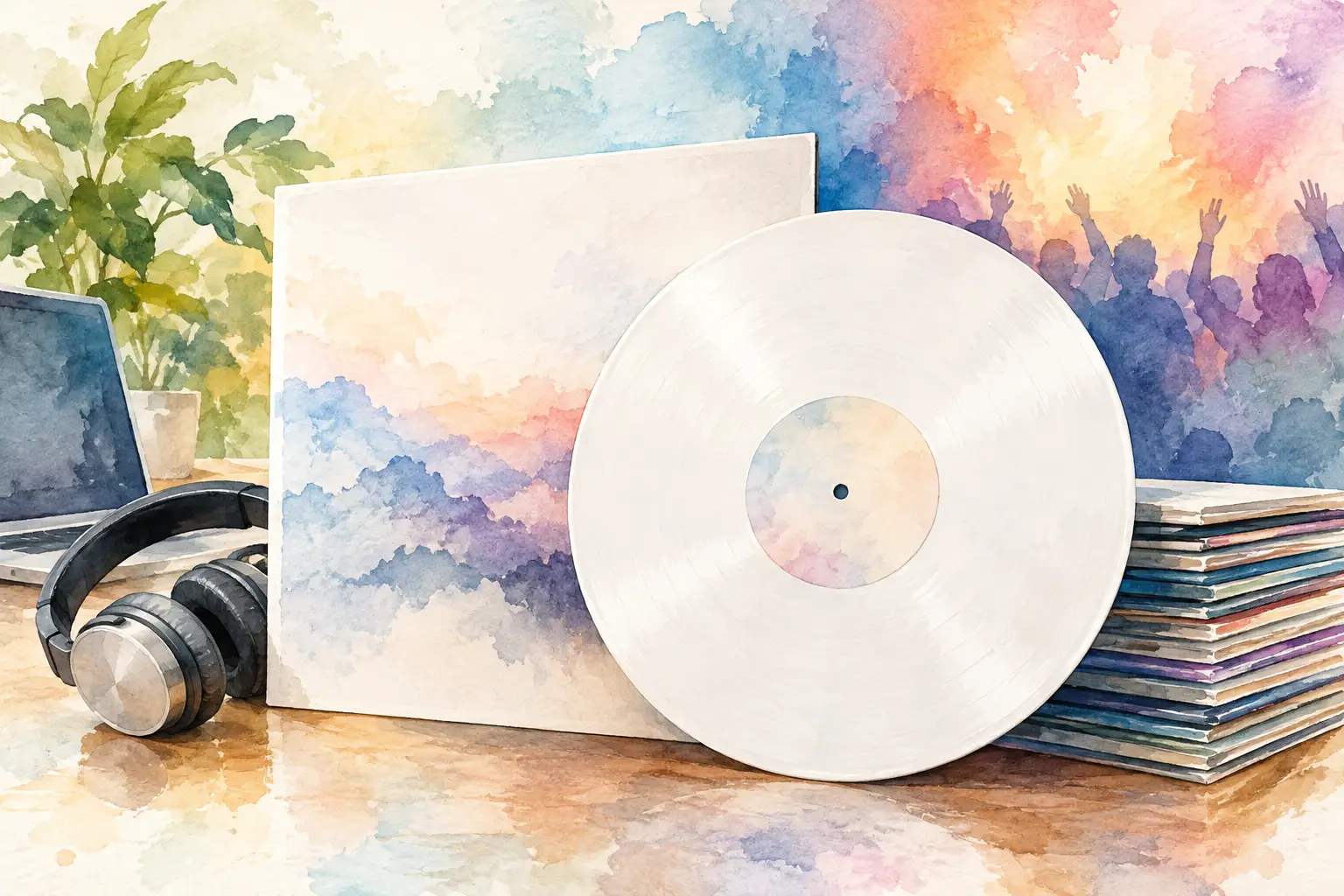
A DJ receives a plain 12-inch with a handwritten catalogue number, no artist name and no polished sleeve. They play it at 2am, the room reacts, and suddenly everyone in the booth wants to know what it is. That is the classic answer to what is a white label in music: a deliberately unbranded or minimally labelled record, often made for promotion, testing, DJ play or a fast independent release.
White labels belong to the machinery of club culture. They built anticipation before social feeds, streaming pre-saves and release-day posts existed. Yet the phrase now has a wider meaning too. It can describe a physical vinyl pressing, a promotional version of a track, or a branded product or service supplied by one business and presented under another name. In music, context matters.
What is a white label in music?
Traditionally, a white label is a vinyl record carrying little more than a blank white centre label. Sometimes it has a stamp, a catalogue number, a track title or the name of a distributor scribbled in marker. It may be an advance pressing, an unofficial bootleg, a limited DJ promo, or the first run from a new independent imprint.
The lack of information is not always accidental. It can be part of the point. If listeners cannot rely on an artist’s profile, label reputation or a familiar vocal credit, they judge the record by the groove, bassline, arrangement and impact on the floor. For a house cut, acid workout, techno tool or drum and bass roller, that is a serious test.
White labels became especially significant in scenes where DJs needed fresh music before it reached the wider public. Shops, distributors and record bags carried rumours as much as stock. A mysterious record that worked in a set could create demand long before an official release appeared.
The sound came before the branding
A white label could give a producer the freedom to test a tune without a major campaign behind it. Press a small quantity, get copies into the hands of trusted DJs, then see what happens. If it got rewinds, requests and repeat plays, there was evidence that the track had a life beyond the studio.
That approach suited fast-moving dance scenes. A track made for a packed club on Friday might feel dated if it waited months for artwork approval, a formal release schedule and a full promotional cycle. White labels kept the pipeline moving.
They also protected an element of surprise. An established producer might put out a left-field track without expectations getting in the way. A remix could circulate anonymously. A DJ might play a weapon for weeks while the audience tried to identify it. Mystery became marketing, even if nobody called it that at the time.
Why white labels became part of DJ culture
For DJs, a white label was often a signal that they had something exclusive, early or unusual. In a pre-digital club landscape, selection was a competitive advantage. Two DJs could own the same records, but the person with the unreleased gem had a moment nobody else could copy.
There was also a physical culture around it. Plain sleeves were marked with set notes, tempo clues and rough track names. A record box might contain a white label that had been rinsed for years, its label worn down and its history impossible to trace. That is not just nostalgia. It reflects how dance music travelled through trust: producer to DJ, DJ to dancefloor, dancefloor to demand.
The format was never automatically glamorous, though. A plain record could indicate a limited promo, but it could also mean a cheaply made pressing with uncertain audio quality. Pressing vinyl costs money, distribution takes effort, and anonymous releases can be hard to sell once the initial excitement fades. The mystique works best when the music is strong enough to carry it.
White label, promo and test pressing: the difference
These terms overlap, but they are not identical.
A test pressing is a small batch made to check the sound and manufacture before a full vinyl run. It may have a plain label, but its job is quality control. Labels, producers and mastering engineers use it to spot problems such as distortion, surface noise or an uneven cut.
A promo is sent to DJs, radio presenters, reviewers or tastemakers ahead of a release. It may be fully branded, partly branded or white label. The purpose is exposure and feedback, rather than a retail sale.
A white label describes the unbranded or minimally branded presentation. It can be a promo, a test pressing or a commercial release in its own right. The key is that blank, mysterious or stripped-back identity.
An unofficial bootleg sometimes appears as a white label too, especially when it uses a sample or remix that has not been cleared. That does not make every white label illegal. Plenty were legitimate independent releases. But collectors and DJs should not assume that a blank label means rights have been handled properly.
What white label means beyond vinyl
The phrase has expanded well beyond record shops. In business, white labelling means one company creates a product or service that another company rebrands as its own. Think of a music-focused platform offering playlist tools, merchandise fulfilment, web services or digital distribution infrastructure that a label can present under its own banner.
This is different from a white label record, although the shared idea is similar: the original maker stays in the background while someone else controls the visible identity. For independent artists, that can be useful. It lets a small team offer more to fans without building every technical system from scratch.
There is a trade-off. White-label services can save time and reduce development costs, but they may limit customisation or make several brands feel similar beneath the surface. The strongest independent projects use the tools while keeping their own visual world, musical point of view and relationship with listeners unmistakable.
Does a white label still matter in the streaming era?
Yes, but it works differently. Most discovery now happens through streaming platforms, DJ clips, radio shows, group chats and short-form video rather than a record shop counter. A producer can share a private link with DJs, send an unreleased track to a radio host or play an ID in a mix. The digital equivalent of the white label is often simply an unnamed or lightly credited track creating a reaction before its formal announcement.
Still, vinyl white labels retain a particular pull. They turn a release into an object with scarcity, texture and a story. For collectors, that matters. For DJs, a limited pressing can be both a playable tool and a connection to a scene’s history. For artists making club music, it can make sense when the track is built for the format and the audience genuinely values physical releases.
It does not make sense for every release. Pressing vinyl is not a magic shortcut to credibility, and a limited run will not replace a thoughtful release plan. Digital listeners need clear artwork, reliable metadata and easy access. Club-focused tracks may benefit from an early DJ promo or a small white-label edition, while vocal pop, chillout and wider streaming releases may need clearer artist recognition from day one.
How independent artists can use the white-label mindset
The useful lesson is not that every producer should print blank labels. It is that music can earn attention through real-world response before the campaign becomes polished. Put a new track in a DJ mix. Share it with selectors who understand the sound. Watch which section gets messages, track IDs and repeat plays. Let the tune build its own evidence.
For a house or acid release, that might mean testing the mix in a club set before final mastering. For a downtempo track, it could mean placing it in a radio show and seeing whether listeners ask for it. For any genre, it means treating audience response as creative information, not just a number on a dashboard.
White-label culture also reminds artists not to over-explain everything. A strong title, distinctive production and a well-timed first play can say more than pages of hype. Give fans enough to join the story, then reward their curiosity when the full release lands.
The next time an unknown track takes over a dancefloor or appears as an ID in a mix, listen closely. The label may be blank, but the record is already telling people exactly what it is.

Leave a Reply