This Chatham House meeting is chaired by Emma Ross from the Global Health programme. Also on the panel are: Winnie Byanyima, Sir Michael G Marmot, Susan Cole and Matthew M Kavanagh PhD.
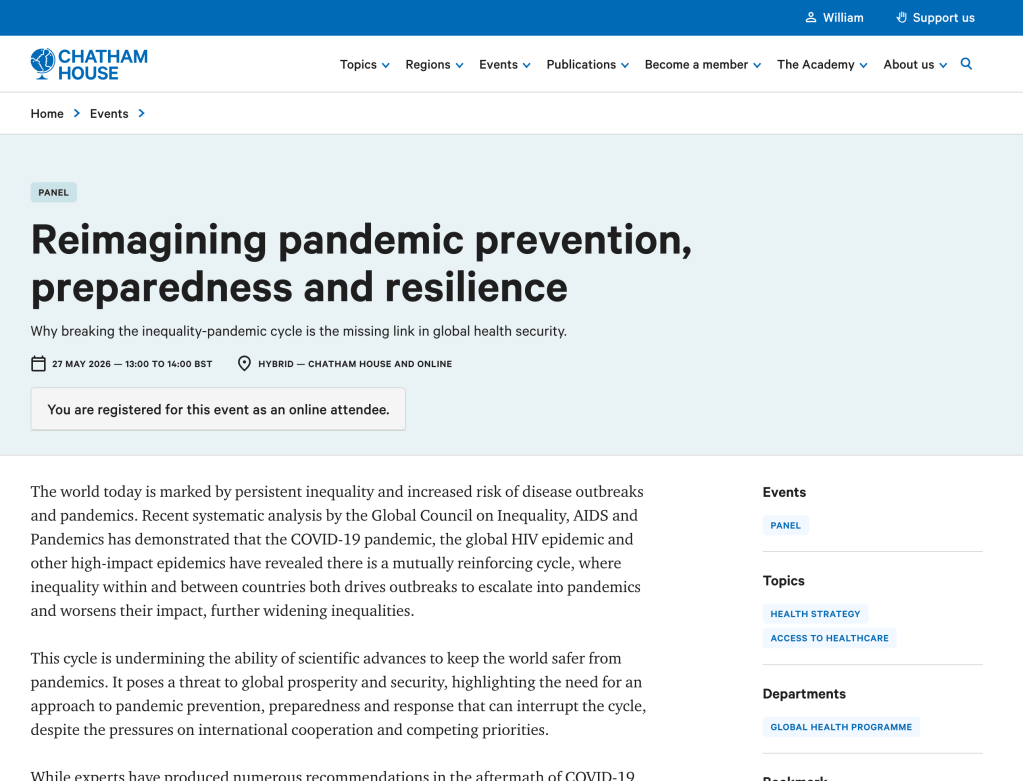
The discussion is on the link between inequality and pandemics.
Pandemics are usually talked about as viruses. Unequal societies are not just unlucky, they are structurally exposed. In real time we see this in the Ebola outbreak in Democratic Republic of Congo.
During the COVID epidemic we saw what society could provide in terms of vaccine but due to inequality we saw how more people were killed than necessary. There is income inequality, racial inequality and gneder inequality. The panel was set up to conduct research and to examine the eivdence. There was a cyclical relationshipbetween inequality and pandemics. They were made to become more economically destructive. Higher income inequality led to higher COVID nd AIDS deaths. Unequal access to housing etc creates more vulnerability.Without breaking the cycle we will see one pandemic after another. We need to close the gap on access to finance.
What is genuinely new in the inequality cycle? Prior to COVID there were three myths in middle income countries and high income countries. There was the myth that we don’t need to do anything to prevent outbreaks. The pandemic prepareedness did not prevent countries from dealing with the COVID pandemic. Camus said (in La Peste) that the plague will reveal the corruption in society.
Rich countries had forgotten about the pandemic that is AIDS. The profits of pharmaceutical companies were more important than health. Communities have to have trust in government.
Two shots a year can stop HIV in its tracks. Can we bring the science together to stop pandemics? We thought in 2019 that we knew what preparedness was? There as almost an inverse relationship with those that suffered from COVID. Inequality does not cause viruses to jump from animals to humans. In lower income countries it is harder for governments to reach through and deal with crises. MRA vaccines were not rolled out efficiently across the world. The inequality between countries can be considered a systemic risk. How do we minmise systemic risk?
Has the inequality gap shrunk anywhere? Is it improving anywhere? Income inequality is not gettting any better. The gap between countries has shrunk but within countries it hasn’t. We know hat communities are marginal. How do we plan for that?
There certainly has been some improvement over the decades, in particular with the HIV response Despite the tremendous progress we stand at the precipice of all that progress disappearing. An example is due to the USAID cuts.
A lot of progress has been made in the treatment of HIV in black Londoners. In British Colombia there is a very high suicide rate in indigenous commnities. This is not a pandemic of an infectious disease but is still a health problem. A New Zealand Maori, if you come to write papers we are not interested but if you come to partner with us we are. In Liverpool they said they wanted it to be their thing. You tell us what the evidence shows and then we will figure out how to deal with it.
40% of the wealth was captured by 1% at the top. The concentration of wealth at the top. This causes extreme inequality. Ahandful at the top can maximise it for themselves but at the bottom there is stagnation. the top 20 parmaceutical companies ahnded 1 million dollars to their sharholders every five minutes. Mauritius had a more equal response. There isn’t a single pandemic plan that effectively sructures in inequality.
The pandemic fund finances preparedness but nothing else. We need to prepare local funding for the rollout of vaccines. Which policies can realistically be done without vast amounts of money? Fr developing countries money is raised through taxation or from borrowing or for lower income countries there is aid. For lower and middle income taxation has been stagnant. There is a need to close thos eloopholes. When poor African countries go to the financial markets they have to borrow at higher rates.
It is clear that inequality does seriosuly affect pandemic preparation. This lecture has examined many points of this debate and has been enlightening.


Leave a comment