
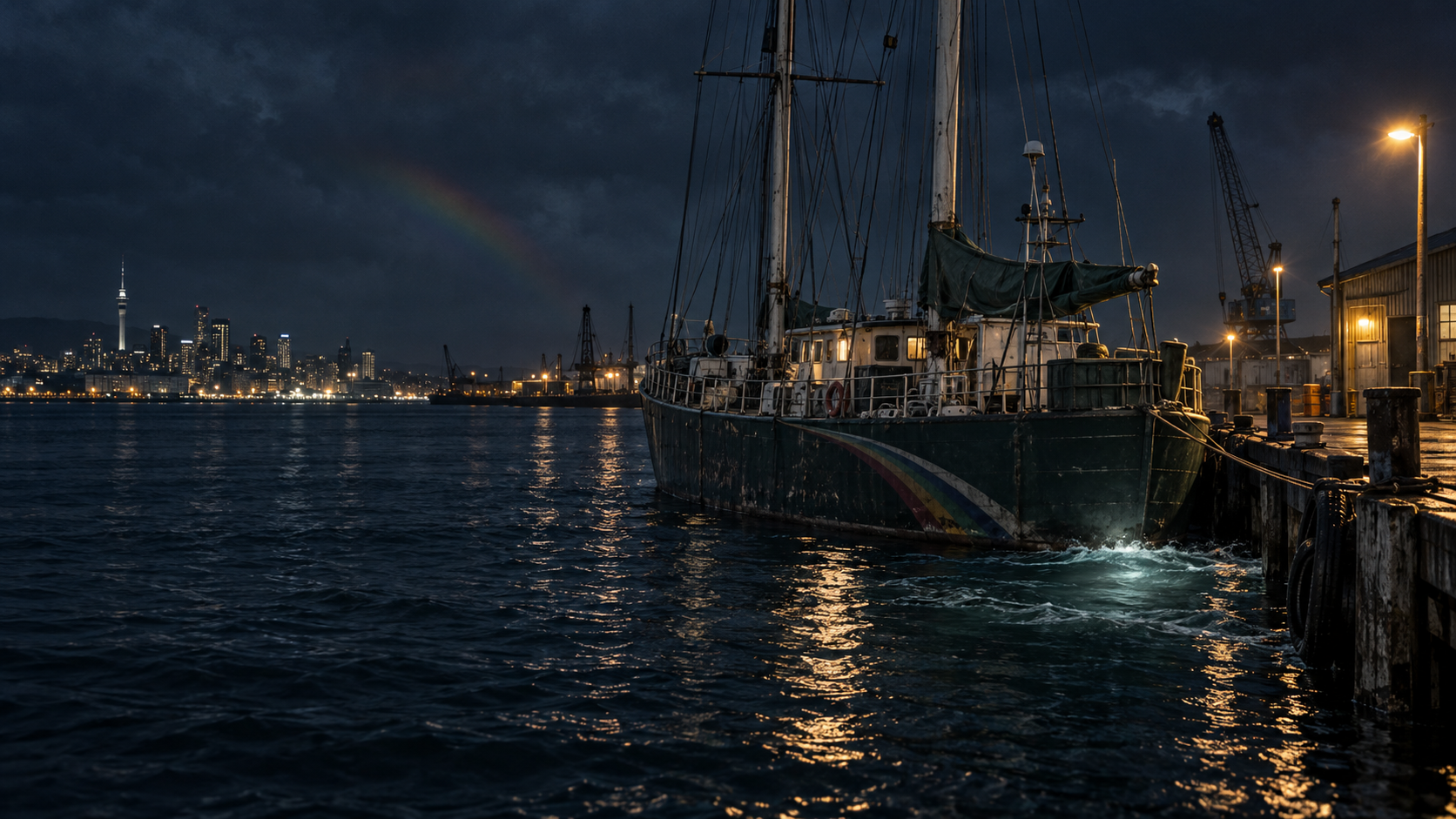
On 10 July 1985, two explosions tore through the hull of the Rainbow Warrior while it lay at Marsden Wharf in Auckland, New Zealand. The Greenpeace ship had been preparing to sail into the Pacific and protest against French nuclear testing at Moruroa Atoll.
This was no accident. French secret-service agents had planted two limpet mines beneath the waterline.
The operation sank a ship, killed a man and caused an international scandal. Yet it failed in its central purpose. Instead of silencing Greenpeace, the attack turned the Rainbow Warrior into a worldwide symbol of resistance.
A ship built for protest
The original Rainbow Warrior began life in 1955 as a British fisheries research vessel named Sir William Hardy. Greenpeace acquired the ship in the late 1970s and transformed it into a campaigning vessel.
Its name was inspired by a Native American prophecy describing people of many colours joining together to protect the Earth. Whether viewed as history, legend or environmental folklore, the name perfectly suited a ship carrying activists across borders in defence of oceans, communities and peace.
The Rainbow Warrior became closely associated with campaigns against nuclear testing, whaling and the dumping of radioactive waste at sea. It was more than transport. It provided Greenpeace with a moving platform from which environmental damage could be witnessed, photographed and brought to public attention.
In May 1985, the ship helped to relocate around 300 people from Rongelap Atoll in the Marshall Islands. Their home had been contaminated by radioactive fallout from American nuclear testing. From there, the vessel travelled to New Zealand before its planned voyage towards the French nuclear-testing zone.
That journey would never take place.
The night of the bombing
Shortly before midnight on 10 July, the first explosion damaged the ship near its propeller. People aboard began evacuating.
Photographer Fernando Pereira returned below deck, reportedly to recover his photographic equipment. A second, much larger explosion ripped open the engine-room area. Water poured into the vessel and Pereira drowned.
He was 35 years old and the father of two children.
The bombs had been placed by divers working for France’s foreign intelligence service, the DGSE. The intention was to “neutralise” the Rainbow Warrior before it could interfere with or draw international attention to France’s nuclear programme in the Pacific.
France initially denied responsibility. That position became impossible to maintain as New Zealand police uncovered a network of operatives, false identities and forged documents. Two agents, Alain Mafart and Dominique Prieur, had entered the country while posing as a married Swiss couple.
Both were arrested. They pleaded guilty to manslaughter and wilful damage and received ten-year prison sentences. Under a later agreement brokered by the United Nations, they were transferred to a French military base on Hao Atoll. Both left the island in less than two years.
French prime minister Laurent Fabius eventually admitted the truth: DGSE agents had sunk the ship and had acted under orders.
An attack on New Zealand—and peaceful protest
The bombing was extraordinary not only because France targeted an environmental organisation, but because it carried out a deadly covert operation in the harbour of a friendly sovereign country.
For New Zealand, the attack became a defining national event. It reinforced the country’s developing nuclear-free identity and damaged its relationship with France. A state had used military explosives in Auckland to prevent peaceful activists from challenging government policy.
The consequences spread far beyond diplomacy. Attempts to suppress protest often depend upon secrecy and fear. The Rainbow Warrior operation produced the opposite result. Every revelation generated more publicity for Greenpeace and greater scrutiny of nuclear testing in the Pacific.
The ship could no longer sail, but its cause travelled farther than ever.
You can’t sink a rainbow
The original Rainbow Warrior was later moved to Matauri Bay, where it was scuttled in December 1987. Its wreck became an artificial reef, a marine sanctuary and a memorial to Fernando Pereira.
The name survived as well.
A second Rainbow Warrior entered service in 1989 and continued campaigning until its retirement in 2011. Greenpeace then launched a third vessel—the first Rainbow Warrior designed and constructed specifically for the organisation.
The modern ship uses wind power whenever conditions allow, but its greatest inheritance is not technical. It carries the memory of a moment when a powerful government believed explosives could make an inconvenient protest disappear.
Why the Rainbow Warrior still matters
The story remains relevant because the underlying struggle has not ended. Governments and corporations still attempt to control information, intimidate campaigners and keep environmental damage out of public view. Activists, journalists and photographers continue to take risks to document what is happening.
The Rainbow Warrior also reminds us that environmental history is human history. Nuclear testing was not an abstract geopolitical exercise for Pacific communities. Its consequences entered people’s homes, bodies and futures. Greenpeace’s voyage connected those experiences to audiences who might otherwise never have seen them.
Fernando Pereira boarded the ship to take photographs. His work was about making distant events visible. His death should never be reduced to a footnote beneath the more dramatic story of spies and sabotage.
More than four decades later, the Rainbow Warrior remains an icon because its story contains both tragedy and defiance. The original vessel rests beneath the sea, covered in marine life. Other ships have carried its name into new campaigns and new waters.
France succeeded in sinking the boat.
It did not stop the voyage.


Leave a Reply