
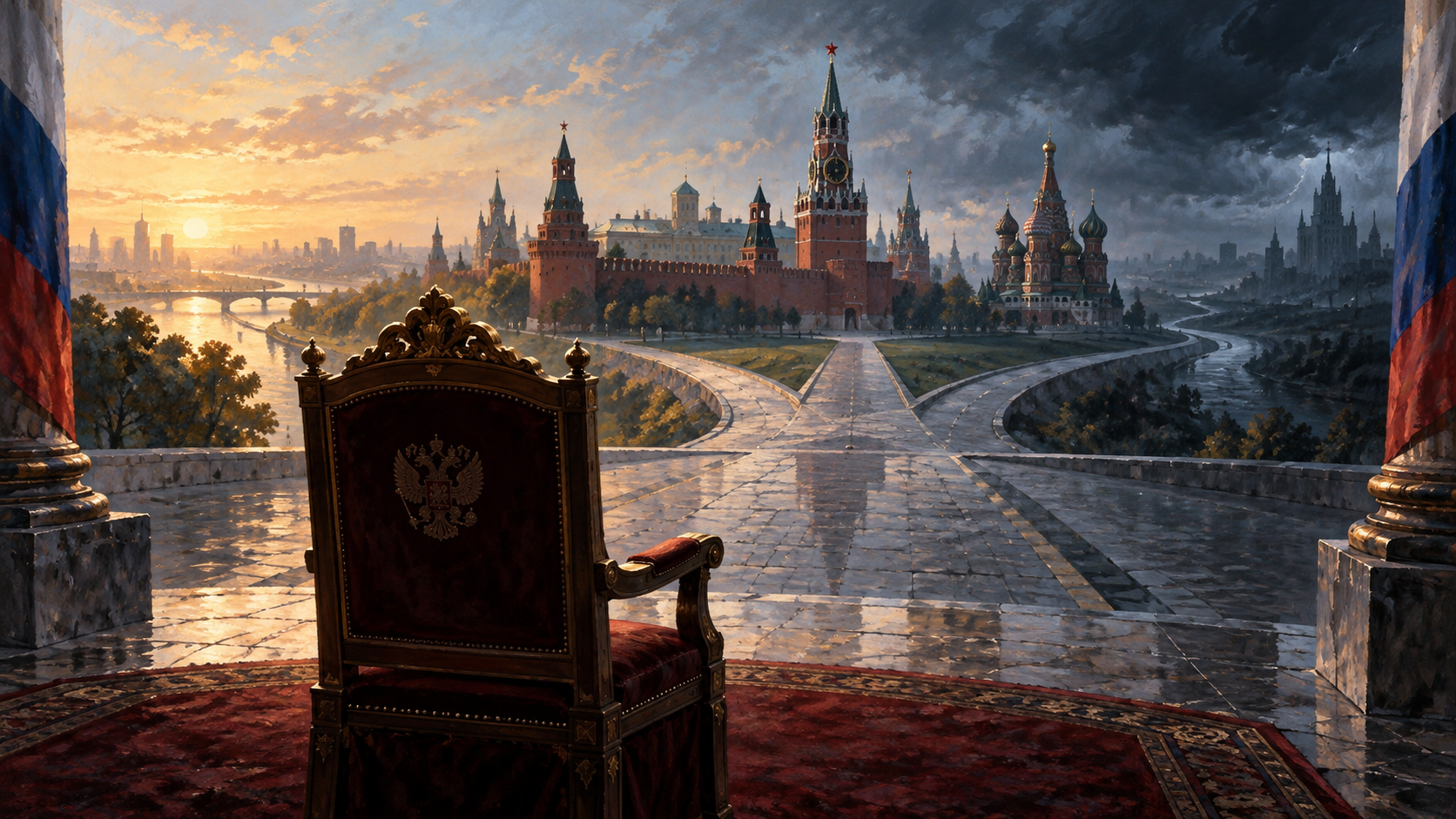
One day, Vladimir Putin’s rule will end. What nobody can confidently tell us is whether the system he built will end with him.
A post-Putin Russia could become more open, less aggressive and more interested in its people’s prosperity than territorial conquest. It could also remain authoritarian under a different leader, turn towards an even harsher nationalism, or experience a struggle between competing centres of power.
These are possible futures, not predictions of an imminent departure. The circumstances matter enormously: an orderly handover would create different opportunities from a sudden death, an internal challenge or a crisis linked to the war in Ukraine.
The strongest starting assumption is that Russia’s next leadership would emerge from within the existing system. The Council on Foreign Relations identifies that as the likeliest route, given the strength of the state and the weakness of independent political organisations. That would give insiders a substantial advantage over anyone promising a democratic break. Council on Foreign Relations
Putin’s departure could open a door. Who controls that door would determine how far Russia can change.
The first possibility is continuity.
Russia’s authoritarianism rests on more than one personality. Security agencies, senior officials and politically connected business interests all have something to protect. Freedom House’s 2026 assessment describes a political system dominated by Putin, with business magnates dependent on government patronage and meaningful opposition severely restricted. Those relationships would not disappear when a new president arrived. Freedom House
An agreed successor could therefore promise stability, preserve the existing distribution of wealth and keep political competition tightly controlled. The language might soften. The machinery of power could remain familiar.
Such a government might even make limited concessions: release some prisoners, relax particular restrictions or blame unpopular decisions on the previous administration. Those changes would matter to the people affected, but they would not automatically make Russia democratic.
The test would be whether citizens gained lasting rights that the next president could not simply take away.
A second possibility is a pragmatic thaw.
A successor would inherit the costs of Putin’s choices without necessarily sharing every one of his ambitions. There could be incentives to reduce international confrontation, restore economic relationships and direct more attention towards living standards.
The Foreign Policy Research Institute argues that a future leader would have reasons to improve relations abroad and seek relief from the burdens of war and sanctions. That is an incentive, however, rather than a guarantee of changed behaviour. Foreign Policy Research Institute
Imagine a Russia that remained politically restrictive but became more willing to negotiate, allowed greater cultural freedom and gave businesses more room to operate. That would fall short of the democratic future many would hope for, yet it could still represent a meaningful improvement.
Chatham House explored a version of limited change in its 2023 study of a hypothetical Russian defeat followed by Putin’s replacement. It explicitly presented a scenario rather than a forecast, and suggested that much of the existing state system could survive even a major political shock. Chatham House
The danger is that warmer diplomatic language could be mistaken for deeper reform. A government can seek foreign investment while continuing to imprison its critics.
A third possibility is a harder, more confrontational Russia.
There is no reason to assume every potential successor would be more moderate. A leader struggling to establish authority might reach for nationalism, portray compromise as betrayal and promise to complete Putin’s unfinished mission.
War also creates interests that can outlast the leader who began it. The European Council on Foreign Relations has examined the recruitment of veterans into Russian political and administrative roles, arguing that this emerging constituency could constrain future foreign-policy moderation. Veterans are not a single political bloc, but the institutional legacy of war deserves attention. European Council on Foreign Relations
An unstable succession could intensify these pressures. Rival factions might compete to demonstrate toughness, while a new president could fear that concessions abroad would expose weakness at home.
That makes the manner of Putin’s departure almost as important as the identity of his replacement.
A fourth possibility is a prolonged struggle over power.
When authority has become highly personal, removing the person at the centre can unsettle the arrangements beneath him. Officials who previously accepted Putin as the final arbiter might find it harder to accept one another.
That could produce bargaining, purges, shifting alliances or competing claims to legitimacy. It would not necessarily mean civil war or the break-up of the Russian Federation. Those are severe possibilities, not sensible assumptions to treat as inevitable.
For neighbouring countries, any uncertainty involving a nuclear-armed state would make reliable communication and restraint especially important.
The most hopeful possibility would be a democratic opening. It would also require the most substantial work.
A credible transition would need independent journalism, political organising without intimidation, courts capable of resisting executive pressure and elections whose outcomes were genuinely uncertain. Regions would need a meaningful voice in how they were governed.
For ordinary people, change would become real through everyday freedoms: criticising a minister without fearing arrest, investigating corruption, organising a campaign, making art or choosing a government that could actually lose office.
None of this should depend on finding a supposedly benevolent strongman. Durable freedom requires institutions that can restrain an unpopular or dangerous leader.
Ukraine would remain central to judging any new government.
A change in the Kremlin would not erase the invasion, occupation or suffering inflicted on Ukrainians. A successor’s willingness to pursue peace would need to be assessed through actions: ending aggression, respecting Ukrainian sovereignty and engaging seriously with security, reconstruction and accountability.
Ukraine must have agency in decisions about its future. A diplomatic reset negotiated over its head would offer a poor foundation for lasting peace.
Britain and its allies should therefore remain open to verifiable change while maintaining support for Ukraine. Any easing of pressure should follow concrete progress. A different face on television would be insufficient evidence.
At the same time, we should leave room for a better relationship with Russian society. Writers, musicians, students, researchers and independent journalists should be able to imagine a future beyond permanent isolation and confrontation.
Russia’s future belongs to its people. They deserve the chance to shape it freely, and their neighbours deserve to live without fear of domination.
The most plausible immediate outcome may be substantial continuity, followed by an uncertain contest over how much change is possible. A freer and more peaceful Russia remains worth hoping for, but its arrival would require more than Putin’s exit.
The decisive moment would come when power itself became accountable—and when ordinary Russians could change their leaders without waiting for a crisis.


Leave a Reply