
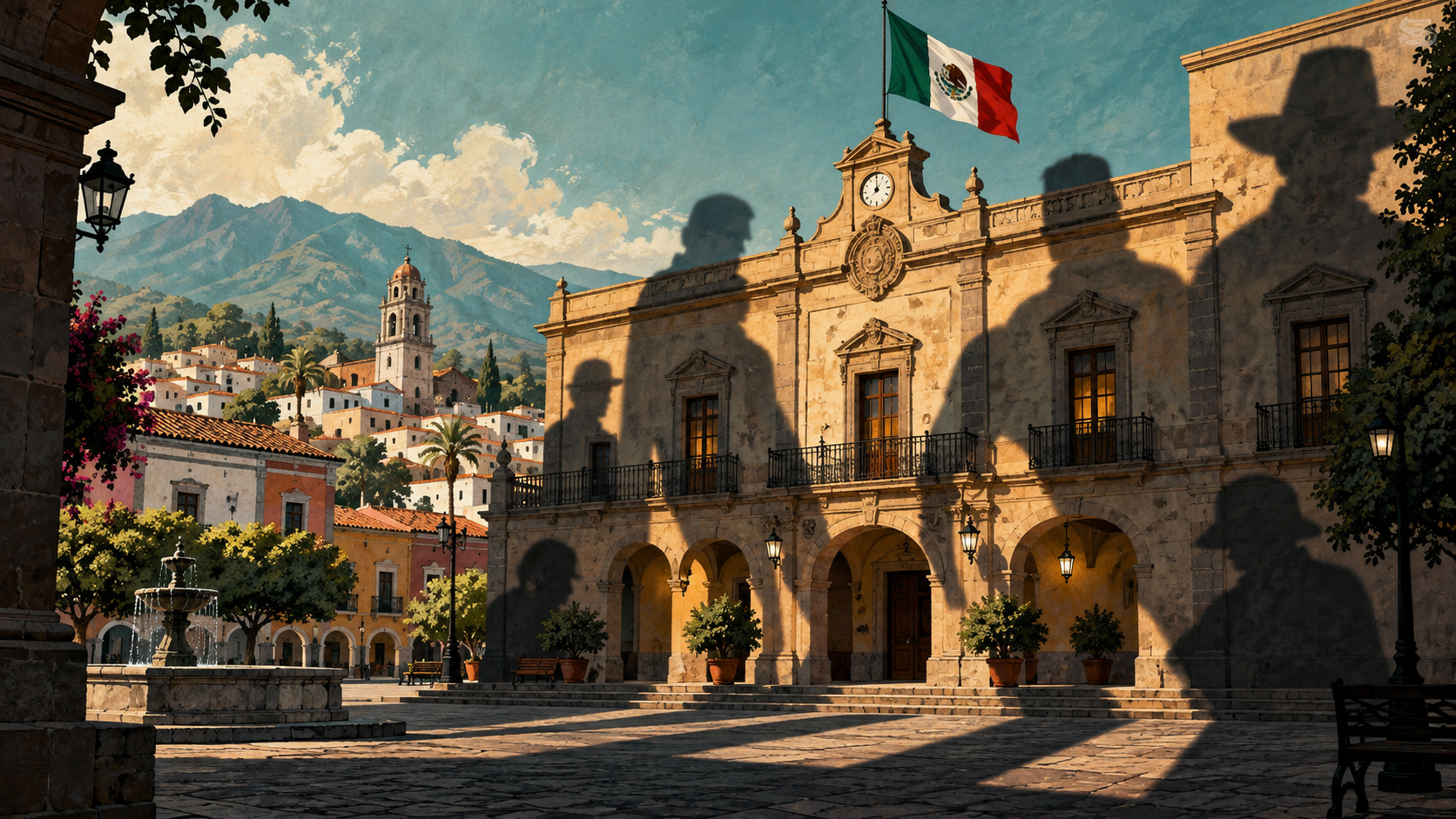
A government’s power is measured partly by whose instructions people feel compelled to obey. Who decides whether a business can operate? Who controls the road into town? Who can punish someone and expect to escape punishment themselves?
In parts of Mexico, criminal organisations have acquired enough authority to make those questions deeply uncomfortable.
So, do Mexico’s drug cartels form a shadow government? In some places, they exercise powers that resemble government. But the evidence points to competing systems of criminal rule, intertwined with public institutions, rather than a single hidden administration controlling the country.
That distinction matters. It helps explain both the scale of cartel power and why confronting it is so difficult.
The term “drug cartel” can itself obscure what these organisations do. Trafficking remains central, but criminal groups also extract money from legitimate economic activity. International Crisis Group’s research describes criminal interests in Mexico’s avocado and lime industries, mining, port commerce and fuel theft. A business can therefore become entangled with organised crime without having anything to do with illegal drugs. International Crisis Group, Mexico’s Forgotten Mayors
Once an armed organisation regularly collects payments and dictates the conditions under which people work, it begins to exercise a form of authority over everyday life.
Extortion can resemble taxation from the victim’s perspective: payment is compulsory, and refusal carries consequences. But the resemblance has limits. Paying a cartel buys no enforceable rights, democratic representation or public accountability. The organisation demanding protection money may also be the source of the danger.
Researchers use the term criminal governance to describe the rules criminal organisations impose on people beyond their own membership. It is a useful concept because trafficking and governing are different activities. Moving an illegal shipment through a district does not necessarily mean ruling its residents. Dictating their behaviour does.
Research on the Jalisco New Generation Cartel examines how social control can support criminal business while coexisting with the state. That is a more precise starting point than assuming every place with a cartel presence has become a cartel-run territory. Ruling Violently: The Exercise of Criminal Governance by the CJNG
Cartel authority also depends on more than fear alone. In her research on Sinaloa, Vanda Felbab-Brown describes efforts to cultivate relationships with businesses, officials, religious figures and communities. Selective assistance and interventions in local disputes can help an organisation build influence. Its methods vary between regions and local leaders. Brookings, How the Sinaloa Cartel Rules
It is easy to turn such accounts into a romantic story about criminals providing what government cannot. That misses the underlying imbalance. A family may accept help because it needs food. A shopkeeper may cooperate because refusal is dangerous. Neither response establishes freely given consent.
The political dimension becomes clearer when criminal organisations interfere with elections.
Guillermo Trejo and Sandra Ley’s research documents attacks on municipal candidates and mayors, penetration of local governments, and coercive criminal rule in parts of Michoacán and Guerrero. Controlling who reaches office can give an organisation influence over the public institutions that might otherwise constrain it. Cambridge University Press, Votes, Drugs, and Violence
The implication is stark: a cartel does not need to abolish an election if it can intimidate candidates or restrict what the winner is able to do.
Nor does it need to replace every public official. Sometimes the greatest advantage comes from having someone inside the institution.
The case of Genaro García Luna provides a particularly serious example. Mexico’s former secretary of public security, who held that position from 2006 to 2012, was convicted in the United States in 2023 and sentenced to more than 38 years in prison in October 2024. Evidence at trial established that he accepted millions of dollars in bribes while assisting the Sinaloa Cartel, including by providing sensitive information and facilitating drug shipments. US Department of Justice, García Luna sentencing
This establishes corruption at an exceptionally high level. It does not establish that every Mexican institution answers to a cartel. The distinction between those claims is essential.
Indeed, the “shadow government” metaphor can become misleading precisely because it suggests two separate structures: an official government visible to the public and a criminal government operating behind it.
Research on Mexico instead describes relationships in which state and criminal actors can form overlapping networks of power. The boundary between the two may be contested, negotiated or compromised. That is more complicated than a simple contest between government and gangsters. Utrecht University, research on Mexico’s crime–governance nexus
Geography matters too. International Crisis Group documents enormous differences between municipalities, alongside fragmentation into rival criminal groups. Its findings do not support treating the entire country as one uniformly governed criminal territory. Public officials can be collaborators, targets or opponents of organised crime, sometimes working under severe constraints. International Crisis Group, Mexico’s Forgotten Mayors
My conclusion is that Mexico contains areas of shadow governance, but “the cartels are Mexico’s shadow government” is too sweeping a claim.
The more useful question is where criminal organisations can make binding decisions about other people’s lives—and how they acquire that power. Through threats? Through economic dependence? Through captured officials? Through some combination of all three?
Those distinctions should shape the response. Arresting a trafficker does not, by itself, ensure that a threatened shopkeeper can safely report extortion or that a mayor can refuse criminal demands. Restoring public authority means making those choices possible.
For the person living under coercion, the decisive test is practical: can they refuse the cartel and still expect the state to protect them?
Where the answer is no, criminal power has moved far beyond the drugs trade.


Leave a Reply