
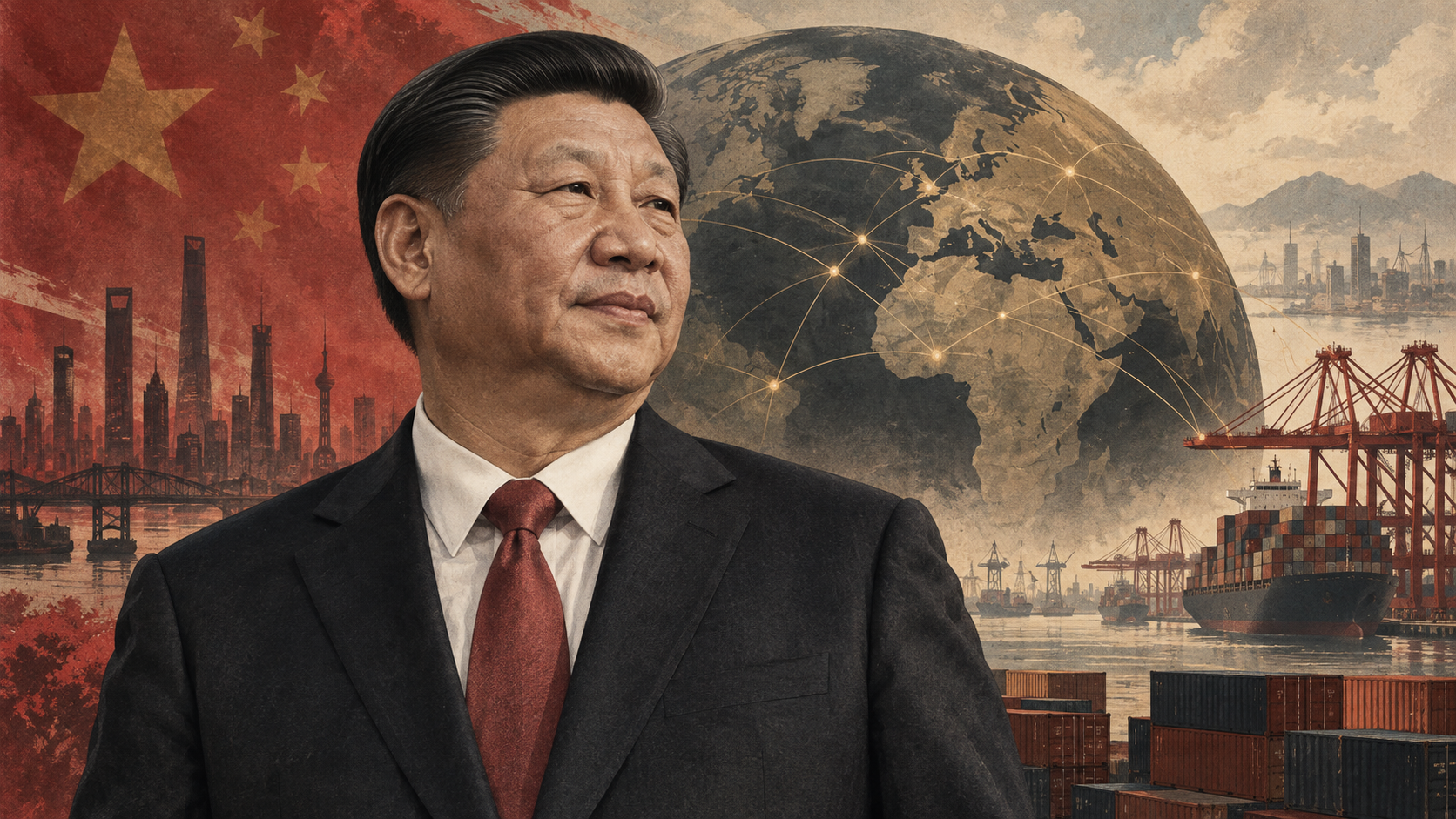
When people talk about the most powerful person on Earth, the American president is usually the default answer. Yet Xi Jinping has a serious claim to that title. He combines extraordinary authority within China with the international influence of a country that other governments cannot afford to ignore.
My view is that Xi has the strongest claim when we measure personal control over a major power. Whether he can shape the wider world more effectively than the American president is a much closer question.
The distinction matters. A leader’s freedom to give orders and their ability to achieve results are two different measures of power.
Xi’s authority rests on three positions: general secretary of the Chinese Communist Party, chairman of the Central Military Commission and president of China. Together, they place him at the summit of the party, the armed forces and the state.
The removal of presidential term limits in 2018 helped make an extended tenure possible. His more consequential party and military positions already lacked equivalent formal limits. Describing him simply as China’s president therefore understates where his authority comes from. Congressional Research Service
Xi also operates in a system without competitive national elections that could remove him from office. Independent opposition, journalism and civil society face severe restrictions. Freedom House’s 2026 assessment describes a party leadership that has tightened control over political and public life. Freedom House
That gives him room to pursue priorities over a longer period than leaders who must regularly defend their records to voters. It also makes challenging his decisions far more difficult.
There is an enormous human cost to that concentration of authority. The freedom of a ruler to act grows when the freedom of citizens to resist shrinks. Recognising Xi’s power should never be confused with endorsing the system that sustains it.
What makes his position globally significant is the scale of the country he leads. China’s influence reaches into the materials and production processes on which other economies depend.
Critical minerals offer a particularly clear example. The International Energy Agency’s 2026 outlook documents how Chinese export controls on rare earths disrupted manufacturers, with some carmakers reducing output or temporarily stopping operations. Decisions in Beijing can therefore affect factories and jobs thousands of miles away. IEA
This is a powerful source of bargaining strength. A government does not need to deploy soldiers to make another country feel the consequences of a disagreement.
There are limits, however. Using commercial dependence as political pressure gives other countries a stronger incentive to find alternative suppliers. Economic influence can be spent in ways that gradually weaken it.
The United States also retains formidable advantages. SIPRI estimates American military expenditure at $954 billion in 2025, compared with $336 billion for China. Those figures do not translate directly into combat effectiveness: costs, geography and the demands of a particular conflict all matter. Nevertheless, they demonstrate the resources available to Washington. SIPRI
The dollar adds another dimension. The Federal Reserve’s 2025 review found that its international use remained dominant, supported by the depth of American financial markets. That position gives the United States influence across the financial system that China has yet to match. Federal Reserve
Donald Trump’s claim to be the world’s most powerful leader therefore rests on substantial national capabilities. Xi’s competing claim rests partly on how much more tightly authority is concentrated in his own hands.
Even that concentration contains weaknesses.
China’s military purges are revealing. In February 2026, CSIS documented 36 confirmed purges of generals and lieutenant generals since 2022, alongside 65 additional officers assessed as missing or potentially purged. Those categories should not be treated as equally certain. Its analysis suggested that routine military operations continued, while leadership gaps may have affected more complex exercises. CSIS ChinaPower
The ability to remove senior commanders demonstrates authority. Repeatedly removing people from an institution you depend upon also raises questions about trust, appointments and effectiveness. Both things can be true at once.
A further danger is the quality of information reaching the top. In any organisation, people become less candid when disagreement threatens their careers. In a highly personalised political system, that can leave the leader exceptionally powerful yet poorly informed.
Economic pressures impose another constraint. The IMF’s February 2026 assessment highlighted China’s prolonged property adjustment, debt pressures, weak domestic demand and ageing population. These are problems that political authority alone cannot solve. IMF
A government can order investment. Restoring household confidence, improving productivity and persuading people to spend are harder tasks.
So, is Xi Jinping the most powerful leader in the world?
On the combination of personal authority and national scale, I would give him a narrow yes. On the ability to secure outcomes across the world, the answer remains contested.
That judgement recognises how much control Xi has accumulated without assuming that China’s rise makes every objective achievable. Other governments retain choices. Economic relationships create mutual vulnerabilities. Institutions can obey their leader while failing to deliver what he wants.
The ultimate test of Xi’s power will be whether he can turn extraordinary authority into lasting prosperity, security and international influence. The ability to issue an order is impressive. The ability to make it succeed is what decides the argument.


Leave a Reply