
A bassline starts to bend, bubble and snarl. The kick drum keeps marching while a tiny silver machine sounds as if it has developed a mind of its own. If you have ever heard that deliciously squelchy sound in a warehouse set, a festival tent or a late-night playlist, you have already met the heart of the answer to what is acid house music.
Acid house is house music pushed into stranger, more psychedelic territory. It is built around repetition, drum-machine rhythm and an electronic bass sound that can twist from playful to menacing in seconds. It began in Chicago in the 1980s, travelled rapidly to the UK, and helped turn dance music from a local club movement into a youth-culture flashpoint with global reach.
What is acid house music, exactly?
At its simplest, acid house is a style of electronic dance music defined by the Roland TB-303 Bass Line. The 303 was originally designed in the early 1980s as a practice accompaniment device for guitarists. It was not a commercial success in that role. Its synthetic bass did not convincingly imitate a human player, so second-hand units became cheap enough for adventurous producers to misuse brilliantly.
Instead of programming a conventional bass part, acid producers made the machine slide between notes, accented certain steps and moved its filter and resonance controls while the pattern played. That is where the famous acid squelch comes from. It can sound rubbery, metallic, wet, sharp, cartoonish or hypnotic, often all within the same eight-bar loop.
Underneath sits the house framework: usually a steady four-to-the-floor kick drum, hi-hats, claps or snares, and a tempo built for the dancefloor. Acid house can be raw and minimal, with little more than drums and 303. It can also include vocal samples, piano stabs, chords, rave sirens and dense layers of percussion. The 303 is the calling card, but the attitude matters just as much: repetitive enough to lock dancers together, unpredictable enough to keep them alert.
Chicago roots and the first acid records
House music was already alive in Chicago clubs before acid house acquired its name. DJs and producers such as Frankie Knuckles, Ron Hardy, Marshall Jefferson and Larry Heard helped shape a new, machine-led dance sound from disco, soul, electro and the city’s club culture. It was music made for long nights, often created with limited equipment but huge imagination.
Phuture’s track Acid Tracks is widely regarded as the landmark acid record. The group, featuring DJ Pierre, Earl Smith Jr and Herb Jackson, created a long 303 workout that sounded unlike the smoother house records around it. Ron Hardy played early versions at Chicago’s Music Box, stretching the record out and letting the crowd absorb its unusual force. The response was intense.
The word “acid” has attracted plenty of mythology. Some connect it to the music’s mind-altering, psychedelic feel; others point to slang and club stories that grew around the scene. There is no single neat explanation that settles every version. What matters musically is that acid came to describe the 303-led sound and the heady, ecstatic atmosphere surrounding it.
Chicago gave acid house its blueprint. But it was the UK that turned it into a cultural earthquake.
When acid house hit Britain
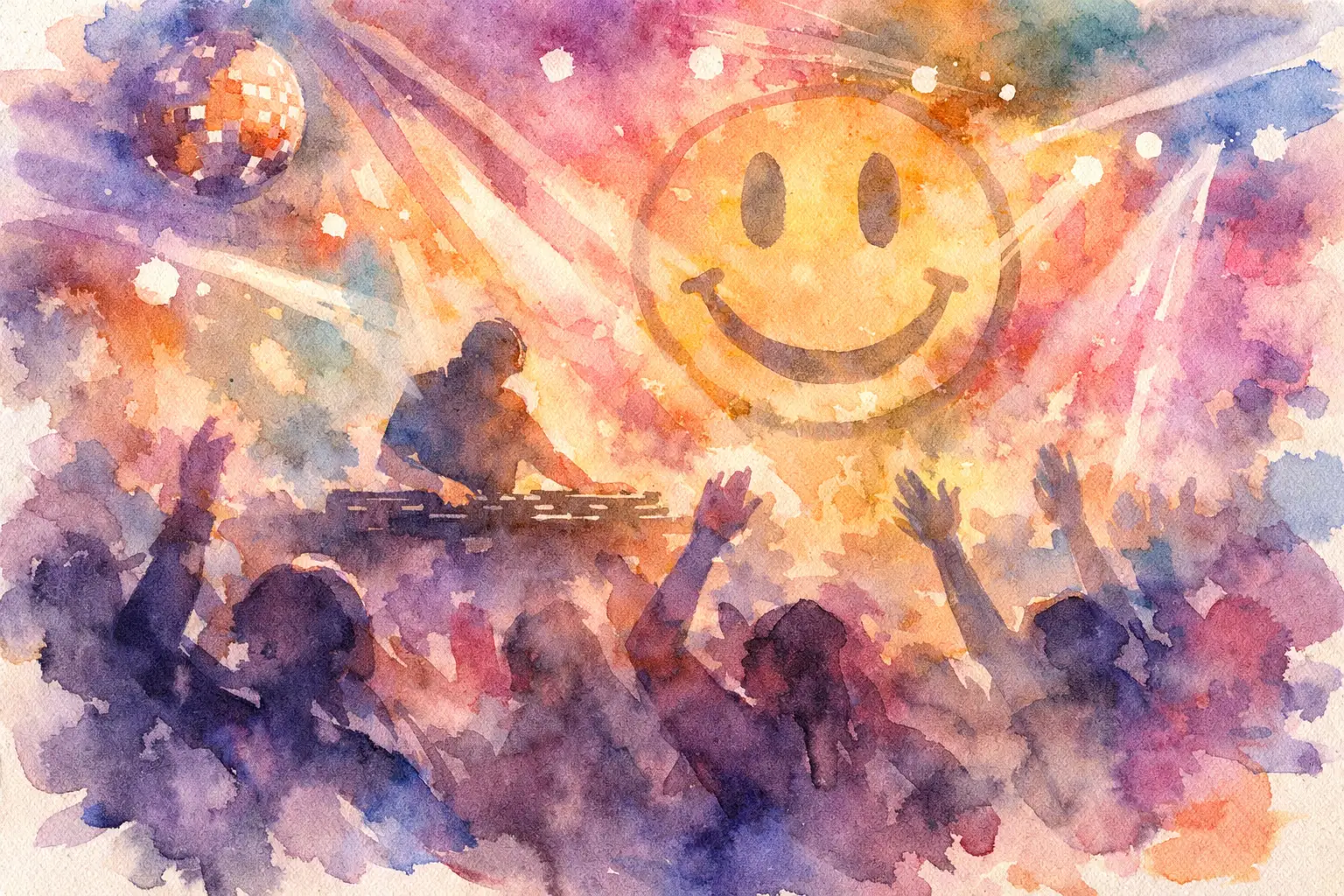
By 1987 and 1988, imported Chicago records, Ibiza holidays and a new generation of DJs had brought acid house into British clubs. The records spread through specialist shops, pirate radio, flyers and word of mouth. Then came the smiley-face graphics, baggy clothes, outdoor parties and the so-called Second Summer of Love.
Acid house was not just about a particular synth line. It represented a different way of gathering. The dancefloor placed strangers in the same rhythm for hours, with DJs shaping the journey rather than simply playing individual songs. Illegal raves and warehouse events grew because established venues could not always contain the demand, or the volume, or the freedom of the new scene.
That history deserves a little care. Acid house culture was joyous and communal, but it was also met with moral panic, policing and media caricatures. Not every record with a smiley on the sleeve was musically adventurous, and not every person involved shared the same experience. Still, the period changed British nightlife permanently. It helped create the infrastructure, audience and appetite for rave, techno, hardcore, jungle and much of the electronic music culture that followed.
The sound: why a 303 can feel so alive
A great acid line is rarely complicated in the traditional sense. It might use only a few notes. Its power comes from motion and tension. The sequence repeats, but the producer opens the filter, increases resonance, adds accents or changes the slide settings. A familiar phrase suddenly bites harder, then retreats into the mix before returning with new pressure.
That makes acid unusually physical. You do not only hear the bassline as melody; you feel it changing shape. On a proper club system, resonance can cut through the kick drum like a beam of light, while the low end gives the room weight. The best tracks understand restraint. If every control is at maximum from the first bar, there is nowhere left to travel.
Tempo and mood vary widely. Early Chicago acid can be sparse, jacking and funky. UK acid house often carries a brighter rave charge. Acid techno tends to be tougher, faster and more industrial. Acid trance leans into longer builds and larger melodic spaces. Modern producers might blend acid with electro, breakbeat, drum and bass, pop or downtempo music. The core sound survives because it is flexible.
Acid house is not one thing
It is tempting to reduce acid house to any track containing a squelchy bass preset. That misses the point. A 303-style sound can appear in techno, trance, electroclash, garage or a modern pop production without making the whole track acid house.
Context decides a lot. Is the acid line central to the arrangement? Does the rhythm draw from house and its dancefloor swing? Does the track use repetition and gradual modulation to create momentum? If the answer is yes, acid house is a useful label. If it is a brief decorative riff in an otherwise unrelated track, “acid-influenced” may be more accurate.
The same is true of newer hardware and software. You do not need an original TB-303 to make acid music. Many modern instruments reproduce its architecture or take the concept further, and software versions make the sound accessible to producers working entirely in a laptop. Original machines have character and collector appeal, but creative programming matters more than owning vintage gear.
How to recognise acid house in a DJ set
Listen for the relationship between drums and bass rather than waiting for a genre label. Acid house usually announces itself through a repeating electronic sequence that seems to talk, gurgle or sting as its tone changes. The kick is often direct and dependable, leaving room for the 303 to become the lead voice.
In a well-built set, acid works as a tension tool. A DJ may introduce a restrained line over a rolling house groove, then bring in a more abrasive record once the room is ready. It can lift a familiar dancefloor without relying on a huge vocal chorus or an obvious drop. That makes it ideal for DJs who enjoy creating a proper arc rather than chasing quick reactions.
For listeners, the entry point does not have to be a history lesson. Start with the tracks that make you move. Some people fall for the loose Chicago jack; others prefer the colourful UK rave edge or the relentless drive of acid techno. A track such as Wez G’s Windy City Acid sits naturally in that continuing conversation: a nod to the city where the sound began, made for listeners still chasing that machine-funk rush.
Why acid house still matters
Acid house endures because it makes electronic music feel wonderfully human. The source may be a programmed sequence, yet every tweak can sound impulsive and emotional. It is precise but unruly, simple but capable of endless variation. That contradiction is its magic.
Its influence also reaches far beyond nostalgia. Producers keep returning to acid because a changing filter can create drama without cluttering a mix. DJs keep reaching for it because the groove has a direct line to the body. Listeners keep finding it because the sound remains instantly recognisable without ever being fully predictable.
Put on an acid record when you want music that does not merely sit in the background. Let the loop run long enough to change your sense of time, turn it up responsibly, and see where the squelch takes you. CHEERS!

Leave a Reply