
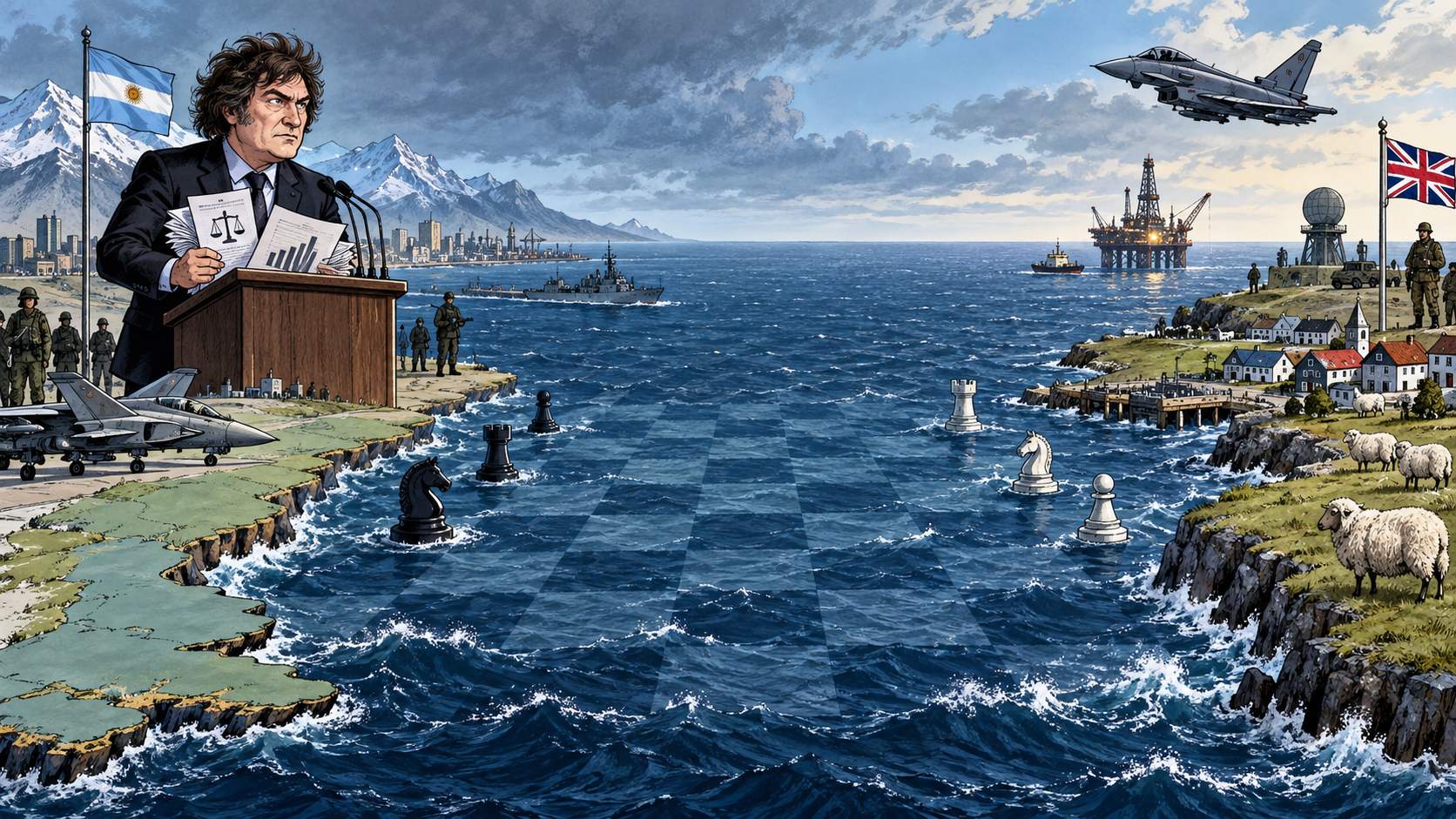
The short answer: an Argentine invasion of the Falkland Islands is highly unlikely in the foreseeable future. The political temperature has risen sharply, but the latest evidence points towards economic pressure, legal action and nationalist diplomacy—not preparations for another war.
That distinction matters. Recent headlines are more serious than the routine sovereignty statements issued by successive Argentine governments. President Javier Milei has promised sanctions against companies involved in Falklands oil production, announced further investment in Argentina’s military presence in the South Atlantic and seized upon signs that Washington might reconsider its diplomatic position.
None of this means Britain should become complacent. It does mean that talk of an imminent “Falklands War Two” runs well ahead of the facts.
Why has the dispute suddenly intensified?
The immediate trigger is oil.
In December 2025, Navitas Petroleum and Rockhopper Exploration approved the first phase of the Sea Lion oil development, around 220 kilometres north of the Falkland Islands. The project has an estimated budget of $2.1 billion through completion, with production expected to begin in 2028. The Falkland Islands Government approved the associated development programme and granted the necessary permissions. Rockhopper Exploration and the Falkland Islands Government have both confirmed the investment decision.
Argentina regards that activity as an unlawful exploitation of resources in waters it claims as its own.
On 4 September 2026, Milei’s government began sanctions proceedings against 45 individuals and companies allegedly connected to Falklands hydrocarbon activity. The measures extend beyond the principal oil businesses to shareholders and service providers. Argentina has since said that it will pursue criminal proceedings against Navitas Petroleum and associated executives. Argentina’s presidential office described the sanctions as evidence that the country would never abandon its sovereignty claim.
Milei has also promised additional funding for a naval base in Tierra del Fuego and improvements to communications infrastructure in southern Argentina. His language has become markedly harder: further development of the islands, he said, would be treated as a violation of Argentine national security.
These are meaningful developments. They raise commercial and diplomatic risk around the Falklands. But they still fall well short of a military threat.
What has Milei actually said about using force?
Crucially, Milei has not threatened an invasion.
Even while announcing sanctions and military investment, his government continues to describe dialogue as the route to a “peaceful and definitive” settlement. In April 2026, Milei publicly reaffirmed Argentina’s claim while calling for a peaceful solution through negotiations with Britain. He also pledged that 10 per cent of revenue from privatisations would be directed towards weapons and other defence investment. Argentina’s official account of the speech presents military reconstruction as a long-term national project rather than an operational plan against the islands.
Argentina’s constitution itself describes recovering sovereignty as a permanent national objective while requiring that it be pursued in accordance with international law and respect for the islanders’ way of life.
Milei’s harder tone must also be understood in a domestic political context. The sovereignty claim crosses party lines in Argentina, and a presidential election is due in October 2027. Opposition politicians have previously criticised him for being too accommodating towards Britain and for expressing admiration for Margaret Thatcher.
The Falklands therefore offer Milei a rare national cause around which he can rally voters. That makes escalation in rhetoric likely. It does not make a landing operation likely.
The Trump factor
The most destabilising new ingredient is uncertainty about the United States.
Washington traditionally avoids deciding the underlying sovereignty dispute while recognising Britain’s administration of the islands. During the 1982 war, however, American intelligence and logistical assistance proved extremely valuable to Britain.
Donald Trump has recently declined to give Britain an unequivocal guarantee of American support in a future conflict. He has also said that his administration continually reviews US positions. Milei portrayed those remarks as evidence that the international climate was moving in Argentina’s favour.
That could encourage Buenos Aires to apply more diplomatic pressure. A formal shift in American policy would be a psychological and diplomatic setback for Britain.
It would not transfer sovereignty to Argentina, invalidate the islanders’ wishes or remove the British forces already stationed there. Nor is an ambiguous presidential comment the same thing as American support for an Argentine military operation.
Milei is likely to use his relationship with Trump as leverage. Betting the country on US approval for an invasion would be an entirely different—and extraordinarily dangerous—decision.
Could Argentina capture the islands militarily?
Argentina is rebuilding some important capabilities. Its acquisition of 24 former Danish F-16 aircraft is the most significant improvement to its air force in decades. Argentine pilots conducted their first solo F-16 flight in the country in July 2026, according to the Argentine government.
The aircraft will eventually give Argentina a credible supersonic fighter capability after years without one. They do not, by themselves, create the ability to invade and hold an archipelago across hundreds of miles of hostile sea.
An invasion would require much more than fighters. Argentina would need to assemble, protect and sustain an amphibious force; suppress British air defences; secure the airfield at Mount Pleasant; land troops and heavy equipment; keep them supplied; and deter or defeat a British counterattack. Preparation on that scale would be difficult to conceal.
Britain also maintains permanent forces on the islands. The RAF says that Mount Pleasant currently hosts four Typhoon fighters, a Voyager tanker and an Atlas A400M transport aircraft. The wider defensive structure includes ground forces, air defence, local reservists and a Royal Navy patrol presence. The RAF’s Mount Pleasant profile confirms the permanently based aircraft.
The garrison changes the problem fundamentally from 1982. Argentina could no longer assume that a small landing force would seize the islands before Britain reacted. It would have to defeat an established joint defensive system from the beginning.
Argentina’s armed forces are modernising after a prolonged period of underinvestment, but possessing several modern aircraft is not the same as possessing a complete expeditionary warfare system. Training, maintenance, munitions, aerial refuelling, reconnaissance, naval protection and logistical endurance all matter.
The military balance could evolve over many years. Today, however, Argentina does not appear to have the combination of amphibious lift, air superiority, naval cover and sustainment required for a credible invasion with an acceptable chance of success.
Would Britain fight?
There is little ambiguity in London’s public position.
Britain says sovereignty will not be negotiated unless the islanders wish it. In the 2013 referendum, 99.8 per cent of participating voters chose to remain a British Overseas Territory, on a turnout of 92 per cent.
In June 2026, the British government told the Organization of American States that no change in the islands’ status could occur without the population’s consent. It also stated that British forces in the South Atlantic were defensive and maintained at the level considered necessary to protect the territory. The full UK statement is available here.
An attack would almost certainly produce a British military response. Argentina’s leaders must also assume that Britain’s allies might provide intelligence, logistics, diplomatic backing or other assistance—even if Washington remained publicly equivocal.
For Milei, an unsuccessful invasion would destroy his presidency, devastate Argentina’s economy and reopen the trauma of 1982. A successful initial landing would still risk a prolonged war against a nuclear-armed permanent member of the UN Security Council.
Those costs create powerful deterrence.
So how likely is another invasion?
My assessment is that a deliberate Argentine invasion is very unlikely—probably below five per cent over the next twelve months.
That figure is not a scientific forecast. It is a judgement based on four central facts:
- Argentina’s government continues to advocate a peaceful settlement.
- There is no publicly visible mobilisation for an amphibious operation.
- Argentina lacks several of the capabilities required to seize and hold the islands.
- The political, military and economic consequences of failure would be catastrophic.
Over a five-to-ten-year period, the risk is harder to quantify. It would rise if Argentina developed substantial amphibious and aerial-refuelling capabilities, began stockpiling suitable munitions in the south, reduced diplomatic contacts, moved forces towards Tierra del Fuego or convinced itself that Britain lacked the will to respond.
For now, the more plausible confrontation will occur through courts, sanctions, energy markets, diplomatic forums and pressure on companies involved in Sea Lion.
What warning signs should Britain watch?
The clearest indicators of a genuine change would not be another fiery speech. They would be observable military preparations:
- large-scale joint naval and air exercises near the islands;
- requisitioning or conversion of civilian shipping;
- rapid deployment of troops, fuel and ammunition to southern bases;
- acquisition of amphibious assault vessels and additional aerial tankers;
- sustained surveillance of Mount Pleasant;
- evacuation warnings or the breakdown of diplomatic relations;
- political language abandoning an explicitly peaceful solution.
The new base investment in Tierra del Fuego deserves scrutiny, as does the gradual modernisation of Argentina’s armed forces. Neither currently amounts to evidence of an invasion plan.
The real danger is miscalculation
The most realistic risk is not that Milei secretly intends to repeat the decision of Argentina’s 1982 military junta. It is that escalating political theatre creates an incident neither side initially wants.
A confrontation involving an oil-support vessel, fisheries enforcement, military patrols or sanctions could produce a cycle of retaliation. Domestic politics might then make de-escalation harder. Ambiguous signals from Washington add another opportunity for leaders to misread one another.
Britain should therefore combine credible defence with disciplined diplomacy. Keeping Mount Pleasant properly equipped reduces the temptation for any future Argentine government to gamble on a rapid fait accompli. Maintaining practical communication with Buenos Aires reduces the risk that a commercial or maritime dispute becomes a military crisis.
Conclusion
Argentina is applying more pressure over the Falklands than it has for some time. Sea Lion oil has raised the economic stakes, Milei has toughened his message, military modernisation is under way and uncertainty surrounding American policy has encouraged speculation.
But an invasion is not the most likely outcome—not even close.
Argentina presently has stronger incentives to wage a political, legal and economic campaign than to begin a war it might lose. The islands are better defended than they were in 1982, the inhabitants overwhelmingly favour their existing status, and Buenos Aires still formally commits itself to peaceful diplomacy.
The current crisis should be taken seriously without being sensationalised. The danger to watch is a long period of mounting pressure and possible miscalculation, not an Argentine armada appearing over the horizon tomorrow.
Assessment updated 8 September 2026.


Leave a Reply