
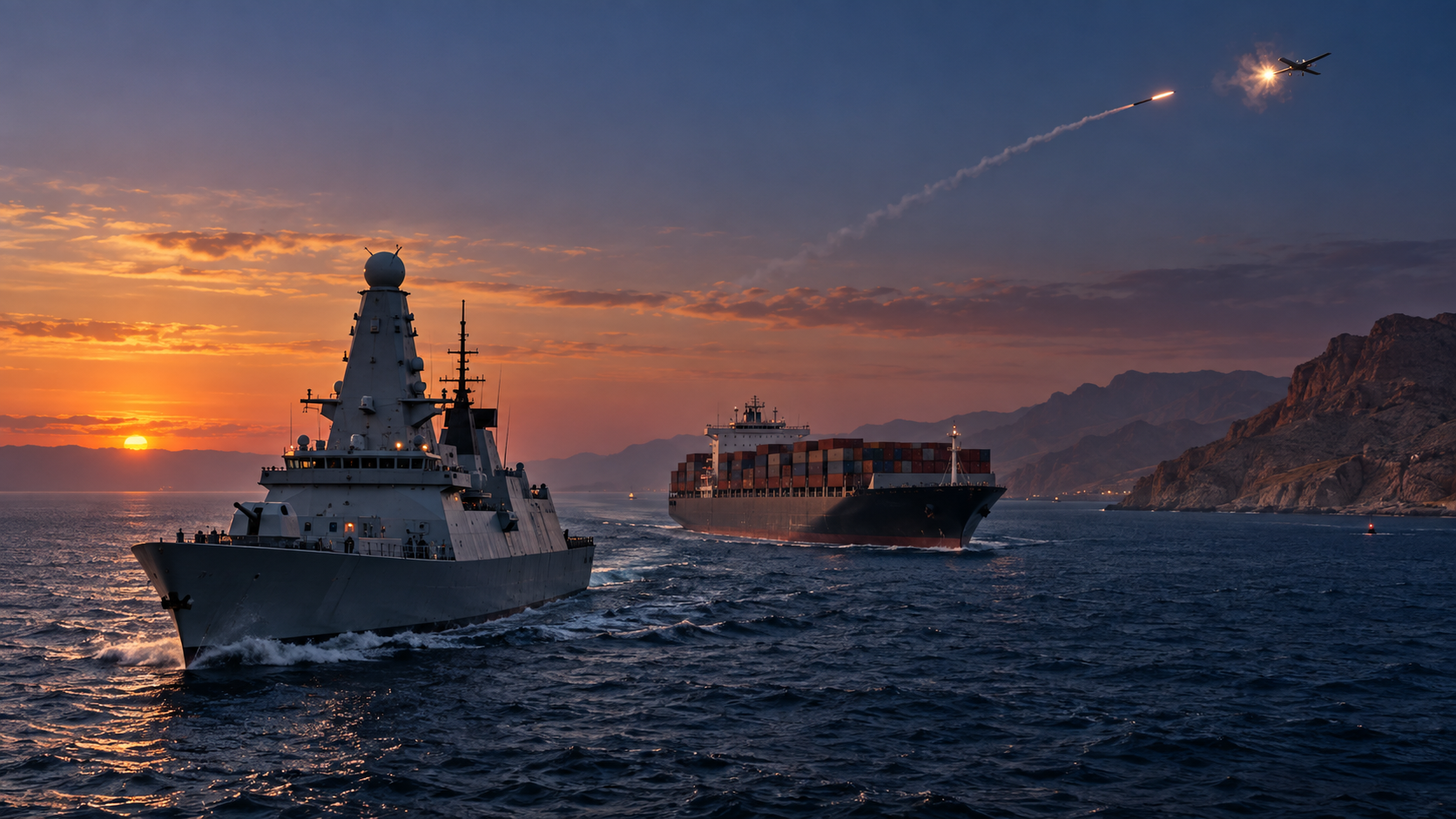
The international community has spent too long treating Houthi attacks on commercial shipping as an unpleasant disruption rather than a direct challenge to international security.
These are not harmless acts of protest. Missiles, drones and armed vessels have been used against merchant ships carrying civilian crews through one of the world’s most important maritime corridors. Seafarers have been killed, vessels damaged and global supply chains placed at risk.
The International Maritime Organization recorded 61 confirmed incidents affecting shipping between January 2024 and September 2026, following another 17 incidents in the preceding two months. In August 2026, the organisation again condemned a deadly attack in which innocent seafarers lost their lives. IMO: Red Sea situation
Britain and its allies need a stronger response—not an uncontrolled war, but a sustained strategy capable of imposing real consequences.
Freedom of navigation is not optional
The Red Sea and the Bab el-Mandeb Strait connect Europe and Asia through the Suez Canal. When that passage becomes unsafe, ships must either accept an intolerable risk or take the longer route around the Cape of Good Hope.
The effects do not remain thousands of miles away. Longer voyages consume more fuel, occupy vessels for more time and increase insurance and freight costs. Those costs eventually reach British businesses and households.
More importantly, freedom of navigation is a basic principle of the international order. No armed movement should be permitted to decide which civilian ships may pass through an international waterway.
The United Nations Security Council has repeatedly demanded an end to Houthi attacks on merchant vessels. Its original Resolution 2722 was not an invitation to negotiate the meaning of safe passage. It was an unequivocal demand that the attacks stop. United Nations Security Council
They have not stopped.
Condemnations that produce no meaningful consequences gradually become advertisements for weakness.
A stronger approach does not mean indiscriminate war
Calling for a strong-armed response should not be confused with demanding the destruction of Yemen or punishment of its people.
Yemen has already endured years of civil war, hunger, displacement and collapsing public services. Any British or allied action must distinguish rigorously between the Houthi military apparatus and Yemeni civilians. It must comply with international law, use the strictest possible targeting standards and include serious measures to protect humanitarian relief.
Strength without discipline would be both immoral and strategically foolish. Civilian casualties would feed Houthi propaganda, increase recruitment and make a future political settlement more difficult.
But restraint cannot mean paralysis. A credible strategy should combine defensive naval power, carefully limited military action, economic pressure, interdiction and diplomacy.
What a firm strategy should involve
First, Britain should continue working with allies to protect merchant ships and intercept incoming missiles and drones. Naval escorts, surveillance and rapid intelligence sharing can reduce the immediate danger to civilian crews.
Second, launch facilities, radar systems, weapons stores and unmanned-vehicle infrastructure being actively used to attack shipping should remain legitimate targets for proportionate action, provided that attacks are necessary, legally justified and planned to minimise civilian harm.
Third, the supply network behind the campaign must be disrupted. That means stronger enforcement of the UN arms embargo, closer maritime inspection and coordinated action against the financial and procurement networks that obtain missile, drone and communications components.
Fourth, consequences must reach commanders and facilitators rather than the wider Yemeni population. Targeted sanctions, asset freezes and travel restrictions are preferable to broad economic measures that would deepen civilian suffering.
Finally, military pressure must support a political objective. The desired outcome is not permanent bombardment or regime change. It is the end of attacks on shipping, the release of detained seafarers and the restoration of safe navigation alongside a wider Yemeni peace process.
Britain cannot act alone
A durable response requires a broad coalition. The safety of the Red Sea is not exclusively a British, American or European concern. Asian exporters, Arab states, African economies and every country dependent on maritime trade have an interest in keeping the route open.
Britain should therefore press for greater operational and diplomatic participation from affected states. The wider the coalition, the harder it becomes for the Houthis to portray enforcement as a Western assault on Yemen.
Regional diplomacy is particularly important. Oman, Saudi Arabia and other neighbouring states have channels and interests that Western governments do not possess. Pressure and negotiation should operate together: a clear route to de-escalation must exist, but it must be accompanied by a clear cost for continued aggression.
The danger of doing too little
Some will argue that any military response risks escalation. That concern is valid. Every use of force carries uncertainty, and the Middle East hardly needs another open-ended conflict.
Yet failing to respond also causes escalation. If repeated attacks succeed in closing an international trade route, the lesson will be noticed far beyond Yemen. Armed groups elsewhere will see that relatively inexpensive drones and missiles can hold global commerce hostage.
The choice is therefore not between risk and perfect safety. It is between the managed risks of firm collective action and the growing risks created by impunity.
Britain should resist demands for reckless escalation, invasion or collective punishment. But it must also reject the comforting fiction that statements of concern will protect ships and their crews.
Resolve with limits
The Houthis must be given a straightforward choice: stop attacking civilian and commercial vessels, release detained seafarers and participate seriously in diplomacy—or face sustained, proportionate pressure against the military and financial systems enabling those attacks.
That is not warmongering. It is the defence of civilian life, international law and a trading system upon which millions of ordinary people depend.
A strong policy is not measured by how loudly governments threaten their opponents. It is measured by whether it establishes clear objectives, brings together credible allies and imposes consequences without losing sight of the innocent.
Britain needs precisely that kind of policy in the Red Sea: determined enough to deter further attacks, disciplined enough to avoid a wider war and persistent enough to show that international shipping cannot be held hostage with impunity.


Leave a Reply