
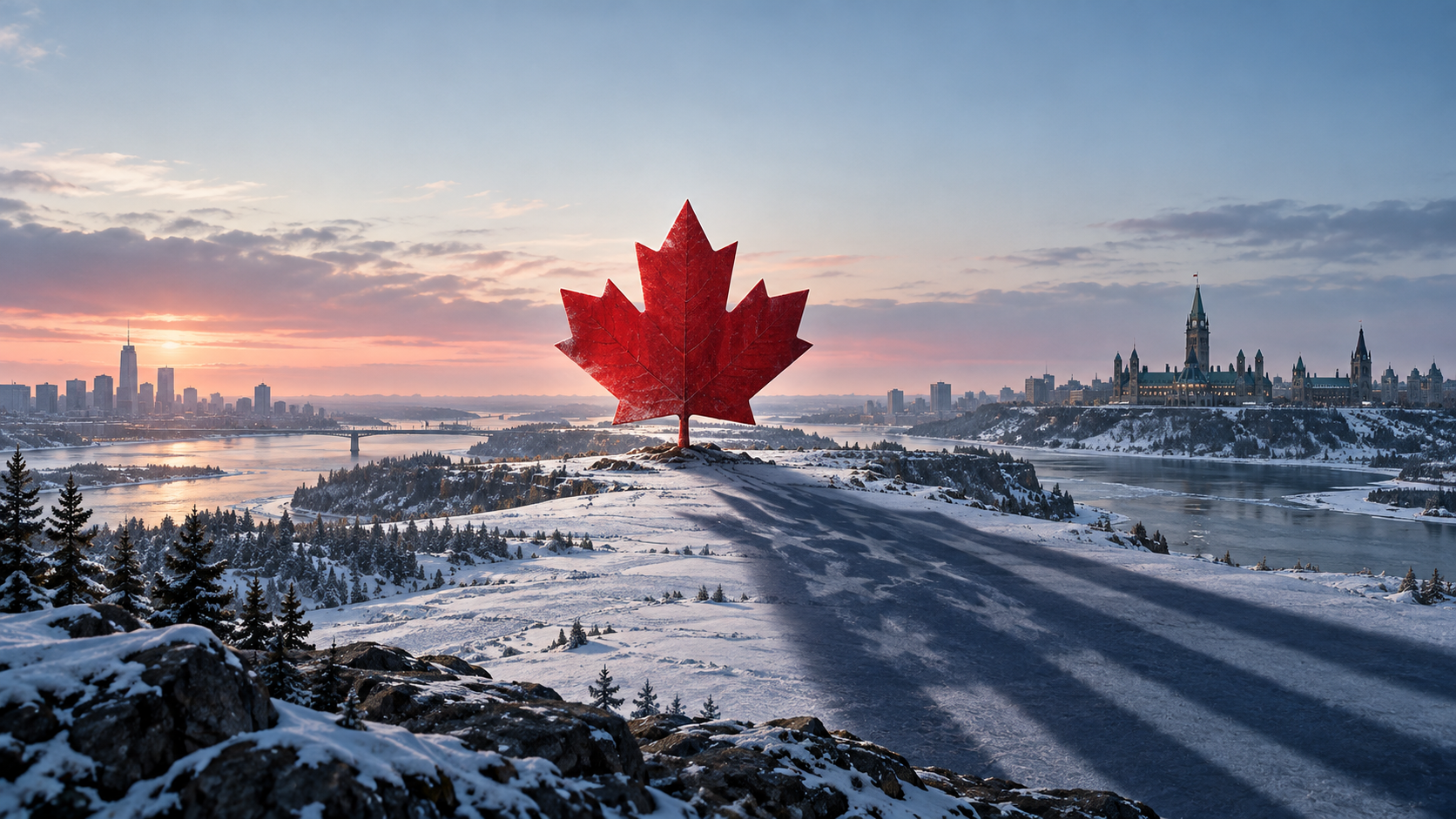
The short answer is that an American annexation of Canada remains extremely unlikely. A military takeover is even less plausible. However, sustained American pressure on Canadian politics, trade and strategic choices is not only possible—it is already happening.
That distinction matters.
When Donald Trump repeatedly talks about Canada becoming America’s “51st state”, it is tempting either to dismiss the idea as a joke or to treat invasion as imminent. Neither response is particularly useful. The realistic danger is not American troops marching into Ottawa. It is a more gradual attempt to weaken Canada’s room for independent action through tariffs, investment decisions, political pressure and interference in its domestic divisions.
Canada is unlikely to disappear. It could nevertheless find its sovereignty increasingly constrained.
Is Trump serious about taking Canada?
Trump has discussed absorbing Canada too frequently for every remark to be dismissed as casual humour. In February 2025, he said he was serious about wanting Canada to become the 51st state. He also spoke of using economic pressure rather than military force. Former Canadian prime minister Justin Trudeau reportedly warned business and labour leaders that Trump’s interest was genuine and connected to Canada’s natural resources. The Associated Press reported both statements at the time.
Yet presidential interest is not the same as a workable American policy.
Annexation would require Canadian consent or an extraordinary act of aggression. It would also need substantial approval inside the United States. The American Constitution gives Congress—not the president alone—the authority to admit new states. Any settlement would raise enormous questions about representation, borders, citizenship, taxation, provincial powers, Indigenous treaties, Quebec’s status and the Canadian Crown. Congress’s constitutional guidance confirms that the admission of new states is a congressional power.
A president cannot simply sign an executive order turning another sovereign country into American territory.
Canadians overwhelmingly reject annexation
The greatest obstacle is straightforward: most Canadians do not want it.
An Angus Reid Institute survey in March 2025 found that nine out of ten Canadians would vote against joining the United States. A later Ipsos study found opposition hardening further, particularly among older Canadians. Although support can rise when pollsters attach attractive financial guarantees to the proposal, there is no evidence of anything approaching a democratic mandate for union.
The regional picture deserves attention. Support has sometimes been higher in Alberta and Saskatchewan, while younger Canadians facing housing costs and economic insecurity have shown more openness than older generations. Those figures reveal grievances which American political interests could exploit. They do not show Canada preparing to vote itself out of existence.
Even a narrow referendum victory would not make annexation automatic.
The Supreme Court of Canada ruled in its Quebec secession reference that a clear majority answering a clear question could create a duty to negotiate, but could not produce unilateral secession. Any fundamental territorial change would require constitutional negotiation that respected federalism, democracy, the rule of law and minority rights. The Court’s judgment makes clear that a referendum would begin a process rather than settle it.
Dissolving Canada would be immeasurably more complicated than the departure of one province.
Could America take Canada by force?
In raw military terms, the United States possesses overwhelming superiority. Canada could not defeat the United States in a conventional war fought without outside support.
That fact does not make an invasion likely.
Canada is a NATO ally, a close intelligence partner and an integral participant in continental defence. Since 1958, the two countries have jointly operated NORAD, described by the organisation as the world’s only binational military command. Canadian and American personnel share systems, facilities and responsibility for aerospace warning and defence. NORAD’s own history shows how deeply the two countries’ security structures are integrated.
Invading Canada would therefore mean attacking one of America’s closest partners, destroying its international credibility and turning a peaceful border into an occupation zone stretching thousands of miles.
Canada is also a vast country of more than 40 million people. Capturing government buildings would be easier than governing the territory. Any occupation would face political resistance, civil disobedience, economic disruption and possibly armed resistance. It would divide the United States internally and create a constitutional crisis across the Western alliance.
The strategic gains would be tiny compared with the damage. America already enjoys access to Canadian energy, minerals, markets and defence cooperation without paying the ruinous price of conquest.
My assessment is that a deliberate American military invasion of Canada is exceptionally unlikely—well below one per cent over the next twelve months. That is a judgement, not a scientific forecast, but no visible military preparations or political consensus currently point towards such an operation.
Could Canada voluntarily join the United States?
This is also highly unlikely.
For a peaceful union to become plausible, several things would have to change simultaneously:
- Canadian support for annexation would need to rise from a small minority to a durable majority.
- That support would need to extend across provinces, including Quebec.
- Indigenous nations would have to be involved in negotiations concerning treaty and territorial rights.
- Canada would require an enormous constitutional settlement.
- The United States Congress would have to approve admission and decide whether Canada entered as one state, several states or a territory.
- Both countries would have to agree arrangements for debts, pensions, healthcare, taxation, currency, armed forces and natural resources.
Each issue could derail the process independently. Taken together, they make voluntary annexation almost inconceivable under present conditions.
Calling Canada the “51st state” also hides an obvious political difficulty for Washington. Canada has ten provinces and three territories, a population larger than California’s and political preferences that would alter the balance of Congress and the Electoral College. American politicians would immediately fight over how Canadian representation should work.
The slogan is simple. The constitutional reality is anything but.
Economic coercion is the more credible threat
Canada’s vulnerability lies in economics rather than invasion.
Despite recent efforts to diversify trade, 71.7 per cent of Canadian merchandise exports still went to the United States in 2025. That was down from 75.9 per cent in 2024, but it demonstrates how much leverage Washington retains. Statistics Canada reported that exports to the US fell during 2025 as trade tensions intensified.
An American administration can use tariffs, procurement restrictions, border delays and regulatory decisions to impose substantial costs on Canadian industries. It can make access to defence programmes, energy infrastructure or the American market conditional on Canadian concessions.
That would not formally end Canadian sovereignty. It could, however, narrow the range of policies available to any Canadian government.
This is why Trump’s language matters even if annexation never happens. Threats can be used as negotiating weapons. By placing an extreme demand on the table, Washington can make lesser concessions appear moderate.
Political interference is more likely than political takeover
The most plausible American intervention would operate through Canadian politics itself.
American organisations, media personalities, wealthy donors and online networks can amplify Canadian separatism, culture-war arguments or hostility towards the federal government. Alberta is the clearest pressure point because its economic grievances, energy resources and existing separatist movement offer fertile ground for outside influence.
That does not mean Alberta is about to join the United States. A 2025 Research Co. survey found that 75 per cent of Canadians opposed becoming an American state, although 45 per cent believed the United States might attempt to annex Alberta if the province held an independence referendum. The polling illustrates the gap between Canadian consent and Canadian anxiety.
A campaign aimed at encouraging provincial fragmentation would be cheaper and less dangerous for Washington than threatening Canada as a whole. Foreign interference might include coordinated propaganda, covert financial support, selective economic promises or efforts to undermine confidence in Canadian institutions.
Such conduct would still face strong resistance, but it represents a more credible scenario than formal annexation.
What warning signs should Canada watch?
The danger would have increased substantially if several developments appeared together:
- sustained American funding or organisational support for Canadian separatist groups;
- explicit offers of statehood to an individual province;
- economic measures designed to reward provinces which defy Ottawa;
- attempts to manipulate a provincial or federal referendum;
- demands for control over Canadian Arctic territory or strategic minerals;
- pressure to place Canadian infrastructure under permanent American authority;
- American legislation preparing a formal route for Canadian admission;
- evidence that a major Canadian party had accepted annexation or permanent political subordination as policy.
Another presidential speech about the 51st state is not, by itself, proof that a takeover is approaching. Institutions, legislation, money and organised political support would be much more important indicators.
The real risk is dependency
Canada is not likely to become part of the United States. Its population opposes the idea, its constitutional structure makes it exceptionally difficult and America has little to gain from using force against a friendly neighbour.
The probability of a complete American political takeover remains very low—perhaps below two per cent over the next five years unless Canadian public opinion changes dramatically.
The likelihood of persistent American coercion is much higher.
Washington has the economic scale to damage particular Canadian industries, influence investment and force difficult choices upon Ottawa. It can also exploit regional resentment and flood Canadian political debate with American narratives. None of this requires annexation.
Canada’s best defence is therefore not military mobilisation against an imaginary invasion. It is national resilience: broader trading relationships, secure elections, transparent political finance, stronger domestic infrastructure and serious engagement with provincial grievances.
The border will almost certainly remain where it is. The harder question is how much independent freedom Canada can preserve on its side of it.
Assessment updated 14 September 2026.


Leave a Reply