
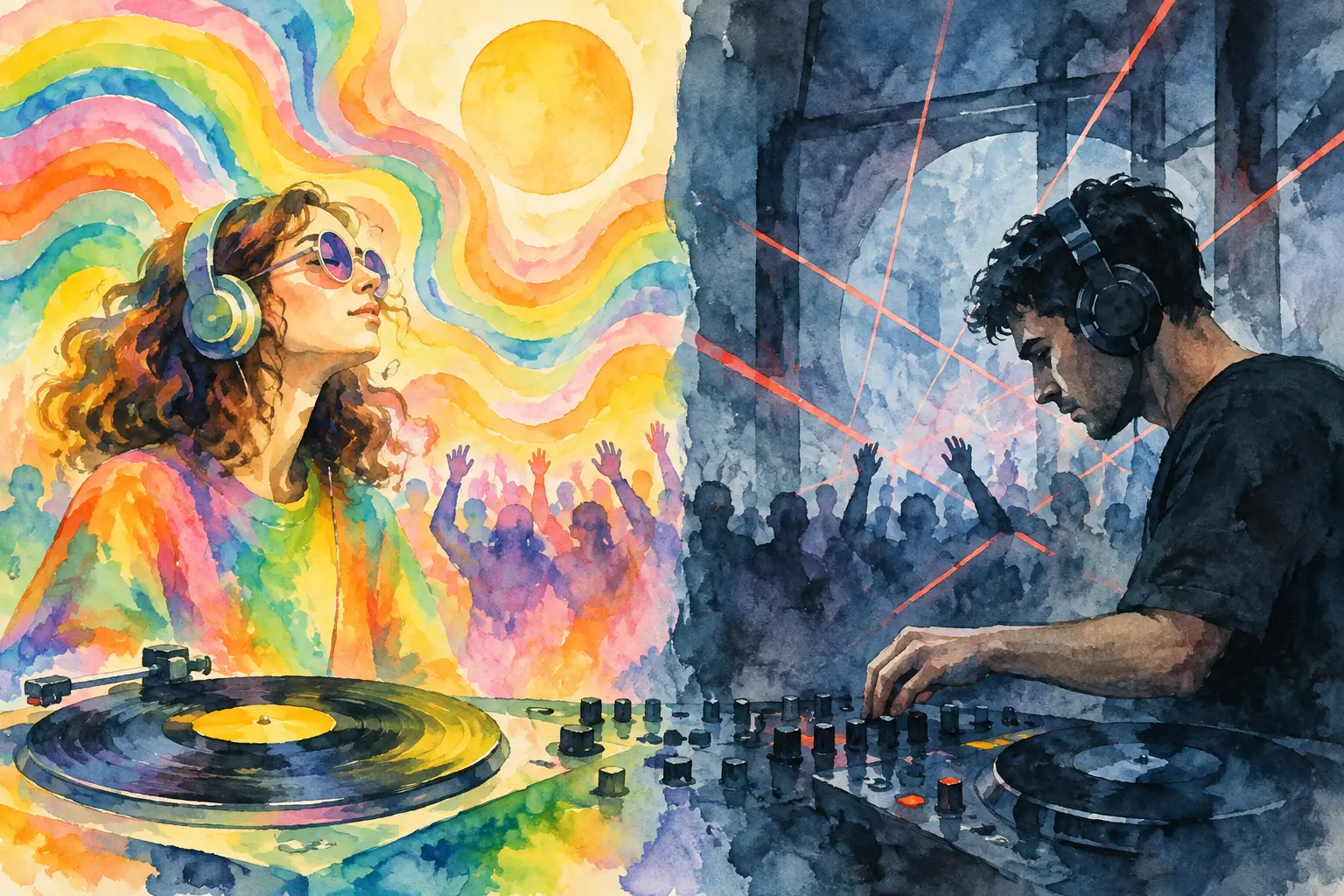
A squelching 303 line can turn a room inside out. A hard, repeating kick can do exactly the same thing. That overlap is why acid house versus techno differences can feel blurry once the lights are low and the DJ is locked into a proper run of records. Yet these are not interchangeable labels. They come from connected but distinct scenes, and they create different kinds of pressure on a dancefloor.
For listeners building playlists, selectors planning a set, or producers choosing where to take a new track, knowing the difference helps. Acid house often feels mischievous, body-moving and unstable. Techno can be just as physical, but it commonly aims for hypnosis, machinery and forward motion. Both can be raw, euphoric, minimal, maximal, soulful or brutal. The clue is in how they get there.
Acid house versus techno differences at a glance
The shortest useful answer is this: acid house is house music transformed by the liquid, resonant sound of the Roland TB-303 bass synthesiser. Techno is a broader electronic form built around repetition, synthetic textures and rhythm, with roots in Detroit’s futuristic machine funk. Acid can appear in techno, and techno tracks can use a 303, so equipment alone never tells the whole story.
Acid house usually keeps a stronger connection to house music’s swing, groove and communal lift. Its signature bassline bubbles, slides and screams around the beat, often behaving like the lead vocalist. Techno more often treats its elements as parts of a system: kick, percussion, bass, chord stab, noise, atmosphere and repetition working together until the track becomes an environment.
Think of acid as a wild line being pushed and pulled in real time. Think of techno as a machine that gains momentum one precisely placed component at a time. Those are broad descriptions, not rules. A deep acid cut may be patient and atmospheric; a peak-time techno tune may be wild enough to melt the same speakers.
Different cities, different starting points
Acid house took shape in Chicago in the mid-1980s. House DJs and producers were already combining disco’s pulse, drum machines, gospel-flavoured vocals and stripped-back club rhythm. The TB-303 was originally designed to accompany musicians, but its unusual filter and resonance controls made it far more exciting as a bassline generator. Producers such as Phuture turned its supposed limitation into a new language.
The sound travelled quickly. In the UK, acid house became tied to late-1980s rave culture, warehouse parties, pirate radio, smiley faces and a genuine shift in youth culture. The visual history is famous, but the music is the lasting point: repetitive grooves made for collective release, with the 303 offering a strange, elastic hook unlike conventional bass guitar or synth bass.
Techno developed in Detroit during the same broad period, shaped by Juan Atkins, Derrick May and Kevin Saunderson, often called the Belleville Three. Their records drew from electro, Chicago house, European electronic music, funk and the industrial character of Detroit itself. Techno imagined a future through drum machines and synthesisers. Sometimes that future sounded sleek and cosmic; sometimes it sounded stark, urgent and metallic.
The scenes exchanged ideas from the beginning. Chicago house fed Detroit techno, Detroit’s innovations travelled to Europe, and UK rave culture eagerly absorbed acid, techno, breakbeat and hardcore. Treating either genre as a sealed box misses the fun. Their differences matter because they reveal the intention behind the groove, not because club music needs gatekeepers.
The sound: squelch versus system
The 303 is acid house’s best-known calling card. Its tone is created through programmed note patterns, accents, slides, filter movement and resonance. A producer can make it purr softly beneath chords or drive it into a sharp, talking squelch that feels almost physical. The pleasure comes from tension: opening the filter, increasing resonance, altering the pattern, then releasing the room into the next phrase.
That does not mean every acid house track is a relentless squeal-fest. Some use the 303 sparingly, with warm pads, piano touches, vocal snippets or classic house drums. But when acid is central, the bassline has personality. It twists, argues, teases and takes up space.
Techno’s sonic identity is wider. One record may centre on huge industrial percussion; another on dubby chord echoes; another on a looping synth sequence so simple it becomes hypnotic. The kick drum is often more forceful and more central to the arrangement than in classic house, while hi-hats, claps and percussion establish a functional, physical momentum.
A useful listening test is to ask what your ear follows. If you are following a restless, filter-driven bassline that seems to lead the track, acid house is likely nearby. If you are absorbed by the cumulative relationship between kick, percussion, texture and repetition, you are probably in techno territory. Naturally, there are tracks where the honest answer is both.
Rhythm, tempo and movement
Both styles commonly use four-to-the-floor drums, so tempo is not a perfect dividing line. Acid house can sit around classic house speeds, often roughly 120 to 130 BPM, though acid techno and rave-focused acid can run much faster. Techno can be anything from slower, spacious grooves to punishing peak-time tempos well beyond that range.
The feel matters more than the number. House-derived acid often has bounce. It leaves room for the hips, with shuffled hats, claps and a bassline that creates a rolling conversation with the kick. Techno often feels more linear. Its energy may come from persistence, with a kick pattern that asks dancers to commit to the pulse rather than chase a melodic groove.
Neither approach is better. A warm acid house record can reset a room after a run of tougher tracks, making dancers grin without losing the drive. A focused techno record can pull scattered energy into one shared direction. Great DJs use both effects deliberately instead of treating genre tags as a fence.
Arrangement and DJ use
Acid house tracks frequently make the 303 performance the story. The arrangement may introduce the beat, establish the bass pattern, then gradually alter filter settings and resonance until the line reaches a peak. Breakdowns can feel cheeky, ecstatic or slightly unhinged. That makes acid brilliant for injecting colour into a set, especially when a crowd needs a memorable hook.
Techno often develops with smaller changes over a longer span. A percussion loop enters. A layer of noise widens. The bass shifts by one note. A chord appears, disappears and returns with more weight. This is ideal for long blends because the track offers a stable rhythmic bed while its details keep evolving. It rewards patience from both DJ and dancer.
For mixing, listen beyond genre names. An acid record with a clean intro and controlled low end may blend beautifully into driving techno. A dense, distorted 303 line can clash with another busy bass part, so give it room. Likewise, a stripped-back techno tool can make an excellent bridge before bringing an acid lead back into focus.
If you are producing, decide what owns the low-mid range. In acid house, the 303 may need to be the main event, which means the kick and other bass elements must support it rather than fight it. In techno, you might give each element a narrower role and build impact through arrangement, saturation, space and repetition. The best choice depends on the track, not the label you hope to attach later.
Where acid techno fits
Acid techno is the glorious overlap that confuses the argument and proves why it is worth having. It takes the 303’s acidic bite and places it inside tougher, often faster techno structures. The kick may be heavier, the mood darker, and the arrangement more relentless than classic Chicago-inspired acid house.
This is where a track can have unmistakable acid sounds while its overall function is techno. The 303 is present, but the groove is less about house swing and more about sustained propulsion. UK free-party culture and European rave scenes gave this combination plenty of room to evolve, creating records that feel built for big systems and late hours.
A release such as Wez G’s Windy City Acid naturally sits in the conversation through its acid reference point, but the final genre call always comes down to the rhythm, arrangement and atmosphere you hear. Names can signal an influence. The speakers deliver the verdict.
Don’t let labels shrink the selection
Genre knowledge should sharpen your ears, not make your listening smaller. Acid house can be playful, emotional and gloriously messy. Techno can be elegant, soulful and deeply funky. Both have underground histories, global communities and enough subgenres to keep a curious listener busy for years.
The next time a track hits, listen for the role of the bassline, the weight of the kick and the way the arrangement creates movement. Then use that instinct in your own playlist or DJ set. If it makes the room move, keep it rolling. CHEERS!

Leave a Reply