
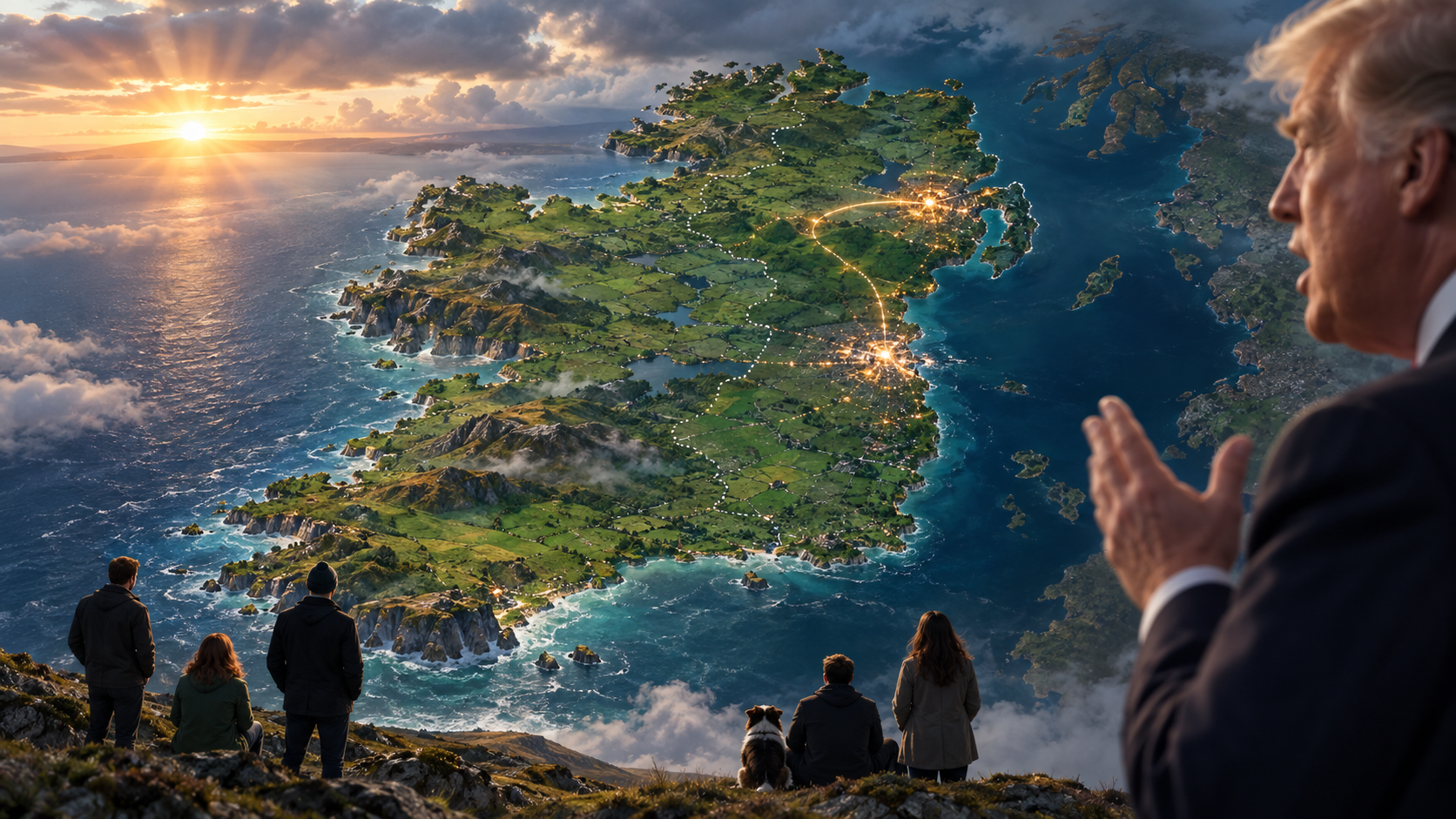
Donald Trump’s support for Irish unity has reopened an old constitutional debate. The case for a united Ireland, however, rests on democracy, practical cooperation and respect for every tradition—not the opinion of any foreign president.
Donald Trump has a habit of reducing complicated political questions to a few blunt sentences. During his visit to Ireland, he said that he would “love to see” the island unified and argued that, if it is going to happen eventually, it “may as well happen now”.
Today he doubled down. Speaking to reporters, Trump described bringing Northern Ireland and Ireland together as “one of the naturals of all time”.
These are extraordinary comments from an American president. Previous US administrations have generally supported the peace process while remaining neutral on Northern Ireland’s constitutional future. Trump has stepped straight across that convention.
Yet the importance of his intervention should not be exaggerated. Donald Trump cannot unite Ireland. Neither can a British prime minister, an Irish taoiseach or a government in Washington.
Only the people of Ireland can make that decision.
Trump’s words matter because they have pushed Irish unity back into international conversation. They do not, by themselves, make the argument. The real case for a united Ireland is democratic, economic and practical—and it must include people who proudly consider themselves British.
The Good Friday Agreement made unity legitimate
For much of the twentieth century, the constitutional question was inseparable from conflict. The Good Friday Agreement changed that.
The Agreement recognised that Northern Ireland would remain within the United Kingdom for as long as a majority there wished it to do so. It also established that a united Ireland could be created through peaceful and democratic consent.
That principle is fundamental. Irish unity is no longer a revolutionary demand to be achieved through force. It is a lawful constitutional option explicitly recognised by both the British and Irish governments.
Under the Agreement, voters in Northern Ireland would have to support reunification. People in the Republic would also vote on the necessary constitutional change.
The same Agreement protects the birthright of people in Northern Ireland to identify as British, Irish or both, and to hold British and Irish citizenship. Those protections must remain central to any serious proposal for unity.
The full Belfast Agreement provides the route. The task now is to discuss honestly what travelling that route would involve.
Brexit changed the argument
The border was deliberately made less visible after the peace agreement. People could live on one side, work on the other and cross without thinking about customs posts or constitutional disputes.
Brexit disturbed that balance.
Northern Ireland was taken out of the European Union even though a majority of its voters supported remaining. Governments have since spent years constructing special trading arrangements to prevent a hard land border while protecting access to the UK market.
Those arrangements may be necessary, but their complexity exposes a basic geographical fact: Ireland is one island containing deeply connected communities, supply chains, farms, public services and transport networks.
Irish unity would return Northern Ireland to the European Union and remove the constitutional cause of many cross-border trade complications. That does not mean there would be no economic disruption. There would be difficult questions involving taxation, pensions, welfare, healthcare, currencies and public spending.
But complexity is an argument for preparation, not permanent paralysis.
One island already shares many interests
The strongest case for unity is found not in flags but in ordinary life.
Rivers, electricity networks, railways, roads, tourism, agriculture and environmental problems do not stop at the border. Neither do infectious diseases, organised crime or the effects of climate change.
Ireland already has practical North–South cooperation in many areas. The Irish Government’s Shared Island initiative is investing in infrastructure, research, civic partnerships and closer economic connections.
That work demonstrates what constitutional debate should look like: cooperation before confrontation, evidence before slogans and relationships before referendums.
A united Ireland could plan infrastructure and public services across the whole island. It could develop the Dublin–Belfast economic corridor, improve neglected border regions, coordinate energy policy and create a stronger combined presence within the European Union.
None of those benefits will arrive automatically. They require competent government, detailed costings and long-term investment. Nationalism alone does not build hospitals or improve trains.
Unity cannot mean absorption
Supporters of reunification sometimes speak as if Northern Ireland could simply be added to the existing Irish state.
That approach would fail.
Nearly two million people live in Northern Ireland. A very large community has a British identity, a unionist tradition and a genuine attachment to the United Kingdom. They cannot be treated as an obstacle to be defeated or a minority expected to abandon its history.
A successful united Ireland would need to be a new political settlement rather than a victory parade.
British citizenship should remain available. Cultural and religious traditions must be protected. The Orange Order, the Irish language, Ulster Scots, Gaelic games and Remembrance Sunday must all be able to exist without fear or humiliation.
There should be an open debate about whether new constitutional arrangements would require a reformed flag, anthem and system of government. Serious consideration should also be given to devolved government in the North within an all-Ireland state.
The purpose of unity should be to reconcile people, not merely to rearrange territory.
The questions must be answered before a vote
A border poll held without preparation could divide communities and leave voters choosing between competing uncertainties.
Before any referendum, both governments should publish detailed proposals covering:
- healthcare and the future of the NHS in Northern Ireland;
- taxation, welfare, pensions and public-sector pay;
- citizenship and constitutional protections;
- policing, courts and security;
- the structure of devolved or regional government;
- currency and banking;
- education and religious rights;
- the financial contribution expected from Dublin, London and the European Union;
- the timetable for any transition.
People deserve to know what they are voting for—not simply what they are voting against.
The Irish Government should begin a formal citizens’ assembly or similar process involving nationalists, unionists and those who identify with neither tradition. Unionists should participate without being asked to surrender their position. Their involvement would test the proposals and expose weaknesses that advocates of unity might otherwise overlook.
Trump has opened a door, but Ireland must walk through it
There is an obvious irony in Donald Trump becoming an unexpected advocate of Irish unity. Several unionist politicians have cultivated close relations with him, while many Irish nationalists strongly oppose his wider politics.
But the constitutional future of Ireland should not depend on whether people admire or despise the American president.
Trump is right about one thing: Irish unity is neither an absurd fantasy nor a forbidden subject. It is a legitimate possible future already provided for by an internationally recognised peace agreement.
Where he is wrong is in suggesting that it might simply happen because it appears natural on a map.
Peaceful reunification would require consent, patience, generosity and years of detailed planning. Its supporters must persuade rather than threaten. They must demonstrate that people would be safer, more prosperous and more fully respected in a shared state.
The strongest case for a united Ireland is not that Britain should be driven out or that history demands revenge. It is that the people who share this island could build a better future by governing it together.
That case deserves to be made confidently—but also carefully.
Donald Trump’s comments have started another argument. Ireland should now turn that argument into a serious, inclusive and democratic conversation.


Leave a Reply