
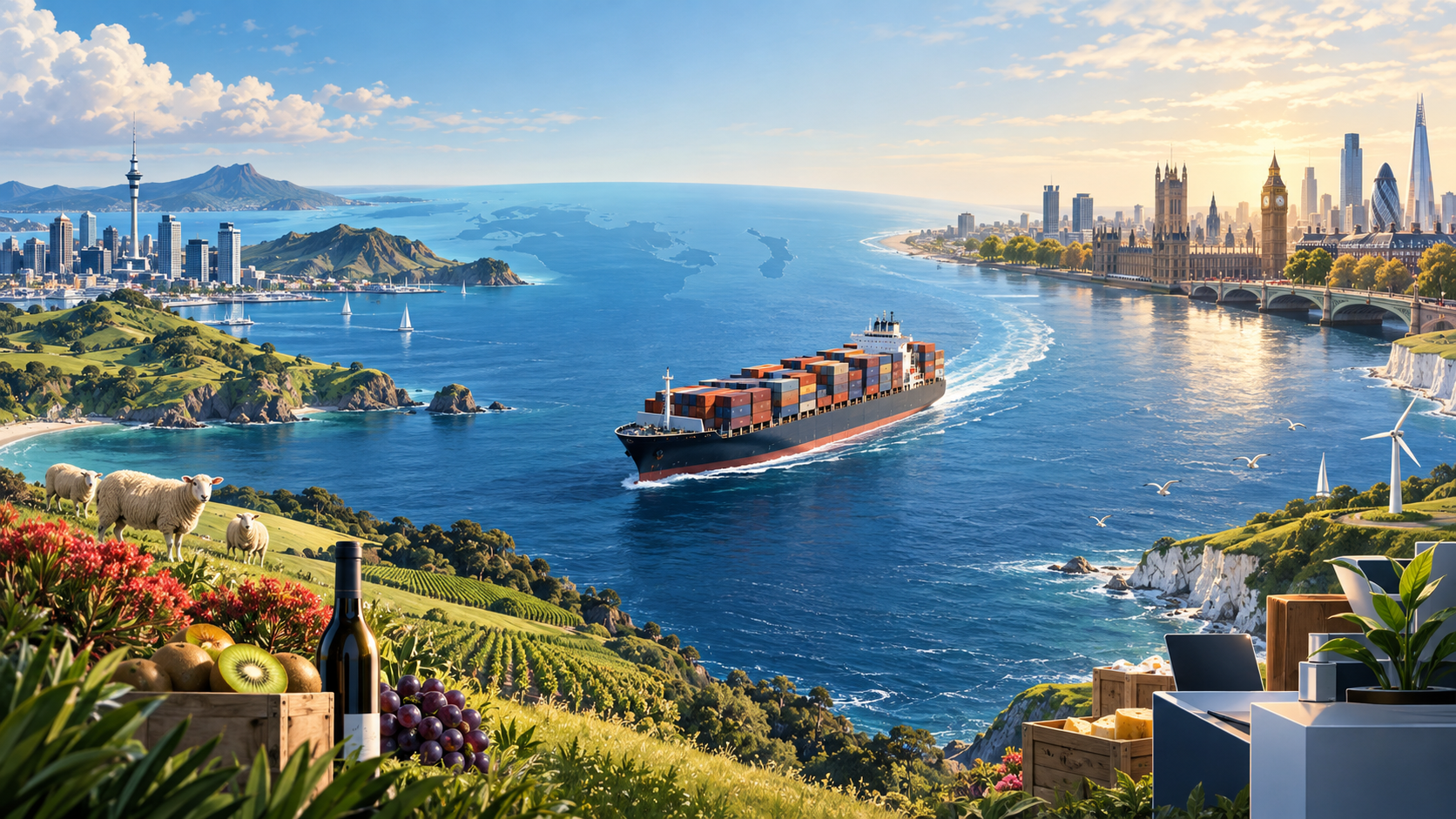
Separated by almost 12,000 miles, New Zealand and the United Kingdom are building a trade relationship based increasingly on services, technology and investment—as well as the familiar exchange of food, drink and manufactured goods.
The commercial relationship between New Zealand and the United Kingdom is an unusual one. Geography suggests that the two countries should be distant partners, yet history, migration, language and closely aligned institutions continue to draw them together.
Today, that longstanding connection is being renewed through a modern free trade agreement, growing digital commerce and stronger links between businesses and investors.
Two-way trade in goods and services reached a record £4 billion in 2025. The UK exported approximately £2.1 billion to New Zealand and imported £1.9 billion in return, according to the UK Department for Business and Trade. That remains modest beside Britain’s commerce with Europe or the United States, but the direction is encouraging: total bilateral trade has risen from £2.3 billion in 2021 and £2.9 billion in 2022. UK Department for Business and Trade
A relationship transformed by history
Britain was once New Zealand’s dominant export market. Refrigerated shipping, introduced in the late nineteenth century, allowed New Zealand farmers to send meat and dairy products halfway around the world. For decades, British households consumed New Zealand lamb, butter and cheese, while New Zealand imported British machinery, vehicles and manufactured goods.
Britain’s entry into the European Economic Community in 1973 forced New Zealand to diversify. Australia, China, the United States, Japan and other Asian economies became increasingly important, while the UK’s share of New Zealand trade declined.
The relationship never disappeared, however. British consumers continued to buy New Zealand wine and agricultural products, while family connections, tourism and migration sustained a substantial trade in services. The UK is now New Zealand’s seventh-largest trading partner and its fourth-largest market for services exports. New Zealand Ministry of Foreign Affairs and Trade
The free trade agreement changes the rules
The UK–New Zealand Free Trade Agreement entered into force on 31 May 2023. It was one of the first entirely new trade agreements negotiated by the UK following Brexit.
For British exporters, New Zealand removed tariffs from all UK goods immediately. Products that previously faced duties—including clothing, footwear, buses and construction equipment—became tariff-free.
New Zealand secured equally significant access to the British market. On the agreement’s first day, 99.5 per cent of its existing goods trade became eligible for duty-free treatment, either through tariff elimination or new quotas. The remaining tariffs will be removed progressively, with sensitive agricultural products liberalised over longer periods. New Zealand Ministry of Foreign Affairs and Trade
The early agricultural figures are striking. In the two years following the agreement’s introduction, New Zealand’s primary-sector exports to the UK rose by 25 per cent to NZ$1.33 billion. Dairy exports reached NZ$157 million in the year ending June 2025, while beef exports increased from less than NZ$15 million before the agreement to NZ$120 million. Lamb remained a central part of the trade. New Zealand Ministry of Foreign Affairs and Trade
The figures do not prove that tariff reductions caused every part of the increase. Exchange rates, commodity prices, consumer demand and supply conditions also influence trade. Nevertheless, the agreement has clearly removed obstacles and made the British market more attractive to New Zealand producers.
More than lamb and Sauvignon Blanc
Popular perceptions of the relationship tend to focus on New Zealand lamb and Marlborough Sauvignon Blanc. Both remain important, but they provide only a partial picture.
Britain exports cars, machinery, pharmaceuticals and consumer products to New Zealand. Its strongest opportunities may increasingly lie in services. UK service exports to New Zealand reached approximately £1.4 billion in 2025, led by travel and professional and management consultancy. British firms also possess recognised strengths in financial services, engineering, law, education, technology and the creative industries.
The trade agreement reflects this changing economy. It supports cross-border data transfers, recognises electronic contracts and signatures, and prevents unjustified requirements to store data locally. British service providers can generally supply New Zealand customers without establishing a local office, while licensing and authorisation procedures must be administered transparently. UK digital-trade guidance and UK services guidance
These provisions matter because distance is much less of a barrier to a software company, designer or consultant than it is to a manufacturer shipping physical goods. New Zealand can also serve as a manageable test market for British businesses considering a wider move into the Asia-Pacific region.
For New Zealand firms, the UK provides access to a large, sophisticated consumer market and one of the world’s leading financial and professional-services centres. London can act as a base for expansion into Britain and, despite Brexit, as a useful commercial bridge to Europe.
Investment and people complete the picture
Trade statistics capture products and services crossing borders, but the relationship is broader than that.
At the end of 2024, the stock of British direct investment in New Zealand was valued at £1.7 billion, while New Zealand investment in the UK stood at £889 million. British capital has long played a role in New Zealand infrastructure, finance and business services, while New Zealand companies have used the UK as a base for international growth. UK trade and investment factsheet
People-to-people movement is equally important. Tourists purchase accommodation, transport and hospitality. Students support education exports. Migrants create professional networks and demand for products from home. Business-travel provisions and expanded youth-mobility arrangements reinforce connections which no tariff schedule can fully measure.
Competition and political sensitivities
Freer trade creates adjustment as well as opportunity. British farmers have expressed concern about increased competition from New Zealand meat and dairy producers, which often operate at greater scale and with different cost structures.
The agreement responds through transitional quotas and agricultural safeguards, rather than opening every sensitive market without limits on day one. Even so, its gradual implementation will require scrutiny. Consumers may benefit from greater choice and lower import costs, while some domestic producers face additional competitive pressure.
New Zealand exporters have challenges of their own. The UK is distant, freight is expensive and supermarket distribution is concentrated. Regulatory compliance, brand recognition and relationships with importers remain essential. A free trade agreement reduces friction; it does not eliminate commercial risk.
What comes next?
The greatest value of the relationship may not be found in simply selling more of the same products.
Agricultural technology, renewable energy, sustainable finance, artificial intelligence, film production, healthcare and advanced engineering all offer room for collaboration. The agreement also contains provisions covering environmental goods, small businesses, women’s economic empowerment and Māori trade and economic cooperation—areas that extend beyond the traditional boundaries of trade policy.
Both countries are now members of the Comprehensive and Progressive Agreement for Trans-Pacific Partnership, adding another shared framework for commerce across the Pacific.
New Zealand will never rival the European Union or the United States in the scale of its trade with Britain. Nor will the UK displace Australia or China as New Zealand’s leading commercial partner. Scale, however, is not the only measure of value.
The two countries offer one another stable institutions, familiar business cultures and complementary areas of expertise. Their challenge is to convert those advantages—and the improved rules supplied by the free trade agreement—into enduring commercial relationships.
The ships carrying butter and lamb to Britain once defined the partnership. Its next chapter is just as likely to travel through a fibre-optic cable.


Leave a Reply