
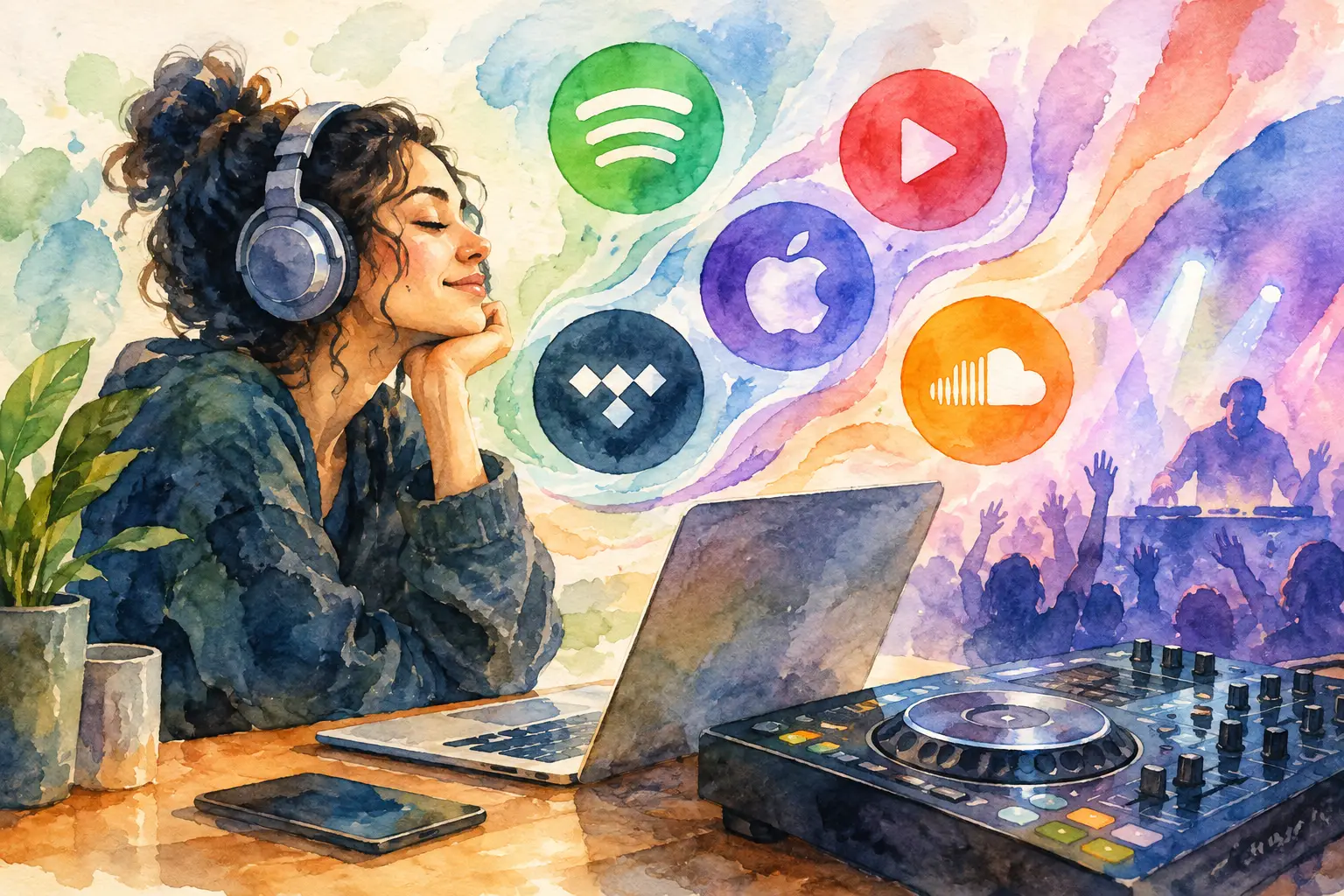
Your next favourite record might arrive via a razor-sharp Spotify recommendation, a SoundCloud upload from a producer with 200 followers, or a YouTube set filmed at 4am in a packed club. That is why a streaming platform review cannot simply crown one winner. For listeners who move between house, acid, techno, drum and bass, chillout, pop and hip-hop, every service has a different job to do.
The right choice depends on how you listen. Are you chasing new tracks for a weekend set, building a soundtrack for the train, following artists closely, or looking for long-form mixes that do not fit neatly into the standard album format? The best approach is usually to give one platform your daily-listening loyalty while using others as specialist crates for discovery, visuals and DJ culture.
Streaming platform review: what actually matters
Big catalogues are useful, but catalogue size alone tells you very little. Most major platforms carry the well-known releases. The difference is in what happens after you press play: how quickly the service understands your taste, whether niche music is easy to locate, how artists can present their work, and whether the platform respects the way dance music is really consumed.
For club-focused listeners, discovery needs to go beyond a generic mood playlist. A good service should make it possible to jump from an acid house track to the label behind it, from a remix to the original producer, or from a DJ’s selection to the records that make up the set. Context matters. So does the ability to save music quickly when a tune hits at exactly the right moment.
Audio quality deserves attention too, though it is not the only measure. Higher-quality streaming can reveal extra detail in percussion, basslines and spacious ambient productions, particularly with decent headphones or speakers. Yet an outstanding discovery engine may bring more joy than a technical advantage you only notice during a careful home listen. It depends on your kit, your ears and whether you are listening on the move or sitting down with an album.
Finally, consider artist support. Streaming income is complicated and rarely generous for independent musicians, so following an artist, saving releases, adding tracks to real playlists and sharing them with friends all make a practical difference. A platform that helps you stay connected to artists may be more valuable than one that merely plays songs well.
Spotify: the daily discovery heavyweight
Spotify remains the natural home base for many listeners because it makes listening frictionless without making it feel random. Its personalised recommendations, release alerts and playlist tools are excellent for people who want fresh music arriving regularly rather than hunting through every new release manually.
It is particularly useful when your taste is broad. One session can move from vocal dance music to deep house, then into a leftfield electronic playlist, with enough listening history behind it to make the next suggestion plausible. For a listener who follows DJs, artists and curators, the ability to save tracks and organise playlists is a major strength. A playlist can be a warm-up crate, a running selection, a beach-chill folder or a record of tunes worth revisiting months later.
There are trade-offs. Spotify’s scale means independent releases can disappear quickly unless they gain saves, shares or playlist activity. The app also favours track-by-track listening over the rougher, more immediate culture of unofficial edits, radio recordings and evolving DJ sets. If you want the polished, widely available release experience and strong recommendation tools, it is hard to beat. If you want the underground’s messier first draft, use it alongside SoundCloud.
SoundCloud: where the underground still moves fast
SoundCloud remains vital because it captures music before it has been fully packaged. It is where DJs test edits, producers post works in progress, radio hosts share episodes and new names can build an audience without waiting for a traditional release schedule. For dance music, that speed is part of the fun.
The platform is especially strong for long-form listening. A two-hour house mix, a noisy techno session, a chilled beach selection or a drum and bass radio show all feel at home there. Comments can be chaotic, but they also create a sense that people are listening together rather than simply consuming an algorithmic feed.
Its weakness is inconsistency. Metadata can be patchy, duplicate uploads are common and a track you love may vanish because of rights issues. Discovery can feel like crate digging: rewarding, occasionally confusing and dependent on who you follow. That is not a criticism if you enjoy the chase. SoundCloud is less like a perfectly organised record shop and more like a back room full of white labels, demos and unexpected gold.
YouTube: the visual archive and set destination
YouTube is not always treated as a music streaming service, but it deserves a serious place in any review. It excels where music meets performance, personality and visual culture. DJ sets, live sessions, music videos, studio clips and radio footage can turn a track into a whole world.
For a DJ fan, watching how a selector builds energy across an hour can be more instructive than hearing isolated tracks. For artists, video gives releases a second life through lyric videos, visualisers, live clips and short-form posts. YouTube’s search can also surface rare material that is difficult to find elsewhere, including old interviews, obscure remixes and full programmes.
The experience can be distracting, however. Recommendations may pull you away from your intended listen, adverts can interrupt the mood, and audio quality is not normally the primary reason people choose the platform. Treat YouTube as the place to watch, learn and explore rather than the only app for everyday audio.
Apple Music and high-quality listening services
Apple Music is a strong alternative for listeners who want a well-managed library, a polished album experience and lossless listening options. It often suits people who still think in artists, albums and carefully curated collections, rather than treating every listen as an algorithmic experiment.
Its editorial approach can be appealing when you want genre programming with a human touch. The service is less dominant in public playlist culture than Spotify, which may matter if you enjoy seeing what friends, DJs and independent curators are sharing. But for listeners invested in sound quality and album flow, it is a credible main platform.
Other high-quality-focused services can make sense if audio is your first priority. Before paying more, be honest about your listening conditions. Lossless files are a lovely extra through good wired headphones, monitors or a proper home system. On a busy bus with basic earbuds, better discovery and a larger community may matter more.
Build a listening setup, not a platform loyalty test
The smartest answer is often a two-platform routine. Keep Spotify or Apple Music for official releases, saved albums and daily listening. Use SoundCloud for mixes, unreleased material and direct contact with developing scenes. Visit YouTube when you want visual sets, performance footage or a deeper look at the people behind the music.
This approach also makes your listening more active. Follow the artists whose releases you genuinely replay. Save rather than merely stream the tracks that deserve to stay in rotation. Give playlists useful names so they become practical tools rather than a digital pile-up. A folder called “Late Set Acid”, “Sunday Chillout” or “New DnB Finds” tells you far more than a hundred tracks sitting in one giant favourites list.
For DJs, separate listening from preparation. Streaming is brilliant for testing directions, spotting transitions and finding artists to investigate. It is less reliable as the sole foundation for a performance, especially where Wi-Fi, availability and version changes are concerned. Keep a dependable music collection for serious set preparation, then let streaming continue doing what it does best: feeding the next idea.
The best service is the one that keeps you curious
A great platform should not make every choice for you. It should give you enough useful recommendations to keep momentum, while leaving room for a strange remix, a new producer, a radio show or a left-turn genre discovery. That balance is where music listening stays exciting.
Try each service with a specific mission for a week: find ten new club tracks, listen to three full DJ mixes, follow five independent artists, or build one playlist you would happily send to a mate. Keep the platform that makes you want to press play again – then support the artists who make that feeling possible. CHEERS!

Leave a Reply